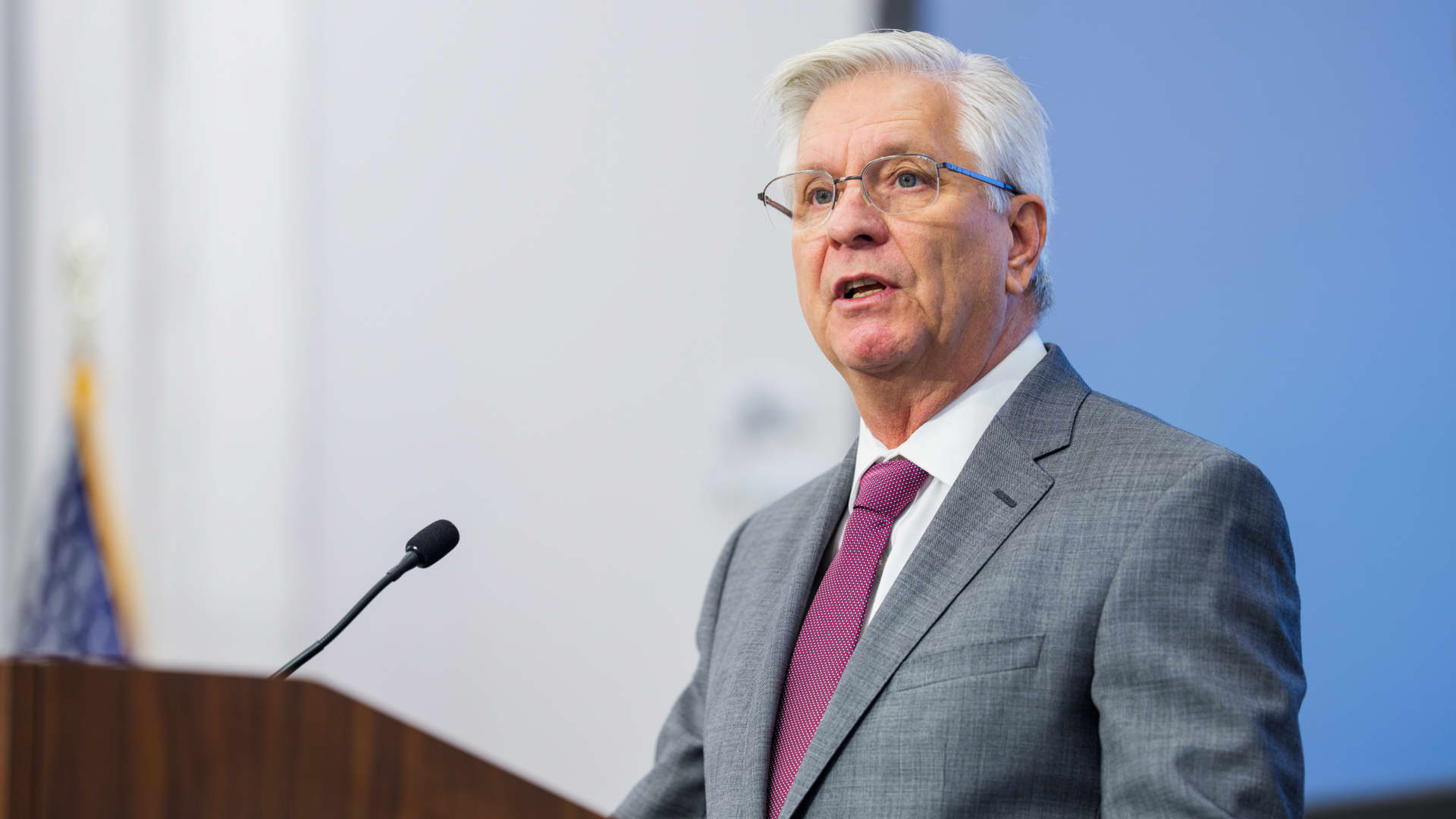
Christopher Waller, governor of the US Federal Reserve, during the Federal Reserve’s Payments Innovation Conference in Washington, DC, US, on Tuesday, Oct. 21, 2025.
Aaron Schwartz | Bloomberg | Getty Images
Federal Reserve Governor Christopher Waller on Monday expressed concern about inflation but cautioned against “fighting the last war,” saying the central bank should wait for more data before raising interest rates.
In remarks delivered for a speech in New York, Waller said inflation has expanded beyond the often-cited drivers such as the energy price spike in tariffs. Rather, he cited other factors, particularly artificial intelligence, as root causes for why price increases have held stubbornly above the Fed’s 2% target.
Waller warned that “the desire to avoid past mistakes is often the author of new ones.”
“I am cognizant of the mistake we made in 2021 by not responding sooner to the high inflation we observed, and I am determined to avoid repeating it,” he said.
However, he said that doesn’t reflexively mean raising interest rates to head off the current spate of price increases.
Waller said there is still “a credible case for inflation to begin to fall back” but noted there is an “equally plausible” scenario where inflation could stay elevated or increase, “requiring tighter monetary policy in the near term.”
The policymaker emphasized a deliberate approach as policymakers evaluate the root causes of inflation, which he listed as tariffs implemented in 2025, the rising energy prices associated with fighting in the Middle East – and “spillovers from demand” from artificial intelligence.
“As always, we need to avoid making the mistake of fighting the last war and reacting too soon to tighten inflation, merely because we waited too long last time,” he said. “But we also must avoid repeating the same mistake we made in 2021 and 2022 by waiting too long to respond.”
Waller cited two factors working in the Fed’s favor this time around: A stronger labor market that isn’t a meaningful source of inflation, and well-anchored inflation expectations, at least by market-based measures.
He cautioned, though, against becoming complacent.
“I often hear people say that because inflation expectations are anchored, central bankers do not have to respond to above-target inflation. This view is wrong,” he said. “Sternly staring at inflation until it melts before our withering gaze is not an option.”
Waller’s remarks come the day before the Bureau of Labor Statistics releases its June reading on the consumer price index. Economists surveyed by Dow Jones expect the gauge to show a decline of 0.2% for the month on the all-items headline reading, owing to a sharp decline in oil, and a 0.2% core increase excluding food and energy. On an annual basis, that would take the headline reading down to 3.8%, from 4.2% in May, and core to 2.8%, from 2.9%.
“I would be very pleased to see a lower reading on core inflation, but after its escalation over the first half of this year, I will need to see several months of lower readings to feel that inflation is moving in the right direction,” Waller said. “For the reasons I have laid out today, I think that is still a reasonable outcome, and I would then continue to hold the policy rate at its current target range.”
The Fed meets again in late July, with markets pricing in about a 39% chance of a rate increase, according to the CME Group.