
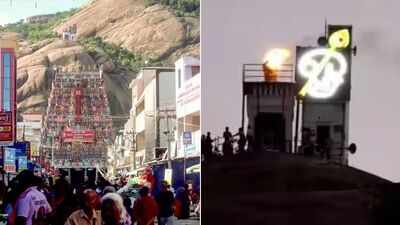
NEW DELHI: The Tamil Nadu government apologised before the Supreme Court on Wednesday after the traditional Karthigai Deepam lamp was not lit at the designated Deepathoon stone pillar atop Thiruparankundram hill in Madurai on November 24, despite the court’s interim direction.In a status report filed by Madurai district collector Nishant Krishna, the state government said the temple’s Board of Trustees did not authorise the team proposed to carry out the ritual and instead decided to retain the customary location.The development came after the ceremonial lamp was lit at the Deepa Mandapam near the Ucchi Pillayar temple, rather than at Deepathoon, which was the subject of the Supreme Court’s November 20 order. The court said it would consider the contempt plea alleging non-compliance with its directions and asked the petitioner and other parties to file appropriate applications.The dispute over the ritual’s location has been continuing for years, with Hindu groups seeking permission to light the lamp at the hilltop stone pillar near the Hazrat Sultan Sikandar Badusha Auliya Dargah, while the state government and temple authorities have maintained that the customary venue is near the Ucchi Pillayar temple.The November 24 ceremony, the subsequent explanation by the district administration and the demand for contempt proceedings have now brought the dispute back before the Supreme Court.
What is the Karthigai Deepam row?
Karthigai Deepam is a traditional Tamil Hindu festival celebrated by lighting lamps in homes and temples. At Thiruparankundram, the dispute concerns the location where the ceremonial lamp, or Maha Deepam, should be lit during the annual festival.For decades, the lamp has been lit at the Deepa Mandapam near the Uchipillaiyar temple on the lower slopes of Thiruparankundram hill. However, Hindu groups have sought permission to light it at Deepathoon, a stone pillar located higher up the hill and around 50 metres from the Hazrat Sultan Sikandar Badusha Auliya Dargah.The disagreement is not limited to the ritual’s location. It also involves competing claims over the stone pillar’s character and the hilltop’s ownership and status. While Hindu groups describe Deepathoon as an ancient structure associated with the ritual, another side argues that it is a survey stone. The dargah committee has also contested the demand, claiming ownership of the hilltop.The dispute has travelled through the courts over several years. In December 2025, a single judge of the Madras High Court directed the temple authorities to light the lamp at Deepathoon. A division bench upheld the direction in its January 6, 2026, judgment. The state government subsequently challenged the High Court’s decision before the Supreme Court.The Tamil Nadu government and the temple administration have maintained that the lamp has traditionally been lit at the Deepa Mandapam near the Uchipillaiyar temple. The state has also raised concerns over the legal and administrative implications of allowing the ritual at the disputed pillar, including the possibility of law-and-order complications because of its proximity to the dargah.
What did the Supreme Court order on November 20
On November 20, a bench of Justices Aravind Kumar and Vipul M Pancholi permitted the lighting of the Karthigai Deepam lamp at Deepathoon on November 24 as a one-time interim arrangement. The order came while the Supreme Court was hearing challenges to the Madras High Court’s directions on the ritual.The court allowed only a restricted team authorised by the temple administration and government officials to go to the location and carry out the ceremony. It also designated the district collector as the nodal officer responsible for coordination and supervision.The Supreme Court imposed safeguards to prevent any escalation at the disputed site. It restrained members of the public from going to the location and prohibited processions, public gatherings, slogan-raising and demonstrations during the ceremony. The court also stayed portions of the Madras High Court judgment that had upheld the direction to restore the practice of lighting the lamp at Deepathoon.Importantly, the permission was limited to November 24 and did not settle the larger dispute over the ritual’s history, the hilltop’s ownership, or any customary or religious right to light the lamp at the pillar. The court clarified that neither the permission nor the ceremony could be treated as proof of an established custom or a continuing right of access to the location.The Tamil Nadu government subsequently approached the Supreme Court seeking a review of the November 20 order and a stay on the one-time permission. However, the interim direction remained the basis for the November 24 arrangements.
What happened on November 24
The Karthigai Deepam ceremony took place amid heightened security and tension at Thiruparankundram on November 24. However, the lamp was not lit at Deepathoon, the location specified by the Supreme Court. Instead, the Maha Deepam was lit at the customary Deepa Mandapam near the Ucchi Pillayar temple at around 6 pm.The development came hours after Madurai collector Nishant Krishna told the Madurai bench of the Madras High Court that the Supreme Court’s directions would be implemented. The High Court had also reminded officials of their responsibility to comply with the apex court’s order and warned of contempt proceedings in the event of non-compliance.State law minister C T R Nirmalkumar confirmed the lighting at the customary location in a post on X, saying: “Karthigai Mahadeepam has been lit at the Deepa Mandapam near Ucchi Pillaiyar temple, directly above the sanctum sanctorum of the presiding deity at Thiruparankundram”.The decision triggered protests by Hindu organisations and BJP workers, who demanded that the government implement the Supreme Court’s direction. Tensions were reported near the hill, where protesters raised slogans against the state government. Police had deployed more than 5,600 personnel in Thiruparankundram and adjoining areas, with restrictions imposed on public access to the hilltop.The district administration later said that the last-minute decision to retain the customary venue followed concerns raised by the temple’s Board of Trustees. The trustees maintained that the Deepa Mandapam was the traditional location for the ritual and that the practice should continue there.
Why did the Madurai collector say the lamp could not be lit at Deepathoon
In a status report filed before the Supreme Court, Madurai district collector Nishant Krishna said the administration had made arrangements to implement the November 20 order but could not proceed because the temple’s Board of Trustees did not authorise the team proposed to light the lamp.According to the district administration’s explanation, the Supreme Court had designated the collector as the coordinating officer, while the temple administration was responsible for authorising the personnel who would carry out the ritual. The administration said it had completed the necessary arrangements, but the trustees eventually resolved to retain the customary location.The Board of Trustees cited religious traditions and established worship practices in support of its decision. It maintained that the Deepa Mandapam near the Ucchi Pillayar temple was the customary venue and that the location was directly above the head of Lord Murugan, the presiding deity. The trustees also referred to Agama rules governing temple rituals and festivals.In its statement after the ceremony, the district administration said: “The trustees unanimously resolved to retain the customary venue, citing religious traditions and established worship practices.”The trustees said their decision followed an examination of historical and religious records and consultations with the temple’s Sthanikars, or hereditary ritual functionaries. They also decided to place their findings before the court.The collector apologised for the failure to light the lamp at Deepathoon and maintained that the administration had made every effort to comply with the Supreme Court’s direction. The state’s position was that the district administration could not independently authorise another team to perform the ritual in the absence of the temple Board of Trustees’ approval.The status report also maintained that there had been no wilful or deliberate disobedience of the Supreme Court’s directions. The government said the failure to carry out the ceremony at the designated location was due to the trustees’ decision to retain the customary venue.
What is the contempt plea against Tamil Nadu officials
The failure to light the lamp at Deepathoon led to demands for contempt proceedings against the state authorities. The petitioner seeking permission for the ritual alleged that the government had failed to comply with the Supreme Court’s November 20 direction despite assurances given before the Madras High Court that the order would be implemented.During Wednesday’s proceedings, a senior advocate appearing for the petitioner termed the developments “most unfortunate”. He argued that the flame should have been carried to Deepathoon and the lamp lit there, and alleged deliberate non-compliance with the apex court’s directions.The counsel also urged the Supreme Court to initiate suo motu contempt proceedings against the authorities concerned. When the senior advocate indicated that the petitioners would move a contempt plea, the bench said, “File it, and then we will see.”The Supreme Court asked the petitioner and other parties to file appropriate applications and said it would hear the matter. The bench of Justices Aravind Kumar and Vipul M Pancholi also said it would peruse the status report filed by the state government.The contempt allegation centres on whether the authorities failed to implement the Supreme Court’s specific direction despite the district administration being tasked with coordinating the ceremony. The state government, however, has denied wilful disobedience and attributed the failure to the temple trustees’ decision not to authorise the proposed team.The Supreme Court’s consideration of the contempt plea will therefore bring the conduct of the officials and the explanation submitted by the district administration under judicial scrutiny.
Opposition slams Tamil Nadu government
The failure to light the lamp at Deepathoon has triggered sharp criticism from BJP leaders, who have accused the TVK-led Tamil Nadu government of disregarding the Supreme Court’s interim order and hurting the sentiments of devotees.BJP national general secretary B L Santhosh accused the state government of defying the court’s directions and said the government would face a “civilisational and legal challenge”. In a post on X, he alleged that the Madurai district administration had lit the lamp at the Ucchi Pillayar Mandapam instead of the Deepathoon stone pillar as directed by the Supreme Court.In another post, Santhosh accused the government of compromising the sentiments of devotees to accommodate its political allies. He said: “You people have hurt devotes & defied SC Order to please some alliance partners & you yourself is Law Minister of a Govt which will fully defied SC Order . To please some friends you let down crores of devotees,” he alleged.Tamil Nadu BJP president Nainar Nagenthran also accused the state government and district administration of failing to implement the court’s order. He criticised the decision to light the lamp at the customary location after the collector had assured the Madras High Court that the Supreme Court’s direction would be followed.“Lighting the lamp at the Pillaiyar temple after assuring the court that arrangements were being made is an act of deception. It is akin to fooling a child with candy, and they are attempting to deceive the Supreme Court and High Court judges,” Nagenthran said.
Share your thoughts in the comments
Be respectful · TOI community guidelines
BJP leader Tamilisai Soundararajan also accused the government of violating the interim order and alleged that the decision was taken to appease its alliance partners. She questioned why the government had not raised its objections based on Agama rules before the Supreme Court.The BJP’s criticism came alongside protests by Hindu organisations in different parts of Tamil Nadu. Demonstrations were reported in Ramanathapuram and Pollachi, where protesters demanded that the government comply with the Supreme Court’s direction. Police detained protesters involved in road blockades, while cases were registered against members of BJP and Hindu organisations over the demonstrations.The state government and temple trustees, however, have defended the decision to retain the customary location, citing religious traditions and established worship practices.