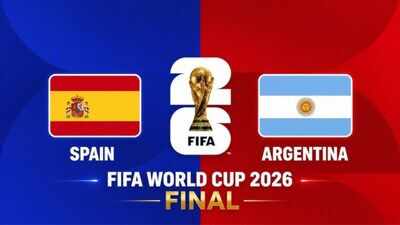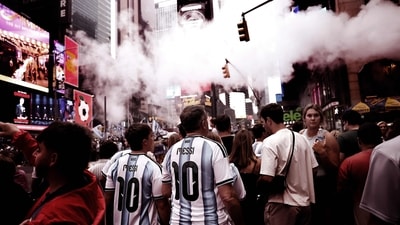
When the referee at MetLife Stadium in New Jersey brings the ball into play on Sunday, something quiet and coordinated will begin to happen across time zones. In a Delhi flat, perhaps, a mobile phone will be turned face down. In a Buenos Aires bar, the volume on an overhead television would climb. In a Casablanca café, chairs may be dragged into a tighter arc around a screen.
For the 90 minutes that follow — over 120, if it stretches to extra time and penalties — the ordinary business of the planet might bend, dim or halt around a football match.
The pattern is now measurable, though in bits and pieces. Broadcasters, utility engineers, hospital wards, police forces, stock exchanges and maternity units have kept records across successive tournaments. Read together, they describe a rhythm: for the duration of a Fifa world cup final, the world syncs its attention on a singular event unlike any other.
During this time, TV viewership goes up, power demand surges, water usage increases at half-time, traffic slows down, and crimes dip.
The screens
Fifa’s audited numbers, released after Qatar 2022, calculated that the final between Argentina and France drew 1.42 billion viewers who watched at least one minute of live coverage. The live average concurrent audience touched 571 million — the largest single-event television audience that the sport’s governing body has ever recorded.
Across the tournament, five billion people engaged with the world cup in some form. Asia and Oceania accounted for 2.59 billion of those interactions. India alone contributed 745.7 million.
Jio Cinema, which held streaming rights for the tournament in India at the time, reported that peak concurrent viewership for the final on its platform reached 32 million — the largest live sports audience the platform had recorded to that point. Total watch-time across its Sports18 channel and OTT platform crossed 40 billion minutes over the course of the tournament.
Also read: Lionel Messi sends one last message before World Cup final
The power grid
In the UK, the collective focus manifests itself in a unique manner. The National Energy System Operator (NESO), which runs Britain’s electricity grid, has kept a control room staffed for televised football for decades. When millions of British viewers simultaneously boil kettles at half-time and full-time, national demand jumps in a way that the grid must plan for hours in advance. The phenomenon even has a name: TV pickup.
NESO’s own figures, released ahead of the 2026 world cup, put the projected pickup for each England or Scotland group-stage match at around 600 megawatts. That is roughly the two cities’ combined electricity draw at any given moment, NESO had said.
The largest football-linked surge on record remains 2,800 megawatts, after England’s 1990 semi-final defeat to West Germany. In the 2022 world cup, England’s quarter-final against France produced a surge of 914-megawatts at half-time.
To absorb the shock, the grid leans on Dinorwig — a pumped-storage power station buried inside a mountain in Snowdonia, Wales. Water is pumped uphill in periods of low demand and released downhill through turbines when a surge hits. The transition from standby to full output takes 12 seconds.
The pipes
Water utilities read the same graph, as people take bathroom breaks when the game pauses. On June 19, 2018, during Japan’s 2-1 group-stage win against Colombia at the Russia World Cup, the Tokyo Waterworks Bureau recorded a 24% jump in water use during half-time. At the final whistle, use surged 50%. A bureau official told AFP the utility had anticipated the pattern and adjusted the city’s supply and pressure ahead of the match.
The New York City Department of Environmental Protection tracks a comparable signature during the Super Bowl, the final of the annual American football championship.
In its own release, the department described three moments of synchronised flushing every year: the start of the halftime show, the end of the halftime show, and the end of the game. During Super Bowl LVIII (2023 season), the post-game surge was calculated to be equivalent to 467,881 additional toilet flushes.
The workplace
The kick-off even strains work output. The outplacement firm Challenger, Gray & Christmas, which has published productivity impact estimates for major American sporting events for two decades, released its projection for the 2026 world cup in June.
If every employed American who identifies as a football fan took a single day off to watch a marquee match, the firm calculated, US employers could lose up to $30.2 billion. An hour of workplace distraction across the same workforce would cost around $4.4 billion.
Challenger said this estimate was only an upper-bound scenario meant to illustrate the scale of potential disruption, not to predict actual absenteeism. “Smart employers won’t try to fight it,” Andy Challenger, the firm’s chief revenue officer, said. “They’ll build it into the schedule.”
Another estimate, by workforce-management vendor UKG that surveyed 8,000 employees across eight countries — Australia, Canada, France, Germany, Mexico, the Netherlands, the UK and the US —returned a global productivity loss estimate of $17 billion.
Its behavioural findings were also telling: 37% of respondents said they would adjust their schedules during the 2026 world cup, 27% expected to miss work, 14% said they planned to secretly stream matches while on the clock, and 11% said they would work while hungover.
The roads
Near stadium cities, roads jam. Elsewhere, during matches involving a home team, they empty out.
The clearest measurement of the emptying comes from Cybit, then a UK fleet-telematics firm tracking more than 50,000 commercial vehicles in real-time.
In the hour before kick-off of England’s group-stage match against Slovenia at the 2010 world cup, Cybit reported, vehicle usage across its tracked fleet fell by 49%. Traffic volumes remained at half of normal levels for the rest of the afternoon.
The knock-on effect on street crime, where measured, has been conclusive too. Mexico’s security and citizen protection ministry reported that on June 11, the day Mexico opened the 2026 world cup against South Africa, the country recorded 30 homicides — well below the daily average of over 70 at the start of President Claudia Sheinbaum’s term in October 2024.
In the US, Atlanta police told the city’s public safety committee that overall downtown crime fell 8% during the first week of the tournament. Kansas City prosecutors received 420 police-referred cases between June 9 and July 13, 2026, down from 536 in the same window the previous year.
The hospitals
A study published in the New England Journal of Medicine in January 2008 tracked the clinical effects of a high-stakes tournament.
Cardiologist Ute Wilbert-Lampen and colleagues at the Ludwig Maximilian University Hospital tracked 4,279 cardiovascular emergencies in greater Munich area during the 2006 world cup, hosted by Germany, and compared them to control periods. On days when Germany played, the researchers found, the incidence of cardiac emergencies was 2.66 times the control-period rate. For men, it was 3.26 times, and for women, 1.82 times. The peak came within two hours of kick-off.
Nearly half of the patients presented with a coronary event on a match day had a known history of ischaemic heart disease, compared with 29.1% in the control period.
The authors concluded that emotional stress associated with matches involving the national team was the plausible trigger, though the Munich data was specific to a host-country population. Whether the effect can be generalised across other countries at the same magnitude has not been established yet.
Nine months on
Another after-effect appeared roughly nine months later, in maternity wards.
The foundational study – published in the Christmas 2013 edition of the BMJ by Jesus Montesinos and colleagues in the Catalonia region of Spain – examined 11,000 births at two hospitals across 2007-2011. It found a 16% increase in births in February 2010 and an 11% increase in March 2010 (relative to the same months across the other years) — nine months on from a run of exhilarating FC Barcelona victories in 2009, including Andrés Iniesta’s last-minute goal against Chelsea. Early Spanish media reports had claimed a 45% spike, but the peer-reviewed figure was smaller though statistically significant still.
A 2024 systematic review by Gwinyai Masukume and colleagues, published in PeerJ, aggregated the world cup-specific evidence.
After South Africa hosted the 2010 world cup, more than 1,000 additional live births were recorded in the host country nine months later, compared with expected levels drawn from prior years. Similarly, unexpected losses pointed the other way. Nine months after popular provincial La Liga sides suffered upset defeats between 2001 and 2015, births in those provinces fell by 0.8%.
But it wasn’t all clear. Iceland’s much-reported baby boom after Euro 2016, the review noted, did not survive scrutiny.
After the whistle
For an estimated one to two billion people expected to watch the 2026 world cup final live and the roughly six billion Fifa expects to engage with the tournament in some form, the 90 minutes at MetLife might be the closest the modern world comes to a coordinated pause. Not silence. Not stillness. A shared, involuntary intake of breath.