
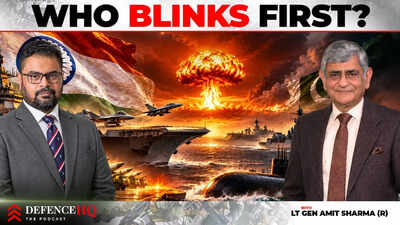
Lt Gen Amit Sharma (retd), former chief of the Strategic Forces Command, says India must build 170 to 200 tanks a year at home, and that a nuclear deterrent succeeds when nothing happensDrones may have made tanks some of the most visible casualties of the Russia-Ukraine war, but India cannot fight and win a conventional war without main battle tanks, according to Lieutenant General Amit Sharma (retd). He commanded a strike corps before heading the Strategic Forces Command (SFC), the tri-service formation that manages India’s nuclear arsenal.“The question is not that do we need a tank or not. Yes, we need a tank,” Sharma, who was commissioned into 45 Cavalry in 1976, told TOI’s Defence HQ. In the subcontinent, he argued, victory is still measured by the territory an army captures and holds. The tank remains the only weapon that combines mobility, firepower and armour protection, and infantry cannot push into enemy territory unless tanks move alongside it. That is why the Army fights as combined arms teams.The tank, Sharma pointed out, has been pronounced dead five times since it first rolled onto the battlefields of the First World War, including when cheap anti-tank missiles arrived. Each time, armies found a way to protect it rather than give it up. Drones are simply the latest test. Whether the answer turns out to be counter-drones, splinter ammunition or dedicated anti-drone systems, militaries must find a way “to destroy the drone before they destroy the tanks”, he said, rather than leave the tank out of the fight.The Army appears to agree. In April 2025, the defence ministry sought proposals for counter-drone systems to be retrofitted on T-72 and T-90 tanks, with an initial order of 75 systems. Its request noted that threats no longer come only from the front.Sharma’s larger worry is not whether India needs tanks but whether it can build enough of them. In September 2024, the Defence Acquisition Council cleared about 1,770 Future Ready Combat Vehicles, the programme now called Project Ranjeet. They will replace the T-72s that still make up the bulk of the Army’s armour, with induction expected around 2030. Because a tank goes in for its first major overhaul after 10 to 12 years, Sharma said, a fleet of that size has to be produced within roughly a decade. That works out to about 170 tanks a year, and closer to 200 if India also wants to export, a rate no single Indian company can manage.His prescription is a whole-of-nation approach. The government and the Army should sit down with industry, encourage consortiums to share the load, and keep firm oversight of quality and quantity. He was equally critical of the lowest-bidder, or L1, system of awarding contracts. “The lowest bidder is obviously not the best,” he said.The urgency, he argued, comes from how wars are now fought. The once-fashionable belief that the next war would be short and swift has been upended by the Ukraine war, now in its fifth year, and by the prolonged conflict in West Asia. India must be ready for a protracted conventional war, Sharma said, and only a strong domestic manufacturing base can sustain one. Exports should follow only once the armed forces’ own needs are met.If the tank is about taking ground, the SFC exists to make sure a war never crosses the nuclear line. Success there, said Sharma, who headed it from 2014 to 2016, is measured by nothing happening at all. “Till the time nuclear weapons are not being used, they’re doing the job,” he said.He recalled a 1989 lecture by the strategist K Subrahmanyam, who asked what India would do if a newly nuclear-capable Pakistan threatened to strike unless India vacated Kashmir. India had no answer then. That Pakistan has never issued such an ultimatum since, Sharma said, is proof that India’s deterrent works.He was dismissive of the low nuclear threshold that Pakistan likes to project. “They are not fools,” he said, describing Pakistan as “an army with a country” whose generals would not risk losing everything. India’s no-first-use doctrine promises massive retaliation to inflict unacceptable damage. Sharma said that holds just as firmly for a low-yield tactical strike on Indian troops, because a nuclear exchange cannot be traded step by step, two kilotons answered with five and five with fifteen. “You cannot get into a duel like this in a nuclear war,” he said. While he commanded the SFC, he saw Prime Minister Narendra Modi lead the Nuclear Command Authority’s Political Council, and he said he had “no doubt” the order to retaliate would be given.That stance echoes PM Modi’s declaration after Operation Sindoor in May 2025 that India would not tolerate nuclear blackmail. Sindoor itself, Sharma said, was a calibrated response to terrorism rather than a war. But as long as Pakistan continues with terror, “Sindoor is on”, and it could escalate into a full-scale conflict if Pakistan chose.China presents a different equation. Beijing also has a no-first-use policy, so the nuclear question between the two neighbours does not arise for now, Sharma said. This is even as SIPRI estimates that China’s arsenal, at about 620 warheads, is growing faster than any other country’s, against India’s roughly 190. Asked about May’s Agni test with multiple independently targetable warheads, he said India must keep its deterrent credible by improving both numbers and technology. On the conventional side, formations including tanks were moved and reorganised after Galwan, and the mountains favour the defender.The more pressing concern, he said, is economic. India imported about $132 billion of goods from China in 2025-26 and exported less than $20 billion, an imbalance he said must be narrowed.