
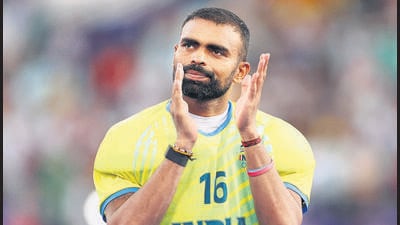
New Delhi: Hockey great PR Sreejesh has raised one of the most controversial topics in Indian sport. By not renewing his contract despite an impressive one-and-a-half-year record as coach of the junior India team, Hockey India has dealt Sreejesh a hard hand, which he hasn’t taken kindly.
“The Hockey India President stated that the chief coach of the senior men’s team (Craig Fulton) prefers a foreign head coach for the junior team, believing it will help develop Indian hockey from the junior level through to the senior level. Hence, the continued preference for foreign coaches — Can’t Indian coaches develop Indian hockey?” the two-time Olympic medallist asked HI.
That’s a question many Indian coaches, who felt they have worked with sincerity and given results only to find themselves replaced by foreign coaches, have asked. It’s a topic that has created a deep divide between Indian and foreign coaches.
Indian sports administrators prefer foreign coaches for their expertise in sports science and high-performance training methods but they have also been shortsighted in not trusting Indian coaches enough. Often, athletes also find themselves drawn into the battle between Indian and foreign coaches.
The yardsticks are very different too. A foreign coach is given a long rope, even when the team’s performance dips. The controversial exit of women’s hockey coach Janneke Schopman is a case in point.
Schopman took the reins from Sjoerd Marijne after the women’s team’s high of a fourth-place finish in Tokyo and despite a series of abysmal performances, HI stuck with her. The result was the Indian women’s team losing the qualifying race for the Paris Olympics and touching the depths. They brought in Harendra Singh to rebuild the team, only to now go back to Marijne.
Similar baffling decisions in hiring foreign coaches have come from the Boxing Federation of India. Bernard Dunne’s controversially left just before the Paris Olympics qualifier and with the men’s team struggling. The team went to Paris under another Irish coach Dmitry Dmitruk, who had little coaching pedigree, and returned empty-handed.
Now BFI has brought back Santiago Nieva, under whom India competed in Tokyo, for the women’s team while the men’s team continues to struggle. One of India’s best boxing coaches Bhaskar Bhatt, who took over in the intervening period and built the women’s team with four medals to show at the 2022 world championships, found himself sidelined once Dunne took over.
“I can understand what Sreejesh has gone through. Our federations do not place faith in Indian coaches, and when it comes to foreign coaches they are allowed to do whatever they want with no accountability fixed,” Bhatt told HT. “The foreign coach just wanted me to be there and say yes to everything he is doing. I had questions about the assessment tests be introduced, about the national camp policy which he completely changed. His training methods, competition calendar were not working for our boxers, but what I found was that I was being targeted. So, I quietly left the India team and went back to my coaching stint in SAI,” he said.
“Do the administrators even verify the background of some of these foreign coaches? Some of them do not have the expertise to train at the highest level. Whatever plans and proposals they make for the Indian teams are cleared without any question.”
A similar fiasco happened in the relay camp in athletics. Last year Jamaican Jason Dawson, the head coach of the men’s 4x400m relay national team, said he was unable to train because of “interference” from Indian coaches.
The relay national camp saw turbulent times due to disagreements between foreign and Indian coaches, with athletes taking sides. The Athletics Federation of India (AFI) told the athletes in no uncertain terms that they have the best coaches to train if they want to be part of the team.
“In track and field, we currently need foreign coaches. Developing Indian coaches will take 10-12 years, and we have started the process. The difference in coaching is all about bio-mechanics, sports science and for that you need a science background. Our coaches lack in that aspect,” said Adille Sumariwalla, AFI spokesperson and World Athletics vice-president.
“Foreign coaches have trained the Olympic medallists, they are constantly upgrading. They know how to maximize the potential of elite athletes. Our coaches need to understand force, vectors and angles. Otherwise, you cannot achieve high performance. Neeraj Chopra has worked with foreign coaches since he was 15, which is why he understands the science behind javelin and his body so well and is able to give such a consistent performances,” says Sumariwalla.
Former international athlete Om Prakash Karhana, throws another perspective. “The coach heads a sports programme. But in India administrators are supreme. There is a clash of ego and authority, and that is why you see intelligent, world class athletes not coming into this profession. Because they would not like their knowledge and expertise to be treated with disdain,” said the former shot putter.
This is why Sreejesh’s outburst is understandable, but it also shows that Indian sport has not done enough to develop local coaches, which means the grassroots movement will remain a significant challenge.