
Investors should avoid stopping their Systematic Investment Plans (SIPs) simply because the stock market is falling. Staying invested through market ups and downs can help improve the chances of generating positive returns over the long term, according to Varun Fatehpuria, Founder and CEO of Daulat Finvest Private Limited.
Fatehpuria said historical data shows that the probability of negative returns reduces significantly when investors remain consistent with their SIPs over five, seven and 10 years.
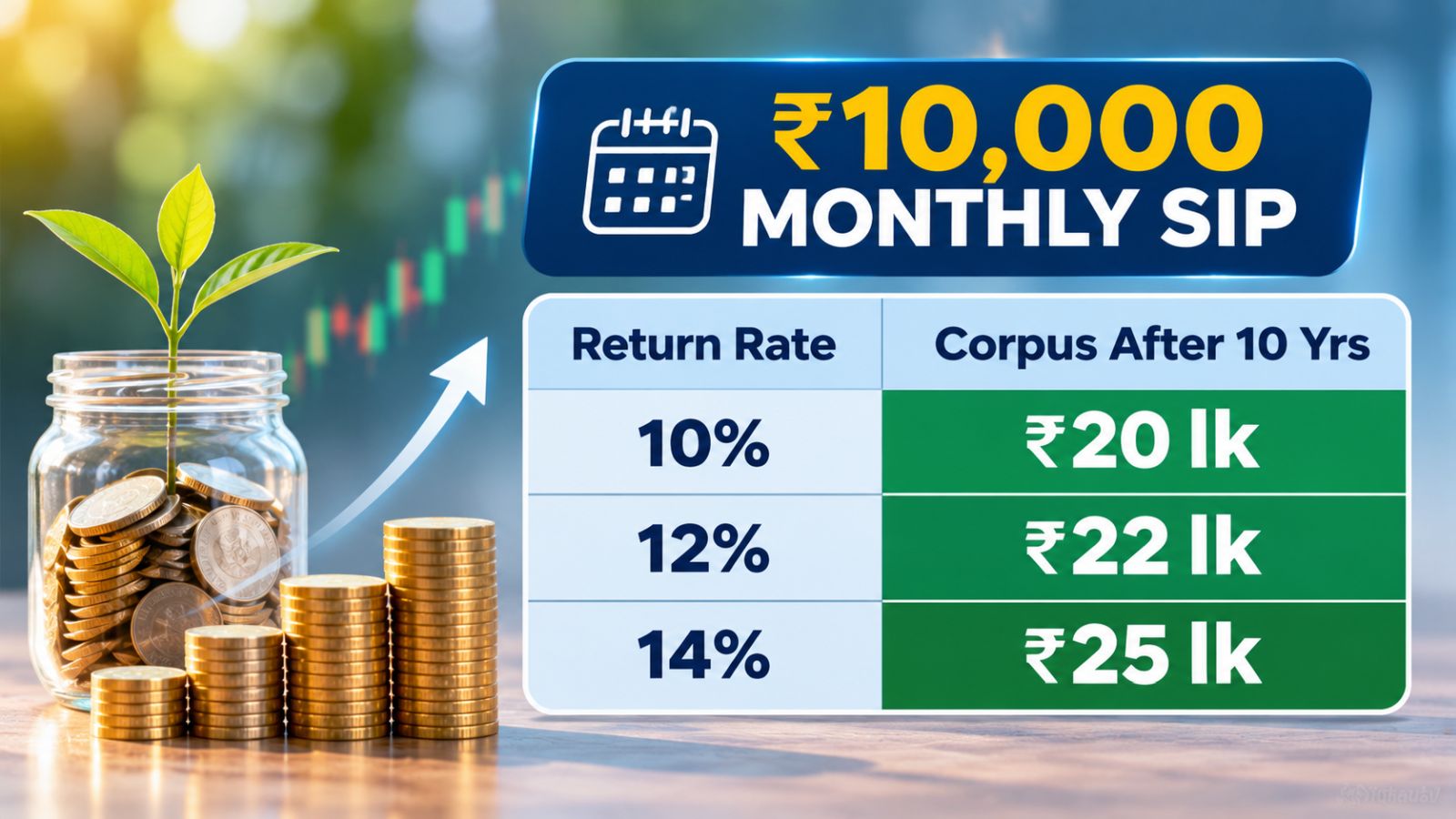
He explained that a monthly SIP of ₹10,000 over 10 years would mean a total investment of ₹12 lakh. Assuming annual returns of 10%, 12% and 14%, the investment could grow to approximately ₹20 lakh, ₹22 lakh and ₹25 lakh, respectively.
However, he cautioned that returns do not come in a straight line, and investors may go through periods when their portfolios deliver little or no growth.
Read Here | SIP in India vs other countries: The best returns ranked over 30 years
Fatehpuria also highlighted the benefits of a step-up SIP, where investors increase their monthly contribution as their income rises. For instance, increasing a ₹10,000 monthly SIP by 10% every year could help build a corpus of around ₹33-35 lakh over 10 years, assuming a 12% annual return.
On stock SIPs, he said investors could consider them as an additional allocation alongside mutual fund SIPs. However, since investing in individual stocks carries higher concentration risk, he suggested keeping this exposure limited to around 10-15% of the overall portfolio.
“I would hate to say there is no perfect date to do.” Fatehpuria said investors need not worry about choosing a particular date or frequency for their SIPs, as historical returns have remained broadly similar across different investment dates and frequencies. He cited the BSE Sensex’s average SIP returns of around 13-13.5% over the past 25 years.
He also explained how SIPs, Systematic Transfer Plans (STPs) and Systematic Withdrawal Plans (SWPs) can serve different investment needs. While SIPs help investors invest regularly, STPs allow lump-sum investments to be deployed gradually, and SWPs can provide regular withdrawals, particularly during retirement.
On when to stop an SIP, Fatehpuria identified three situations: when an investor is close to achieving a financial goal, faces a major change in income or finds that a particular fund is consistently underperforming.
However, he warned against stopping SIPs merely because markets are correcting or moving sideways.
For full interview, watch accompanying video

Why investors should not stop their SIPs during market corrections
Also Read | Mutual fund SIP inflows fall 1% to ₹32,160 crore in October, first decline in six months