
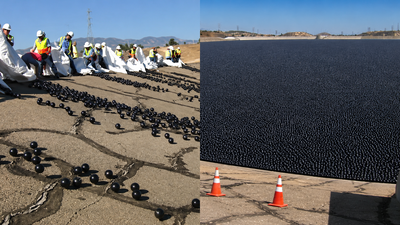
Millions of black plastic balls floating on a drinking water reservoir might sound like an environmental disaster, but for Los Angeles, they became an ingenious solution to several major challenges. The unusual sight attracted worldwide attention and left many wondering why a city would deliberately cover its water supply with 96 million plastic spheres. Far from being a publicity stunt, the floating “shade balls” were introduced by the Los Angeles Department of Water and Power (LADWP) to conserve water during California’s severe drought, protect drinking water quality and meet strict environmental regulations. The project went on to become one of the world’s most innovative and cost-effective examples of modern water management.
What are the black balls dropped into Los Angeles’ drinking water?
The black balls are hollow plastic spheres known as shade balls, each measuring about 10 centimetres (4 inches) in diameter. Made from high-density polyethylene (HDPE), a durable plastic commonly used in water pipes and milk bottles, each ball contains a small amount of water to keep it stable and prevent it from being blown away by strong winds. The Los Angeles Department of Water and Power (LADWP) released all 96 million shade balls into the Los Angeles Reservoir in August 2015, completing what was then the world’s largest shade ball project. The carbon black coating protects the plastic from ultraviolet (UV) radiation, giving the balls an expected lifespan of around 10 years.The Los Angeles Reservoir covers approximately 175 acres (71 hectares). Engineers calculated that around 96 million shade balls were needed to cover most of the water’s surface. Rather than forming a rigid layer, the balls float freely and automatically adjust as water levels rise and fall. Together, they create a protective blanket that blocks sunlight while allowing the reservoir to continue operating normally.
Reducing evaporation during California’s drought
One of the project’s primary objectives was to conserve water. Southern California frequently experiences prolonged droughts, and large open reservoirs lose significant amounts of water through evaporation under intense sunlight. By shading the surface, the balls reduce the amount of solar energy reaching the water, helping to minimise evaporation. LADWP estimated that the project could save approximately 300 million gallons (around 1.1 billion litres) of water each year, enough to supply thousands of households annually.
Preventing the formation of bromate
While saving water was important, protecting drinking water quality was an even greater priority. The reservoir contained naturally occurring bromide, which can react during the water treatment process. After water is disinfected using ozone, exposure to sunlight can convert bromide into bromate, a chemical classified as a possible human carcinogen by the International Agency for Research on Cancer (IARC). Because California has strict limits on bromate levels in drinking water, blocking sunlight significantly reduced the likelihood of this reaction occurring.
Keeping algae, birds and debris under control
The shade balls provided several additional benefits. By reducing sunlight, they limited algae growth, helping maintain water quality and reducing treatment requirements. They also discouraged birds from landing on the reservoir, lowering the risk of contamination from droppings. In addition, the floating layer reduced the amount of dust, leaves and other wind-blown debris entering the water, making the reservoir easier to maintain.
Why not simply build a roof?
Constructing a permanent roof or floating cover over a reservoir of this size would have been technically challenging and extremely expensive. According to LADWP, the shade ball project cost about US$34.5 million, considerably less than the estimated cost of building a large engineered cover. The balls also required less maintenance and could be deployed relatively quickly, making them a practical solution that met regulatory requirements.
How were the shade balls installed?
Installing the balls was surprisingly straightforward. Thousands of boxes containing the plastic spheres were delivered to the reservoir by truck. Workers released them into the water through large chutes, and the balls naturally spread across the surface. Because they float independently, they continuously rearrange themselves as wind and water movement change, ensuring consistent coverage without needing to be fixed in place.
Did the plastic contaminate the drinking water?
No. The shade balls were specifically manufactured for use in drinking water reservoirs and were made from materials approved for long-term contact with potable water. The carbon black coating also helped protect the plastic from degrading under sunlight. Throughout their use, water quality was continuously monitored to ensure the balls did not negatively affect the city’s drinking water supply.
What happened to the shade balls?
The shade balls were never intended to be a permanent feature. As improvements were made to the Los Angeles Reservoir and surrounding water infrastructure, including upgrades to treatment and storage systems, many of the original balls were removed. Those that had reached the end of their service life were recycled where possible, while the reservoir’s modernised design reduced the need for the floating cover.
A simple idea that attracted worldwide attention
The image of millions of black balls floating across a reservoir initially puzzled people around the world, but the project proved to be an innovative response to multiple challenges facing Los Angeles. By reducing evaporation, limiting bromate formation, discouraging algae growth and protecting water quality, the shade balls demonstrated how a relatively simple engineering solution could deliver significant environmental and public health benefits. The initiative remains one of the most recognisable examples of creative urban water management and continues to be studied as an example of practical, cost-effective infrastructure design.