
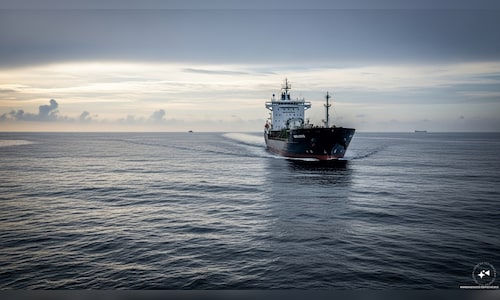
US President Donald Trump said the key shipping route could be “completely open” from June 19 under what he described as a an understanding between Washington and Tehran aimed at ending hostilities in West Asia. He made the remarks during talks with French President Emmanuel Macron ahead of the G7 summit, adding that extensive external intervention may not be required to keep the waterway accessible.
However, no formal agreement or detailed framework has been independently confirmed, leaving significant uncertainty around the scope and enforceability of any such understanding.
The lack of clarity has kept shipping and insurance markets on edge, with underwriters continuing to factor in elevated operational risks in the region.
“For the marine community, what remains absent are the practical details around reopening the Strait—particularly any clear Iranian guarantees on freedom of navigation,” said Marcus Baker, Global Head of Marine, Cargo and Logistics at Marsh.
He noted that while conditions in the Gulf have shown some improvement, insurers remain highly sensitive to the risk of escalation or breaches of informal understandings. A sustained period of uninterrupted, safe transit would be required before war-risk premiums can be meaningfully reassessed.
A similar view was expressed by Balasundaram R, Head of Marine Insurance at Policybazaar for Business, the dedicated corporate and commercial insurance arm of Policybazaar, who said marine insurance pricing does not respond immediately to geopolitical announcements and instead reflects longer-term visibility on risk.
He noted that until a formal agreement is clearly defined and stability is established, insurers are likely to maintain a cautious stance. Any easing in war-risk premiums, he added, is expected to be gradual, as confidence among shipowners and cargo operators would need time to rebuild.
Industry experts also pointed to competitive dynamics in markets such as India, where expanded capacity through mechanisms like the BMI pool for war-risk cover has added supply and helped moderate pricing to some extent, even as geopolitical risks remain elevated.
Overall, while signals around the Strait of Hormuz point to possible de-escalation, marine insurance markets are expected to wait for sustained stability before materially adjusting premium levels.
(Edited by : Ajay Vaishnav)
First Published: Jun 17, 2026 4:11 PM IST