
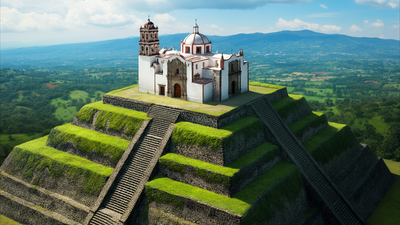
In considering the perfect monuments of the ancient world, the mind instantly takes flight to the sun-baked deserts of Egypt. Our mind’s eye sees the razor-edged precision of geometry on the plateau of Giza, where massive triangles of stone jut into the landscape of the desert. For centuries, such monuments have been considered the highest expressions of human achievement and grandeur. However, our imagination has a colossal blind spot.To view what is possibly the biggest pyramid ever built by any civilisation in ancient history, you do not have to travel all the way to Egypt and find your way to Cairo. In fact, the site of the greatest pyramid is actually situated in the Mexican Highlands. This is because the true kingpin of ancient pyramids is literally resting underneath tons of grass, trees, and even an old colonial church! Due to its massive footprint, many tourists tend to overlook this architectural marvel, taking it for nothing more than just another rolling hill!Switching the criteria from height to footprintThe proud titleholder of the ancient world is the Great Pyramid of Cholula, whose Nahuatl name is Tlachihualtepetl, meaning literally “man-made mountain.” Indeed, this structure is one gigantic building, and its volume is unparalleled in comparison with other pyramids in other countries.As confirmed by an official statement of Guinness World Records, human constructs of such proportions are extremely vulnerable to definitions as to the term “biggest.” The former one would undoubtedly be the Great Pyramid of Giza, which originally stood 146.6 meters tall in sheer grandeur. However, if the latter one is taken into account, then the Mexican giant would utterly dominate in all respects, having almost twice the volume as compared to the African pyramid.When we clean up the criteria and rank the world’s largest surviving pyramids by their total structural volume, the global leaderboard takes on a fascinating new shape.1. The Great Pyramid of CholulaLocated in Puebla, Mexico, this sprawling monument covers an immense base area of 450 by 450 meters. Rather than being built all at once, it was constructed in successive stages over nearly a thousand years by different Mesoamerican cultures. When Spanish forces arrived in the region, the structure was already so overgrown with natural vegetation that they famously built a church right on top of the summit, completely unaware that they were nesting on the world’s largest monument.2. The Great Pyramid of GizaIn second place is this architectural marvel from Egypt that still stands out today as the benchmark of precision in engineering. This pyramid was built in the Old Kingdom era using an estimated 2.3 million stone blocks and is arguably the most easily recognisable building of antiquity.
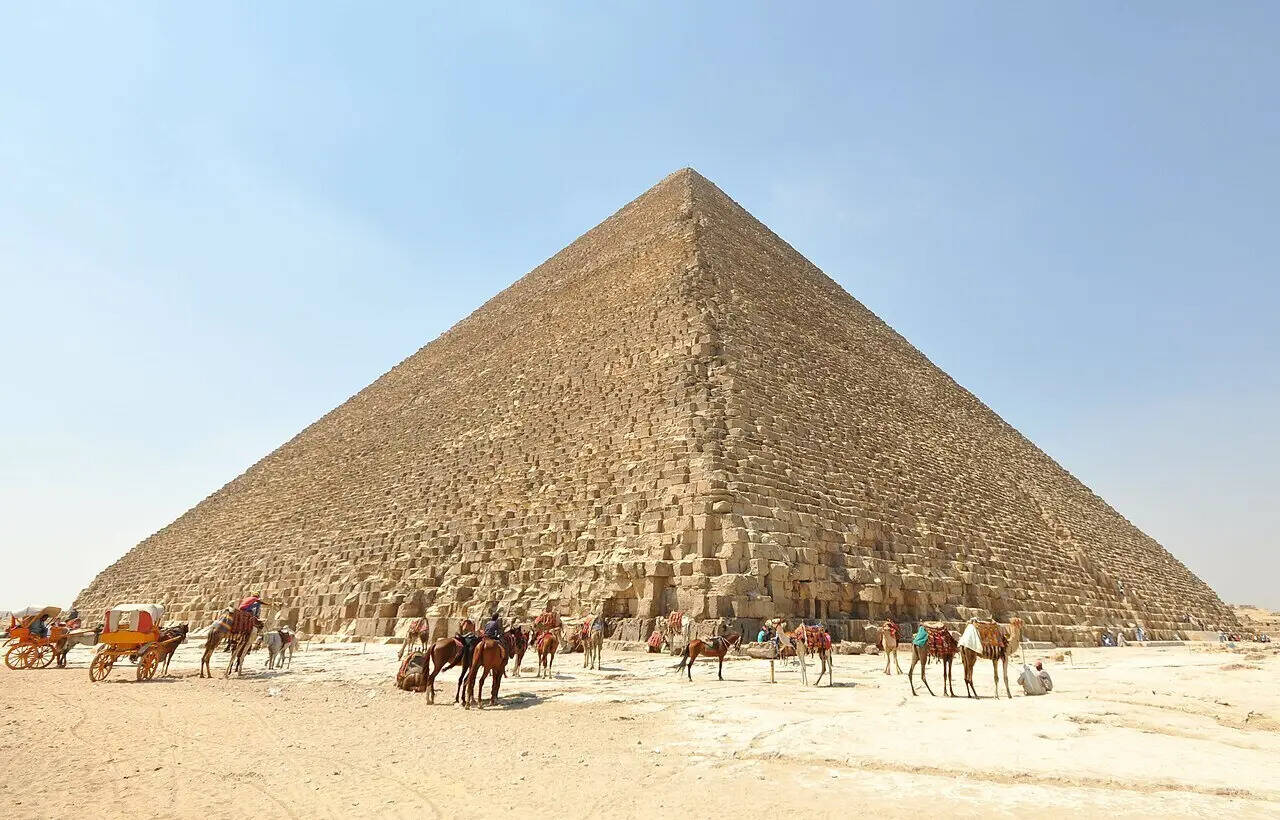
The Great Pyramid of Cholula has a massive footprint, dwarfing the Great Pyramid of Giza in volume. This Mexican marvel is often overlooked, mistaken for a natural hill. Image Credits: Wikimedia Commons
3. The Pyramid of KhafreSitting just a few hundred meters away from the Great Pyramid in Giza, Egypt, Khafre is the second-largest of the ancient Egyptian pyramids. Because it was built on a slightly higher bedrock foundation and still retains a beautiful cap of its original smooth casing stones at the peak, it frequently tricks tourists into thinking it is the tallest structure on the plateau.4. The Red PyramidThe Red Pyramid is one of the largest pyramids in the world. Found in the royal necropolis at Dahshur in Egypt, the Red Pyramid holds a unique place in world history. It was built by King Sneferu and is known by many historians as the first true smooth-sided pyramid ever built.5. Bent PyramidSimilar to the Red Pyramid, it is located in Dahshur and represents a unique pyramid with a peculiar shape that can be considered the oddball of the pyramid family. Once halfway through the building process, the ancient builders noticed that the extreme steepness of the sides had caused instability to the pyramid. Thus, the ancient builders were compelled to change the angle of the pyramid’s blocks suddenly.The elusive nature of measuring ancient rubbleWhen we attempt to rank these giant structures numerically, we face the colossal task of measuring them. According to a UNESCO report, Memphis and its Necropolis – the Pyramid Fields from Giza to Dahshur– estimating the exact volume of any ancient structure is seldom a straightforward mathematical equation.Throughout many years, they have faced severe erosion by nature, collapse, and scavenging by local communities seeking to acquire free materials for construction purposes. In Mexico, the great bulk of Cholula is left untouched deliberately, buried under many miles of tunnels and roots to preserve the historical church atop its peak. Therefore, while we have highly advanced mathematical formulas for calculating volumes, the resulting figures are nothing more than educated guesses and approximations.Instead of regarding this lack of knowledge as a weakness, historians view this puzzle as a reflection of the remarkable abilities of our predecessors. Be it the use of huge stones from the Egyptian desert or the countless numbers of clay bricks from the Mexican mountains, our distant ancestors have been able to change the face of our planet, giving us the legacy of man-made mountains.