
Opening thoughts. This will be a cool(er) and a slightly different edition of Wired Wisdom. Not that we’re uncool every other week, but I believe with the summer well and truly here, it’s important to have a conversation about home air conditioners. It is likely you are contemplating buying one, or know someone who is. Information is priceless. Some of you may have read my Hisense Intelli Cool Pro analysis a few weeks ago. Impressive, I’d noted, on a number of parameters including cooling efficiency and the feature set.
While I was writing that, it got me thinking: Are there some standout Smart AC themes of 2026? There had to be some, it simply can’t be another incremental year. Turns out the more I looked, there are three overarching ones that must define your next AC purchase. For simplicity, I’m focusing on Split ACs for homes. Here’s to hoping you make a cool purchase, armed with the right guidance. After all, these things cost a pretty penny. And something different to talk about this week, beyond smartphones and gadgets!

EDITOR’S CORNER
Class of Smart ACs of 2026
As the 2026 line-ups from prominent AC brands (at least the ones I’d recommend) have firmed up, three pillars defining updated propositions have emerged. Energy efficiency in which AI is playing a major enough role, maintaining indoor air quality, and a self-cleaning mechanism which should really help with the longevity of the AC.
There has been certain refinement in terms of reducing energy consumption, at a hardware level and AI-optimised usage modes that monitor ambient conditions to alter cooling and therefore electricity usage (that’s the underlying advantage of ‘inverter’ compressors, unlike fixed speed ones). The AI modes are found in the remote, but compressors have also improved.
Across Panasonic HU18CKY5XFMH-P ( ₹51,990; rated at 18,016 Btu/h or British thermal units per hour), Samsung Bespoke AI Inverter Split AC ( ₹50,990; 16,208 Btu/h) and the Sharp REIRYOU AH-SI18V5B-SCN ( ₹45,490; 17,777 Btu/h) are within range for consistent 1.5-ton capacity with five-star efficiency ratings.
Purely for generational illustration, a 2025 Samsung Bespoke AI AC of similar tonnage was rated at 17,061 Btu/h. Every bit of efficiency matters.

Most ACs now claim to have AI driving automatic cooling modes. Samsung has the AI Energy Mode, Hisense has the AI Smart Mode and Voltas Vertis AI Zest has AI Adaptive Cooling. Mileage will vary depending on your preference for cooling, but it’s good to have a smarter mode that doesn’t need your intervention. Panasonic’s MirAIe and Samsung’s AI Digital Inverter Control are particularly impressive, reading data from indoor and outdoor sensors to alter operation specifics.
In some instances, AC makers are installing layered filters at the indoor unit’s air intake to capture indoor air pollutants. I’ve had a particularly good experience with the Hisense Intelli Cool Pro’s 4-in-1 filter that has negated a need for a separate air purifier in the room (at least in the summer months). Panasonic too has a PM2.5 sensor, and uses the ‘nanoe’ negative-ion method to disable dust particles.

Last but not least is the longevity aspect, and this generation of AC systems seems to have integrated a certain level of self-cleaning and awareness. Not to say that it won’t require regular servicing as a norm, but any extra smartness will help. I say this as someone who’s just replaced an 11-year-old Samsung split AC, not because anything was broken but there was a crying need for a bit more efficiency in a large living room plus dining hall.
If those ACs from much before an era underlined by anti-corrosive coatings and self-cleaning could last so long, a bit more help from technology should ideally go a long way. Take for instance Panasonic’s DustBuster technology, which auto-cleans the outdoor unit coil by reverse running of the unit’s fan for three minutes after every eight hours of running. Samsung and Acerpure’s Chill Neo have an indoor unit self-cleaning system to dry the heat exchanger and remove accumulated moisture.
TECH SPOTLIGHT
Panasonic HU Series 2026
Is this a year when home ACs take a significant leap forward? In terms of smartness, utility and thought-through features? Panasonic’s 2026 lineup of residential ACs ticks off that checklist (being the first Matter-enabled residential AC, is no mean feat). It’s collectively a laundry list of tech and features, which should hold you in good stead with longevity. An AC isn’t something you buy every other summer.
The model I’m specifically analysing is the CS/CU-HU18CKY5XFMH-P (part of Premium five-star Inverter HU series with new fascia, they re-emphasise), a 1.5 ton five-star rated smart split AC (the 2026 portfolio starts at ₹32,490 while this specific model is priced at ₹62,500).
First things first, this is absolutely fantastic at cooling down a large living room and dining hall, in an L-shape that often stumbles ACs. Even at fan speed 3 (out of 5), a draft of perceptibly comfortable coolness streams through to the furthest corners of the hall—that’s a testament to the throw and therefore dispersion of calmness on a hot day. Cooling efficiency is fantastic, and quick, even on a 40-degree North Indian summer afternoon with the sunlight bathing the outer walls of this indoor space.
This 1.5 ton 5 Star unit, for its size and performance, is ideal for large indoor spaces, and will be more than the ticket for smaller rooms such as bedrooms (if you like it to get really cool). There is, basis the experience of speed of cooling down the room, enough of a performance elasticity for the Panasonic CS-EU18CKY5XFM to be successful in peak summer as well. Attention to detail, such as a larger flap size (that’s great for more volume to cool air) and a bigger than usual crossflow fan thanks to a wider (compared with typical 1.5 ton splits; certainly a few inches wider than my LG with similar configuration) indoor unit, lend credence to that observation.

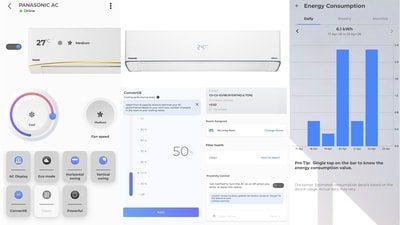
Particularly impressive is the Miraie (written as MirAIe; available for iPhone and Android). The AC takes a couple of seconds to respond with the current status in the app, but that’s a minor niggle. There is the expected AI cooling mode which takes readings from the sensor detecting the room’s temperature and air composition—this may be very convenient for most living room usage scenarios. The Panasonic CS-EU18CKY5XFM is also the first AC that’s Matter enabled in India—Matter is a universal smart home standard that allows smart devices to communicate with each other. Panasonic pitches this as an ability to have multiple Matter devices working together in a private network. Might be useful for those who have a smart home aspiration.
There is something called Proximity Control, which can be configured in the app to enable automatic AC power on or off, depending on how far you are from home—that data is taken from your phone’s location. And as far as the smart aspect goes, this can be connected with Google Home or Amazon Alexa too, for voice commands to control the AC. The app also shows power consumption stats, by day, week or month.
I nevertheless have a couple of observations, regarding this otherwise pristine product package. Some split ACs have started to use BLDC motors, and while Panasonic doesn’t seem to have used it this time around (they haven’t confirmed at the time of writing this), the next generation could deliver even more silent operation if that were to happen.
Secondly, I’ve noticed that the AC doesn’t remember ‘converti8’ settings at next power on (my older LG AC does, for reference)—if you prefer to try and safe some electricity by reducing power bills by switching to a lower compressor capacity setting (this can go as low as 45% of the 1.5 ton capacity), it has to be done manually every time you switch this on.
SECOND THOUGHTS
Power & Efficiency
Often, timing is perfect. Right on cue for this special edition Wired Wisdom, Indian electrical and home appliances company V-Guard shared a study related to an AC’s power consumption in case of low voltage, with the findings “validated by a NABL-accredited laboratory”.
The study benchmarked multiple 1.5-ton AC units from various brands, and notes that when input voltage drops within the 140V–180V range, a common occurrence during peak Indian summers with electricity grids under considerable stress, an AC compressor’s thermodynamic efficiency is compromised.
That is, it lacks required electrical strength to pump refrigerant gas at the speed and volume required for adequate cooling. Therefore it takes much longer to cool the same indoor space, which translates into an exponential rise in power consumption.
Of course, V-Guard wants to plug the benefits of voltage stabilisers (because they are one of the largest brands in that space), but that also makes logical sense. “While modern ACs are built to survive voltage fluctuations, they are not optimised to maintain peak efficiency under them. Our research proves that operating an AC on a dedicated stabiliser isn’t just about protection, it’s an energy-saving strategy that can reduce AC electricity bills by half,” notes Mithun K Chittilappilly, managing director at V-Guard Industries.
It is not just the cost of power consumption. A compressor compensating for low voltage by putting in extra effort causes it to heat up more than it should, and that almost always means faster wear and tear of components.
Wired Wisdom peels away the glitz for a closer look at Technology & AI, with the hope to critically analyse how it impacts you, the human. Want this newsletter delivered to your inbox. Subscribe here.