
Opening thoughts. Samsung is so far ahead in this game, nobody is even close to competing. Regulatory navigation, persistence and corporate will are the reasons why Samsung Wallet in India sets an experiential and acceptability benchmark that even Google is still trying to match. I point this out because a few days ago, Google rather excitedly announced that users in India can now save their Aadhaar Verifiable Credentials directly in Google Wallet. The mind immediately wandered to Samsung Wallet, which I currently have the pleasure of sometimes using with a phone that I really like, the Samsung Galaxy S26 Ultra.
Samsung Wallet has been doing this for years—identity credentials, airline and hotel loyalty cards and more. And while at it, has allowed me to sync Mastercard and Visa cards for a seamlessly integrated Samsung Pay—no need to carry your card or even take out the card holder when making a payment at a store—scan a QR code or simply tap the phone on a payment machine, and off you go shopping bags gently swinging from one hand. One could of course (and right so) argue that Samsung Wallet and Samsung Pay are limited to their own phones, while Google Wallet has wider appeal across Android phones. Correct. But credit where it is due—Samsung’s approach has been spot on, and they got it right much before anyone else. Which begs the question, will we ever get the luxury of Apple Pay in India?
EDITOR’S CORNER
MONEY MATTERS
Technology, India’s banking as well as fintech intersect in more ways than one. There is of course that tech foundation which defines security and reliability. Equally, consumer interface has also got the chance to constantly evolve. That’s exactly what has happened, in a coincidental flurry of activity, in the previous few days. I’ll decode the important developments for you.
E-commerce platform Flipkart, in partnership with Axis Bank and payments platform PayU, has now integrated biometric authentication for card payments within the Flipkart app for Android phones as well as the iPhone. That is, fingerprint or facial recognition confirmation that also eliminates the need for a one-time password, or OTP, to authenticate a transaction. A strong follow-through to the Reserve Bank of India issued the ‘Authentication Mechanisms for Digital Payment Transactions Directions, 2025’ circular that intended to reduce risk of SIM swap or OTP frauds.
Another build-through emerging from the same RBI guidelines is ICICI Bank announcing the addition of biometric authentication for UPI transactions through iMobile, their official mobile banking app. Transactions up top a value of ₹5,000 can be confirmed via facial recognition or fingerprint authentication. “For transactions above ₹5,000, the customer will require their existing UPI PIN to authorise the payment,” the bank says.
There’s more. Meta’s instant messaging platform and PayU have added the phone recharge option to the Payments section, which itself is now easier to find with the “ ₹” icon at the top of the app’s conversation screen. Prepaid connections from Reliance Jio, Bharti Airtel and Vi can be recharged for self or friends and family, using UPI, credit cards or debit cards. WhatsApp also says that the Rupee icon makes it quicker to get to the UPI payments system within the app, including person to person transfers.
Speaking of tech, how about finding some good credit cards that reward tech purchases? BOBCARD, a wholly owned subsidiary of Bank of Baroda, has extended the lifetime free signup offer for its premium credit card, Eterna. This otherwise has a standard annual fee of ₹2,499. I’m talking about this card is, because of a rare and straight 3.5% return on online shopping spends (which is 15 reward points per ₹100 spent; this also includes travel, dining and international spends).
These reward points can be converted into cashback that’s posted directly to your card account, to pay off part or all of next month’s statement. If you get the RuPay variant, that can be UPI linked. The Mastercard or Visa variants work with the Google Pay app.
Last but not least, fintech platform CheQ and AU Small Finance Bank have a co-branded credit card that lights up, quite literally. The CheQ AU Credit Card lights up through an embedded LED, every time a tap to pay gesture is successful—an instant visual confirmation, with the power for the LEDs being delivered by the payment terminal’s NFC field. They say the credit card requires no battery or charging.
If only the rewards system didn’t have the complexity wherein you accrue CheQ Points for spends made on the card (understandable though, the co-brand partnership is to draw users to the platform), and I would be worried about limited or often fluctuating value (an inability to hold value either) in the long term. There’s a one-time fee of ₹999 for the LED version of this card, atop the ₹499 annual fee.
TECH SPOTLIGHT
NUUK HĀLO [v2 LĪNKD]
There is a very clear Scandinavian approach to how Indian tech startup Nuuk approaches its product line. At this point, I’ll say as much—many brands try to achieve that minimalist and functional blend of design language and functionality, but very few achieve the sort of intuitive success they aspire for. Nuuk has has this worked out from the outset, across their range that is as varied as a smart vacuum cleaners including the focused REN BEAM specifically for mattresses and couches, kitchen essentials including an air frier, garment care and some of you may remember my analysis of the HOT BLOX smart radiator heater recently. There was almost a certainly to the HĀLO [v2 LĪNKD], which they claim is India’s most silent smart 3D air circulation fan.
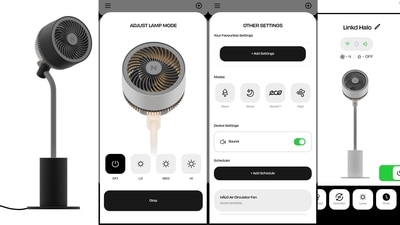
There was a HĀLO v2 previously as well, but the key difference here is the smart connectivity integration. The NUUK app, available for iPhone and Android devices, allows for remote control and management. Don’t think of this as just any floor standing fan, because if used right (as I did, and I’ll illustrate how), this is powerful enough to cool a room on its own standing, and also accentuate the efficiency of the room’s AC. At its highest setting (fan speed up to 12), the HĀLO [v2 LĪNKD] is barely audible even when you may sitting mere metres away from it—there are three Japanese BLDC motors at play, and that’s the key. This is claimed to have a 20-feet air throw distance, and my experience doesn’t suggest at all that isn’t the case. Depending on the AC’s direction of cool air in your room, if you place this at the further edge of that perceptible throw, the HĀLO [v2 LĪNKD] can disperse that cooler air much further still. A 90-degree hall, for instance, can draw a lot of benefit from this.
There are touch controls on the device, but I must note the responsiveness is inconsistent and they don’t always register a touch (and sometimes register two in quick succession). You’ll be mostly using the rather nicely made red coloured remote, or the NUUK app on your phone. The horizontal and vertical oscillations are useful in getting the direction of airflow just right, but there is no way to quickly adjust them—you must go through the full sequence of 30/60/90/120 degree settings before getting the adjustment just right (requires some nifty remote work, one that could’ve been avoided).
The app also gives you additional modes such as Wave, Sleep, Sense and High, and these may work depending on room size, distance from where you’re sitting and ambient temperature. Manual adjustments work better, in my opinion. And the built-in mood lamp is a rather nice touch, with three illumination settings for the warm, welcoming light (love the lighting temperature). At ₹13,499 for what many may initially think is a pedestal fan, NUUK has ensured the HĀLO [v2 LĪNKD] does add a lot more to the experience, smartness, and therefore value. This does nice in the living room, and if you really want to err towards minimalism, the Nordic White may be a better choice than the Midnight Black which I prefer for its nice contrast with the lamp illumination.
Wired Wisdom peels away the glitz for a closer look at Technology & AI, with the hope to critically analyse how it impacts you, the human. Want this newsletter delivered to your inbox. Subscribe here.