
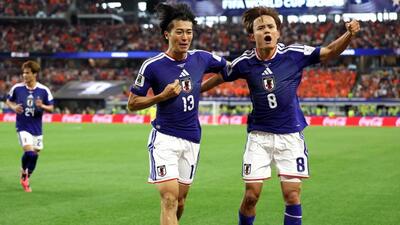
Takefusa Kubo, a talented winger who was shaped in the famous La Masia academy in Barcelona, could not walk properly. He had been left clutching his left knee and needed to be helped back to the Japanese dugout. He sat for the rest of the match with an ice-pack strapped to the knee.
Yet in the dying moments of the match, as the Japanese dugout cleared out onto the field in celebration, Kubo – dubbed the “Japanese Messi” by fans at home – got up as well. As his teammates started to get back into position, he mustered the strength to hop on his good right leg 15-odd meters to congratulate Koki Ogawa.
In that fleeting moment of celebration, Kubo’s gesture gave a glimpse of what has been said quite often about this Japanese team that has travelled to compete at the FIFA World Cup – they play for each other.
On a hot Sunday afternoon at the Dallas Stadium in Texas, they held a physically stronger Dutch team in a thrilling 2-2 draw that proved to be one of the best matches of the World Cup so far.
This was the first time Netherlands have led twice in a match and failed to come out of it with a win. And it was a result that added further substance to the Japanese belief that they could actually go on to win the World Cup.
Such belief, for a team that has an unwanted record of playing the most World Cup matches, now 26, without ever reaching the quarter-final. That streak could end this year, with the Japanese upping the ante.
The first team to qualify for the World Cup with a nearly flawless campaign, they come to the tournament with an impressive record against European giants in recent years, picking up wins against Germany and England in friendlies, while even coming from 2-0 down to beat Brazil 3-2 last year. At the 2022 World Cup in Qatar, they pulled off comeback wins over Germany and Spain to top their group.
On Sunday, the Dutch dominated possession, yet never quite looked in control as the Japanese defence stayed disciplined while the attackers threatened on the counter. Eventually it took a brief slip-up at the back, coupled with Virgil van Dijk’s heading prowess to break the deadlock in the 51st minute.
Down a goal, Japan did not rush, but there was an unmistaken shift in gears. In their very next attack, Kubo set up Keito Nakamura who struck low and hard into the corner of the net just six minutes after conceding.
It took a wonderful, long-range curling effort by Crysencio Summerville in the 64th minute to restore the Dutch lead. But the Japanese would not go away.
Over the years, the standards of the players emerging from Japan have risen to the point that their talent could not be restricted to the island in the Far East. European clubs have come calling regularly, and in the squad of 26, only three play in Japan – 39-year-old veteran Yuto Nagatomo (who spent seven seasons at Inter Milan, apart from stints at Cesena, Galatasaray and Marseille) and the second and third choice goalkeepers.
In fact, five Japanese play in the Dutch Eredivisie as opposed to the two that are in the Netherlands team.
Playing in Europe has made the players stars in Japan, but this remains a squad dictated by the collective whole.
“It’s not about individuals acting like egoists,” former Japanese coach Akira Nishino said, as quoted by The Guardian. “This group of players fight together and within that unity, individuality emerges. There is a strength in these ‘Japanised’ individuals.”
Kubo’s hobble showed the unity in the squad. As did the act of the entire team crowding around Ogawa in celebration, after he rose the highest to powerfully head a corner in the 89th minute. This included Daichi Kamada, who knew full well that the ball deflected off his head before crashing into the net – it was eventually declared his goal.
After the full-time whistle, the players moved to a corner of the field to bow towards their supporters, just as those spectators followed their own endearing tradition of cleaning the stadium.
The Japanese have made their first mark on the World Cup with quiet belief.