
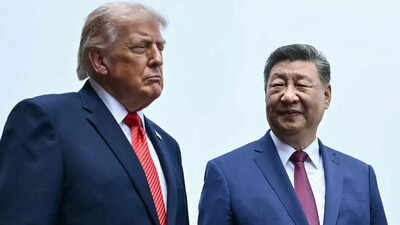
China on Tuesday again warned that Taiwan remains a “red line” in its ties with the United States, just a day before Chinese President Xi Jinping is due to travel to Washington for a summit with US President Donald Trump. Beijing’s warning came as the two leaders prepare to discuss a relationship marked by tensions over Taiwan, trade and security.Xi is scheduled to meet Trump on Thursday during his three-day visit to Washington. It will be their second meeting since May. Beijing has described the summit, coming less than six months after their previous meeting, as a “milestone of historic significance”.
Taiwan at centre of US-China ties
Ahead of Xi’s visit, Chinese state media People’s Daily put Taiwan at the centre of the US-China relationship.A front-page article described Taiwan as a “red line” for Beijing and called it a guardrail and safety net for China-US relations, the Hong Kong-based South China Morning Post reported.“Managing ‘Taiwan independence’ is a key part of building constructive strategic stability between China and the US,” the article said, describing pro-independence forces as a “common enemy” of Beijing and Washington.“The US side must handle the Taiwan question with the utmost caution and take concrete action to safeguard the stable development of China-US relations and peace and stability across the Taiwan Strait,” it warned.Xi is widely expected to raise Beijing’s opposition to a proposed US arms package worth about USD 11 billion for Taiwan. Trump has yet to approve the package. China is also expected to press Washington to scale back its support for Taipei.Beijing claims Taiwan as part of its territory and has vowed to achieve integration with the island. It also opposes countries with which it has diplomatic relations maintaining formal ties with Taipei.
Japan factor
China is also watching Japanese Prime Minister Sanae Takaichi’s meeting with Trump in New York on Tuesday.Takaichi is expected to stress the strength of the US-Japan alliance and the need to maintain a strong position on Taiwan, Japanese officials said. Her meeting with Trump comes as Tokyo seeks to coordinate with Washington on China ahead of Xi’s visit.Japanese officials said Takaichi would also emphasise the need to strengthen deterrence against what Tokyo describes as Chinese military and economic coercion, the Japan Times reported.Relations between China and Japan have remained tense since November last year, when Takaichi said in parliament that a Taiwan contingency could become a “survival-threatening situation” for Japan and potentially lead to action by its defence forces in support of the US.Her remarks angered Beijing, which considers Taiwan part of its territory.
Beijing signals focus on stability
Ahead of Xi’s visit, Chaoyang Shaoxia, a social-media channel widely believed to be affiliated with China’s foreign ministry, said the trip was aimed at “keeping the positive momentum going”.The Chinese foreign ministry, its embassies and ambassadors also posted videos in Chinese and English saying that “from Beijing to Washington DC, the China-US relationship must stay on course towards constructive strategic stability”.Asked about the posts, foreign ministry spokesperson Guo Jiakun said on Tuesday, “China is ready to work with the US to enrich the China-US constructive relationship of strategic stability, enhance dialogue and cooperation, and properly manage differences to contribute to the well-being of both peoples and to a peaceful, stable and prosperous world”.
Fentanyl curbs
China also announced tighter controls on the export of chemicals that can be diverted into the production of fentanyl, addressing another long-standing US demand.Chinese anti-narcotics authorities warned companies and individuals to prevent medetomidine and tartaric acid from being diverted into narcotics production.The China national narcotics control commission said the move was part of intensified efforts to stop chemicals with potential uses in illegal drug production from reaching illicit channels, state-run Xinhua news agency reported.Trump has repeatedly pressed Beijing to curb the supply of chemicals and equipment used to manufacture fentanyl, a powerful synthetic opioid linked to the widespread drug addiction crisis in the US.