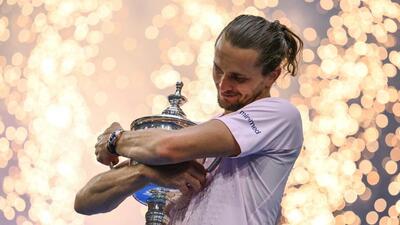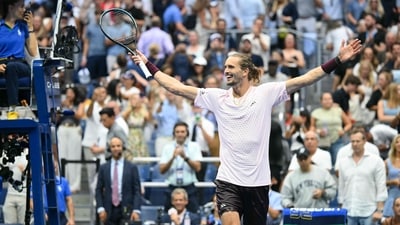
Even as Ben Shelton’s forehand return sailed over the baseline, and the chair umpire announced “game, set, match,” Alexander Zverev walked over to the end of the court, tossed the ball back over the net, seeming to get ready to continue and watch.
It took him almost seconds to realise, until his brother Mischa yelled from courtside. His eyes drifted to the scoreboard, then to the reaction from the crowd, before he held his hands up in a quick move to sink it all in.
Zverev had won the US Open. Six years after his devastating loss in the final in New York, where he won the opening two sets and served at 5-3 in the third, the German wrapped up a three-hour-33-minute clash against Shelton to claim his second major title of 2026 with a 6-3, 7-6(2), 5-7, 6-2 victory.
The disbelief remained stark on his face, and lingered right through his speech to the crowd. “We went 30 years without winning a Grand Slam title and now we won two in a span of three months,” Zverev said. And it genuinely has been that kind of stretch. Amid long-standing questions over whether he ever could, and with time seemingly running out, Zverev finally answered his critics with a maiden major at Roland Garros this summer, followed it with a run to the Wimbledon final, and capped it with this US Open haul.
ALSO READ: Zverev beats Ben Shelton to win US Open, extends American men’s title drought
He didn’t just become the first German man to lift the New York hardcourt title since Boris Becker in 1989 — he also became just the fourth man in history to win his first two majors in the same calendar year, joining Jannik Sinner, Guillermo Vilas and Jimmy Connors. The win also put him at the top of the race for year-end world No. 1.
On paper, it’s a genuinely remarkable season. The numbers are staggering: a 25-2 record at the majors, at least the semifinals at every Slam this year — the only man to manage that in 2026, and the ninth to do it at all in the Open era. He’s also the seventh man in the Open era to clear 25 match wins at the majors in a single year, joining names like Djokovic, Federer, Nadal and Laver.
And yet, it still doesn’t answer the one question that’s followed him for a decade.
The gap that’s still there
Since 1973, only one other man has reached at least the semifinals of multiple majors in a single calendar year without facing a single top-20 opponent along the way: Roger Federer, at Roland Garros and Wimbledon in 2008. Zverev did it twice this year, at Roland Garros and now New York — and it’s actually the third time in his career, after a similar run to the 2020 US Open final, where he lost to Dominic Thiem.
Of the 20 matches he won across the three Slams this summer, Zverev beat just three top-20 players, two of them ranked 10 or above. Both of his major title runs arrived through soft draws. In Paris and New York alike, the path opened up with two of the tour’s best either injured or gone early — Sinner crashed out in the second round at Roland Garros, where Alcaraz was already out with a wrist injury; in New York, Sinner was absent with a knee concern while Alcaraz fell in the quarterfinals. On both occasions, the only realistic meeting with either man would have come in the final itself. Djokovic, for what it’s worth, shared Zverev’s half of the draw in Paris and crashed out in the third round, then sat in the opposite half in New York before a shock first-round exit of his own.
The only times Zverev actually faced Sinner or Alcaraz this year, he lost — five sets to Alcaraz in the Australian Open semifinal, four to Sinner in the Wimbledon final. In fact, five of his 13 losses this season came against Sinner alone: Indian Wells, Miami, Monte Carlo, Madrid, and that Wimbledon final. His only other loss to a top-10 player all year came against Taylor Fritz in the Halle semifinal in June — a three-set defeat that arrived just days after he’d lifted his maiden major in Paris, a reminder that even in his best season, he’s found ways to lose outside the Sinner-Alcaraz bracket too.
The number gets even starker from here: no man has ever won more than one Slam in a calendar year without recording at least eight top-10 wins in that same year. Zverev has just two top-10 wins in all of 2026 — Fritz in the Wimbledon quarterfinal, and Shelton on Sunday night at Arthur Ashe.
Against Shelton, none of it mattered
The world No. 2 brought his experience and big-serving game to the fore and was simply too composed, too precise — facing just a single break point in the entire final. Shelton did break him once, in the third set, perhaps stirring memories of 2020. But a more mature Zverev restored order in the fourth to seal his sixth straight win over the American without a loss, and his 13th set won in their last 14 played. Shelton, gracious afterward, put it plainly: “You’re one of the very best players in the world, maybe the best player in the world this year.”
He might be right, by the numbers. But “best” and “most feared” aren’t the same thing yet. Sinner and Alcaraz have combined to win 12 of the last 14 majors between them, and every time Zverev has stood across the net from either man in 2026, he’s lost. He hasn’t beaten Alcaraz in two seasons. Against Sinner, he’s lost ten meetings in a row.
The verdict
Yes, he has the trophy — two majors this year, in fact — and Zverev has, without question, proven himself a genuinely consistent force at the Slams, building a real gap between himself and everyone outside the top two. But the gap between him and “Sincaraz” remains just as real. Until he actually emerges as a threat against the two of them, “third in a new Big Three” stays a case still waiting to be made — not one this fortnight closed.