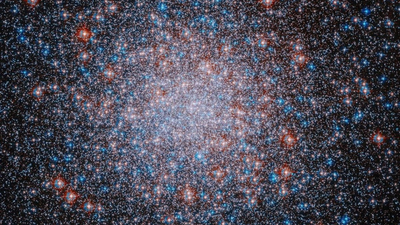
To mark the 250th anniversary of the United States, NASA released a striking new image from the Hubble Space Telescope showing more than 500,000 stars glowing in shades of red, white and blue. The image features Messier 3, one of the largest and most massive globular clusters found anywhere in the Milky Way, a densely packed sphere of ancient stars all bound together by gravity. Beyond its patriotic colour scheme and obvious visual appeal, the cluster is helping astronomers piece together clues about the Milky Way’s distant past, including the possibility that Messier 3 itself is the leftover relic of two smaller star clusters that merged billions of years ago, back when the universe was still young.
What makes a globular cluster different from ordinary stars
Globular clusters are tightly packed, spherical collections of stars held together by their own mutual gravity, and astronomers have identified around 150 of them orbiting in the outer regions of the Milky Way. What sets these clusters apart from more scattered groupings of stars is that their members all formed from the very same collapsing cloud of gas at roughly the same point in time, meaning the stars within a single cluster share a common age and often a similar chemical makeup. According to NASA’s official account of the image, this shared origin effectively preserves an ancient record of conditions from the early Milky Way, making globular clusters some of the most valuable tools astronomers have for reconstructing how our galaxy came together in the first place.
Why Messier 3 stands out even among other ancient clusters
Messier 3, also catalogued as NGC 5272, is remarkable for reasons that go well beyond its impressive size. The cluster sits relatively far from the centre of the Milky Way and is home to more than 240 RR Lyrae variable stars, more than any other known globular cluster in the entire galaxy. These are especially old stars whose brightness changes over time in a predictable, rhythmic pattern, and because astronomers can compare how bright these stars truly are against how bright they appear from Earth, RR Lyrae variables serve as a genuinely useful cosmic ruler for measuring distance, not unlike judging how far away a car is at night simply by knowing how bright its headlights are supposed to look up close.
The unusually young looking stars hiding among the ancient ones
Messier 3 also contains around 70 identified candidates for a rare and puzzling category of star known as a blue straggler, unusually bright, blue tinted stars that appear far younger than the older, redder stars that otherwise dominate a cluster this ancient. In fact, Messier 3 holds a special place in astronomy as the very first globular cluster in which blue stragglers were ever discovered. Astronomers believe these stars gained extra mass by pulling material away from a nearby companion star through gravitational interaction, a process that effectively rejuvenates the star, causing it to burn hotter and bluer and appear considerably younger than its actual age would otherwise suggest.
Evidence pointing to an ancient galactic merger
Perhaps the most intriguing detail about Messier 3 is what its internal structure suggests about its own origin. Astronomers have identified two distinct populations of stars within the cluster, a pattern that has led scientists to suspect Messier 3 may not have formed as a single unit at all, but instead resulted from the merger of two separate globular clusters. Those two original clusters are thought to have both belonged to the same dwarf galaxy at some point in the distant past, before that smaller galaxy was eventually swallowed whole by the much larger Milky Way, leaving Messier 3 behind as a kind of surviving fossil from that ancient galactic encounter.
Why the colours in the image carry real scientific meaning
As with most Hubble imagery, the vivid colours on display are not simply an artistic choice but reflect genuine physical properties of the stars themselves. Blue in the image represents the shorter wavelengths of visible light, while red represents the longer visible wavelengths along with a portion of near infrared light, and because a star’s colour is directly tied to its surface temperature, this means the blue stars scattered throughout the image are considerably hotter than the cooler, redder stars nearby. This straightforward relationship between colour and temperature gives astronomers an immediate, at a glance way to identify the hottest and coolest members of a cluster simply by looking at the finished image.
What this discovery adds to the bigger picture of Hubble’s mission
The Messier 3 image forms part of a larger Hubble Treasury programme aiming to survey roughly half of all known globular clusters across the Milky Way, with the goal of building a detailed timeline showing exactly how our galaxy formed and evolved over billions of years. More than three decades after its 1990 launch, Hubble continues to work alongside newer missions including the infrared focused James Webb Space Telescope and the upcoming Nancy Grace Roman Space Telescope, expected to launch later this year, together assembling an increasingly complete picture of the universe. For a telescope now well into its fourth decade of operation, Messier 3 stands as a fitting reminder that Hubble’s most valuable discoveries are often still hiding in plain sight, waiting inside clusters of stars that have been quietly holding onto their secrets since not long after the universe itself began.A globular cluster that may be the merged remnant of two older clusters, containing stars that rejuvenated themselves by stealing mass from neighbours, and serving as a cosmic ruler for measuring galactic distances, is doing considerably more scientific work than its role as a patriotic anniversary image might suggest. The colours are real, and so is everything they are quietly encoding.