H-1B visas, one of the popular talent entry routes into the US for Indians, will soon come at an over 6-digit figure cost. The Donald Trump administration on Monday issued a proposed regulation that would make permanent an unprecedented fee of more than $100,000 on new H-1B visas for highly skilled foreign workers.The H-1B programme enables US employers to hire foreign workers trained in specialised fields. It provides for 65,000 visas each year, along with another 20,000 for workers holding advanced degrees, with visas approved for periods of three to six years. Before Trump’s order, the fees for these visas generally ranged from $2,000 to $5,000.Also Read | Trump’s new H-1B visa reality for Indians: Unpredictable costs, tougher odds, greater risksWhat is the proposed new move on H-1B visas and why is the Trump administration looking to hike fees? What does this mean for Indian H-1B aspirants?
Over $100,000 fee proposal for H-1B visas
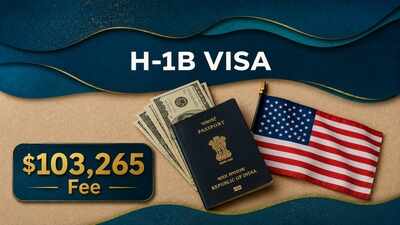
The proposed rule from the US Department of Homeland Security, published in the Federal Register on Monday, would establish a permanent fee of $103,265 for H-1B visas. The regulation could be finalized by the end of the year.Trump first introduced the fee on a temporary basis last year, but it was later blocked by a US court. The measure significantly increases the cost of H-1B visas that are widely used by employers in the technology, education and research sectors.
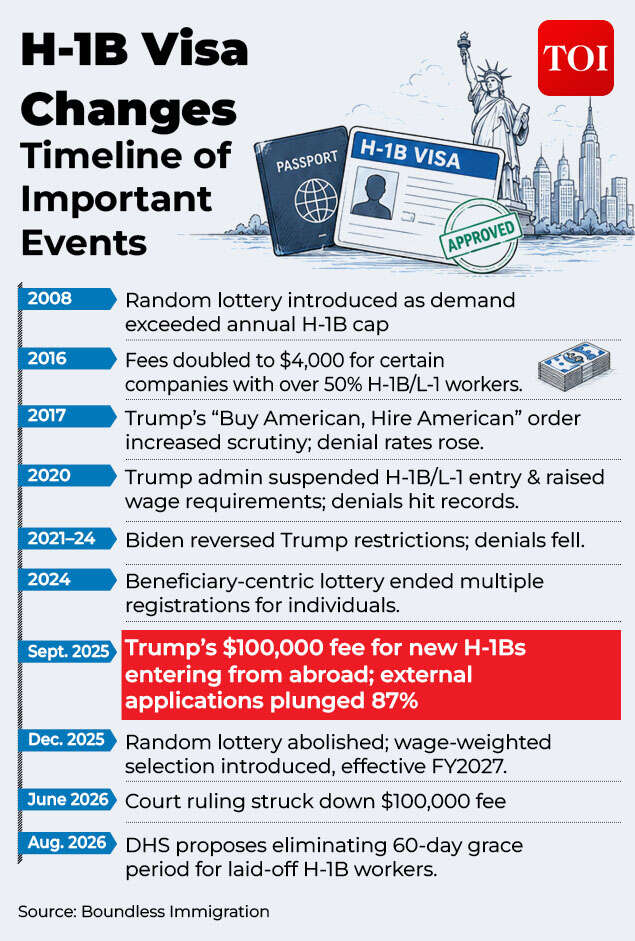
H-1B visa changes: Timeline of Important Events
A federal judge ruled in June that the fee was unlawful and barred the Trump administration from collecting it. A Boston-based appeals court is now reviewing that ruling, while another court is considering whether a judge was right to reject a challenge brought against the fee by a major business group.The temporary fee increase is due to expire in September, a year after it was introduced.The proposed fee would not cover visas issued to foreign nationals who are already in the US on student visas, a group that accounts for a substantial share of new H-1B recipients. It would also not apply when existing visas are renewed.Trump, a Republican, and other opponents of the H-1B programme argue that companies abuse the system by replacing American workers with less expensive foreign labour.Business groups and many companies, however, maintain that the programme is necessary because qualified American workers are not available for certain positions and because US businesses need the ability to attract highly skilled talent.The legal challenges argue that Trump’s authority to restrict entry into the US does not give him the power to override the law that established the H-1B visa programme.The administration has also directed authorities to carry out enhanced vetting of H-1B applicants and proposed changing the visa selection system to give greater preference to workers with higher skills and salaries.Earlier in August, the Department of Homeland Security separately introduced fees of as much as $4,500 for applications to extend the stay of H-1B workers or transfer employees based in other countries to the US.
What it means for Indian H-1B aspirants
Immigration experts see the move as a blow to Indian H-1B aspirants, particularly entry-level talent. Though the Trump administration’s fee is not yet finalised, and if implemented, may be challenged legally, it does reflect on the rising trend of challenges to this route.Xiao Wang, CEO, Boundless Immigration sees this fee as a ‘gut punch’ for Indian H-1B aspirants, compounding what’s already been a brutal year.
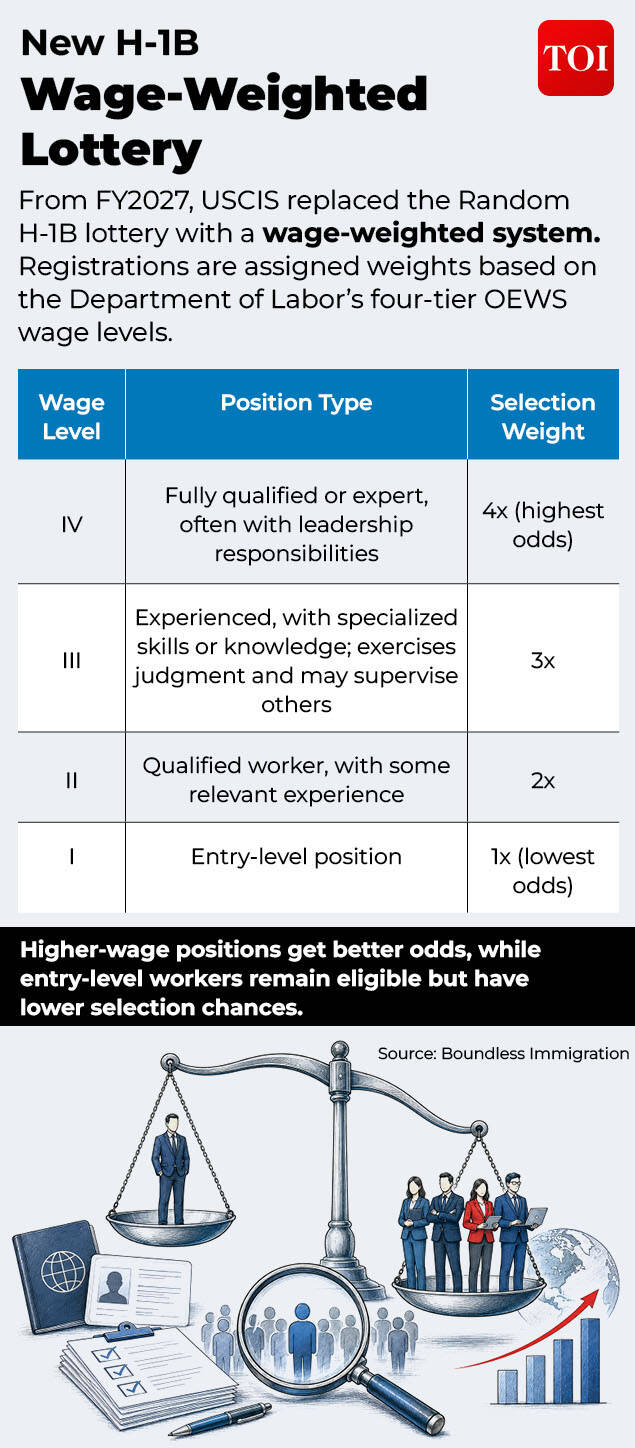
New H-1B Wage-Weighted Lottery
“The $103K fee doesn’t apply to students changing status inside the US or to in-country employer transfers. It lands squarely on workers coming in from abroad. That’s the profile of most Indian IT professionals entering on new H-1Bs,” he tells TOI.“We saw the chilling effect in the FY2026 cap season even before this rule was codified: India-based IT consulting firms pulled back sharply on external applications because the economics stopped working,” he adds.If this gets finalized, the path to the US for a skilled Indian worker narrows further. The wage-weighted lottery already favors senior candidates.“Add a $103K entry fee on top, and you’re essentially pricing out the early-career engineer who doesn’t have a US employer willing to absorb that cost,” Wang explains.Employers have already spent the past year grappling with the prospect of a $100,000 H-1B payment.“This proposal makes clear that six-figure H-1B costs may not be temporary and may be just the starting point. For startups and smaller companies especially, that could fundamentally change who can afford to compete for global talent,” he adds.K Edward Raleigh, Partner at Fragomen, a global immigration law firm, sees employers becoming increasingly selective about who to pick for the H-1B visa lottery.“The fee remains a proposal, will be subject to public comment and, if finalized, will almost certainly face an immediate legal challenge. But if it takes effect, employers will become far more selective about whom they enter in the H-1B lottery, and the number of registrations will likely fall significantly,” Raleigh tells TOI.“We have already seen employers focus more heavily on highly skilled, highly paid workers. A fee of this size would accelerate that shift, making the H-1B route much more difficult for professionals who lack an established relationship with a US employer or a particularly strong or specialized skill set,” he opines.
H-1B path getting increasingly tougher
For years, H-1B visas have been the primary route for Indian professionals looking to work in the US, build long-term careers and, eventually, seek a green card. That path has become considerably less predictable over the past two years as changes to the H-1B application and selection criteria have introduced greater uncertainty.Indian professionals nevertheless continue to account for the largest share of H-1B visa recipients. Their presence is particularly significant across engineering, technology, financial services, healthcare and research-oriented industries.The H-1B application process has undergone several changes in recent months, including a new selection mechanism with a wage-weighted system and changes to the rules governing the 60-day grace period.At the same time, the Department of Homeland Security is moving forward with a proposal to remove the 60-day grace period currently available to H-1B workers who lose their jobs. The period gives them time to find another sponsor, change their immigration status or prepare to leave the US.The proposal has not yet become law. If it is implemented, however, losing a job would leave affected workers with a much shorter immigration window and could make them more reliant on their sponsoring employer.One thing is becoming evident: The path to getting an H-1B visa is getting narrower and more unpredictable. Experts say Indian aspirants should rebalance their expectations to be more realistic and look for alternative destinations or US visa options as well.