
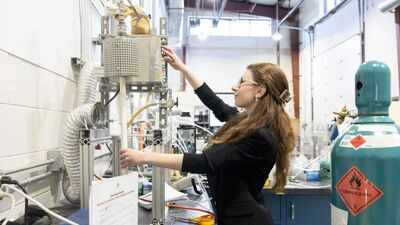
A University of Connecticut student was working on turning leftover campus food into a porous material designed to capture carbon dioxide. Caitlin Noonan, a chemical engineering student, collected about 10 pounds of uneaten food from the university’s South Dining Hall for her research. She processed the scraps to produce biochar and then treated it with steam to create activated carbon, a porous material suited to trapping gas molecules such as carbon dioxide.Noonan’s research aimed to reduce emissions from energy generation at UConn, while potential future applications include industrial scrubbers and portable indoor air filters. According to the University of Connecticut (UConn Today), the project received support from the university’s Office of Undergraduate Research and a 2025 Summer Undergraduate Research Fund Award.
How did the student turn food waste into a material for carbon capture
Noonan, then a rising senior majoring in chemical engineering, was carrying out the project with support from UConn’s Office of Undergraduate Research and a 2025 Summer Undergraduate Research Fund Award. Her research is titled “Converting the University of Connecticut’s Food Waste into Activated Carbon for Carbon Capture, Sequestration, and Usage”.With help from UConn Dining Services staff, she collected about 10 pounds of food waste from South Dining Hall and took it to the Center for Clean Energy Engineering, where her laboratory is based as of 2025.A FoodCycler Eco 5 device, loaned by the university’s Office of Sustainability and supported by Casella Waste Systems, grinds and dries the scraps into powder form.
What made discarded food useful for carbon capture
After the scraps had been dried and ground, Noonan processed the material and subjected it to slow pyrolysis. It produced three outputs: biochar, bio-oil, and syngas. Noonan’s research focused on the biochar, a carbon-rich, porous material that formed the basis of activated carbon. She described biochar as ‘tunable’, meaning its properties could be adjusted for particular uses, including carbon dioxide adsorption.Noonan said, “Most food waste from UConn’s dining halls is already sent to Quantum Biopower, a company that converts it to methane through anaerobic digestion. But food waste from apartment dorms often ends up in the trash. This pilot program helps reduce that waste—and also benefits my research.”
Activated carbon offered potential beyond carbon capture
To make the biochar more porous, Noonan used steam activation at 900°C, or about 1,650°F. The steam removed carbon atoms and created a structure with spaces that could trap gas molecules such as carbon dioxide.She said, “This method is cleaner than chemical activation. Other processes can produce additional waste or environmental hazards. Steam is safer and more sustainable.”It can be heated and reused multiple times for adsorption before being returned to the environment as a soil amendment.Reportedly, biochar and activated carbon made from food waste can remain stable in soil for centuries, while supporting plant growth and improving soil quality.
New material offered potential for cleaner energy and indoor air
Noonan aimed to use the food-derived material to reduce emissions from energy generation at UConn. She also saw future applications in larger-scale industrial scrubbers and portable air filters for indoor use.Noonan said, “When food waste decomposes in landfills, it emits methane and carbon dioxide—two of the most potent greenhouse gases. Food waste alone accounts for roughly 8% of global greenhouse gas emissions. If we can divert that waste and turn it into something useful, we can begin to shift the balance.”Her adviser, Julia Valla, an associate professor of chemical and biomolecular engineering and director of Graduate Studies and Education, said, “As an undergraduate, it’s remarkable that Caitlin’s already making contributions that align with the future of sustainable engineering. Her research on converting food waste into activated carbon for carbon dioxide capture is not only innovative but also addresses major environmental challenges.”