
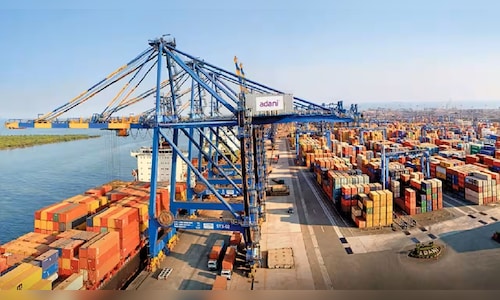
The company’s net profit rose 10.4% year-on-year to ₹3,329 crore, while revenue increased 26.5% to ₹10,737 crore. EBITDA grew 31% to ₹6,559 crore, with margins expanding to 61.1% from 59% a year earlier, reflecting improved operating efficiency and scale.
Operationally, APSEZ crossed a key milestone, becoming the first Indian integrated transport operator to handle over 500 million metric tonnes (MMT) of cargo in a single year. The company also surpassed its FY26 guidance of ₹38,000 crore in revenue and ₹22,800 crore in EBITDA, underscoring the strength of its diversified business model.
Segment-wise, domestic ports revenue rose 13%, supported by a gain in market share, while international ports revenue surged 34%, aided by the addition of NQXT in Australia and ramp-up at Colombo’s CWIT terminal. Logistics revenue jumped 55%, driven by growth in trucking and international freight networks, while marine revenue rose 134% with fleet expansion.
| Metric | FY27 Guidance | Comments |
|---|---|---|
| Revenue | ₹43,000–45,000 crore | 11%–16% growth |
| EBITDA | ₹25,000–26,000 crore | 9%–14% growth |
| Capex | ₹12,000–14,000 crore | — |
| Net debt/EBITDA | Up to 2.5x | In line with earlier guidance |
Commenting on the performance, Whole-time Director and CEO Ashwani Gupta said, “Our strong performance during the quarter underscores the resilience of our business model and disciplined execution of our strategy. Despite geopolitical volatility and global tariff uncertainty, we surpassed our FY26 guidance, led by record cargo volumes.”
He added that the company aims to more than double its revenue and EBITDA by FY31, supported by a target of handling one billion tonnes of cargo by 2030 and scaling up asset-light services.
The board has proposed a dividend of ₹7.5 per share for FY26, with June 12 set as the record date.
Despite the strong showing, the stock came under pressure, falling to an intraday low of ₹1,650 and later trading at ₹1,604.70, down over 3% on the NSE in afternoon trade.