
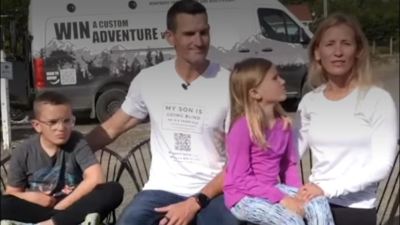
An Arizona couple turned a devastating diagnosis for their son into an unusual fundraising effort, donating a custom adventure van to launch a charity that says it has now paid out $6.1 million in research grants for inherited retinal diseases. According to A Race Against Blindness, founded by physician Stephen Johnston and his wife, nurse Kristina Johnston, the organisation grew out of their son Luke’s 2020 diagnosis with Bardet-Biedl syndrome, a rare genetic condition that can cause progressive vision loss. Its latest funding milestone includes $5.1 million committed to an experimental gene-therapy programme and $1 million for research into treatments that could benefit people with multiple inherited retinal conditions.The charity, which is registered as a US 501(c)(3) public organisation and is based in Gilbert, Arizona, says its aim is to accelerate research into diseases that can cause children to lose their sight. Its financial and grant history is available through its website, while its nonprofit registration and tax filings can be checked through ProPublica’s Nonprofit Explorer.
A diagnosis that changed the family’s plans
In 2020, Luke was diagnosed with Bardet-Biedl syndrome (BBS), a genetic disorder that affects several parts of the body. Its symptoms can include retinal degeneration, obesity, kidney abnormalities and other complications, although their severity varies between individuals. The condition can cause retinitis pigmentosa, in which light-sensitive cells in the retina progressively deteriorate. Night vision may be affected first, followed by peripheral vision and, in some cases, substantial sight loss. The US National Library of Medicine’s MedlinePlus Genetics notes that BBS is associated with changes in several genes, including BBS1 and BBS10.For the Johnstons, the diagnosis brought uncertainty about what Luke’s future would look like and what could be done to protect his vision. Stephen Johnston, who is a physician, and Kristina Johnston, a nurse, said they were unfamiliar with the condition before their son’s diagnosis. They began looking into the research needed to develop treatments and concluded that funding was a major obstacle. Their response was to establish A Race Against Blindness, with the aim of supporting research while raising awareness of inherited retinal diseases that receive relatively little public attention.
How an adventure van became the first fundraiser
The organisation’s first major fundraising initiative began with a vehicle Stephen Johnston had purchased for his family. He donated the custom-built adventure van, made by 27North and valued at approximately $250,000, to serve as the grand prize in the charity’s inaugural sweepstakes.Rather than relying primarily on conventional fundraising dinners or events, the organisation used the prospect of winning a high-value vehicle to attract a wider audience. The idea was to reach people who might not otherwise encounter information about Bardet-Biedl syndrome or inherited blindness.According to the charity’s account, the first van fundraiser helped establish a model that it subsequently used for other vehicle and cash-prize campaigns. By the end of 2024, the organisation said it had paid out $3 million in research grants.A Race Against Blindness was recognised by the Internal Revenue Service as a tax-exempt public charity in February 2023. Its registration can be independently checked using its employer identification number, 92-2174042, through public nonprofit records.
$5.1 million for experimental gene therapy
The charity’s largest funding effort has focused on AXV-101, an investigational gene therapy being developed by Axovia Therapeutics for Bardet-Biedl syndrome type 1, or BBS1. According to the organisation’s grant history, it awarded $1 million to Axovia in October 2024, followed by another $2 million in December that year. A further $1 million was awarded in September 2025, and $1.1 million in January 2026 brought its reported support for the programme to $5.1 million.The funding was intended to support the programme’s development, manufacturing, safety work and preparation for clinical testing. The charity says the money helped advance AXV-101 towards its first human clinical trial.Gene therapy seeks to address disease by introducing, replacing or modifying genetic material. In inherited retinal conditions, researchers are investigating whether such approaches can preserve or improve vision by targeting the underlying genetic defect. However, an investigational treatment is not the same as an approved therapy, and clinical studies are necessary to establish its safety and effectiveness. The AXV-101 programme is intended for people with BBS1-related disease. Its progress does not mean that a treatment or cure is available for all people with Bardet-Biedl syndrome.
Expanding research beyond one condition
The charity’s work has also expanded beyond its original focus. In May 2026, it reported providing $60,000 to support the annual Bardet-Biedl syndrome conference, including patient travel and access to recorded sessions. In June, it announced a $1 million grant to the Foundation Fighting Blindness and the RD Fund for research into gene-agnostic therapies. The charity said a matching contribution brought the funding round’s total impact to $1.55 million.Unlike approaches designed for a particular genetic variant, gene-agnostic strategies aim to develop treatments that could potentially help people with different inherited retinal diseases. Such research may widen the range of conditions that can be addressed, although its eventual clinical benefits remain to be established. The organisation also launched a formal research-grants programme in 2026, publishing funding priorities and evaluation criteria for proposals.
A fundraising model built around transparency
A Race Against Blindness says its sweepstakes are administered by American Sweepstakes & Promotion Co., an independent agency that conducts drawings and verifies winners. Its published rules provide a free mail-in entry option, meaning participants do not have to donate to enter. The charity also lists winners and makes annual financial reports available. ProPublica independently confirms the organisation’s nonprofit registration and provides access to its tax filings.The organisation’s mission remains closely tied to Luke’s diagnosis. What began with a family’s attempt to find options for their son has developed into a fundraising effort supporting research into inherited blindness more broadly.