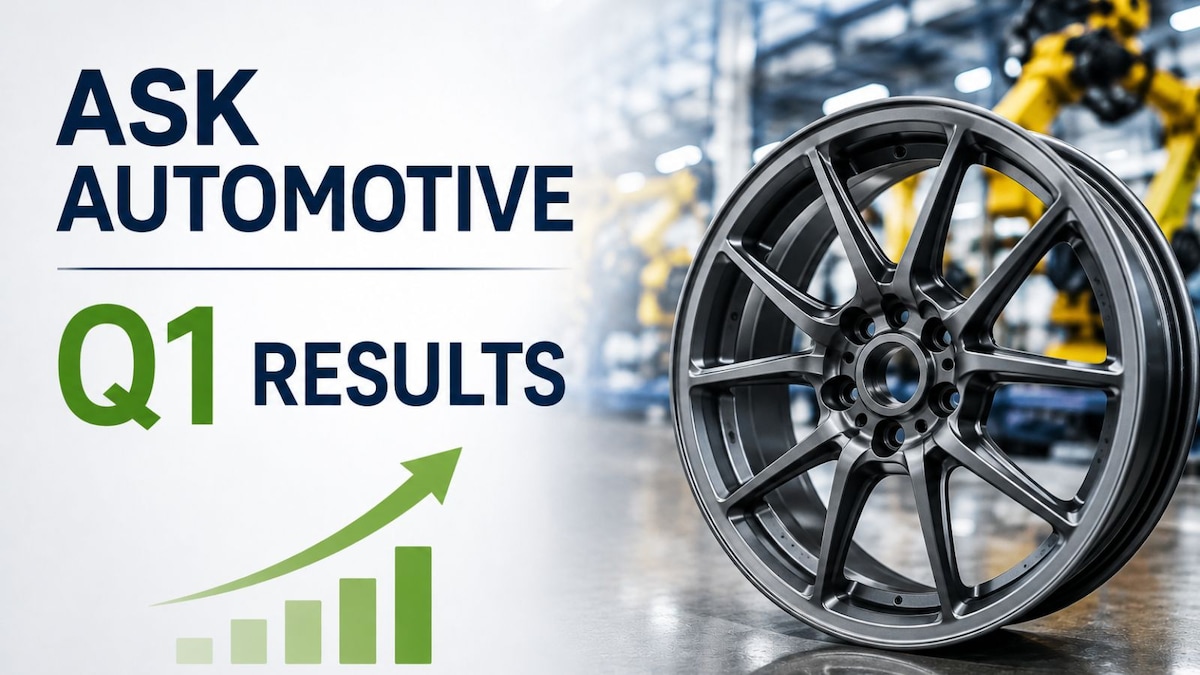
The company reported a consolidated net profit of ₹85.1 crore for the quarter ended June 30, 2026, compared with ₹66.1 crore in the corresponding quarter last year, marking a 28.8% year-on-year increase.
Revenue from operations increased sharply by 52.4% to ₹1,358.1 crore from ₹891.2 crore a year earlier.
The strong growth in revenue indicates healthy demand across ASK Automotive’s product portfolio, with sales momentum helping the company deliver higher earnings despite cost pressures.
ASK Automotive manufactures components across categories such as advanced braking systems, aluminium lightweight precision solutions and safety control cables. The company primarily caters to the domestic automobile industry, with a significant portion of its business linked to two-wheelers and passenger vehicle manufacturers.
Margins impacted by alloy price surge
While revenue and profit increased during the quarter, operating margins came under pressure due to a sharp increase in alloy prices.
EBITDA rose 34.3% year-on-year to ₹160.6 crore from ₹119.6 crore in the year-ago period.
However, EBITDA margin declined to 11.83% from 13.42%.
The company attributed the margin pressure to the “abrupt and phenomenal pass-through” in alloy prices during the quarter.
For auto component manufacturers, raw material costs are a key factor influencing profitability. Metals such as aluminium and alloys form a significant part of production costs, and sudden price movements can impact margins before companies are able to fully pass on the increase to customers.
The company’s ability to maintain growth while navigating input cost volatility remains an important factor to watch in the coming quarters.
New alloy wheel business begins commercial production
ASK Automotive also expanded its product portfolio during the quarter by entering the high-pressure die-cast (HPDC) alloy wheel segment for two-wheelers.
The company commenced commercial production of HPDC alloy wheels on August 4, 2026, marking the beginning of operations in a new product category.
The move represents a strategic expansion beyond its traditional component businesses and allows ASK Automotive to participate in a growing segment of the two-wheeler market, where manufacturers are increasingly adopting lightweight and premium components.
High-pressure die casting is a manufacturing process used to produce complex metal components with better consistency, strength and finishing. Alloy wheels are becoming increasingly common in two-wheelers, particularly in premium and higher-end models.
Captive solar plant to support renewable push
The company also said its 11.55 MWp captive solar power plant in Rajasthan is expected to become operational by the second quarter of FY27.
The renewable energy project is part of ASK Automotive’s efforts to improve energy efficiency and increase the share of cleaner power in its operations.
For manufacturing companies, captive renewable energy projects can help reduce dependence on conventional power sources while providing greater control over long-term energy costs.
The solar plant could also support the company’s sustainability goals as automobile manufacturers increasingly focus on reducing emissions across their supply chains.
Growth outlook remains linked to auto demand
ASK Automotive’s performance is closely linked to trends in the automobile sector, particularly two-wheelers, where the company has a significant presence.
The domestic automobile industry has seen continued demand for newer technologies, lightweight components and safety-related systems, creating opportunities for component suppliers.
As vehicle manufacturers move towards better safety features, improved fuel efficiency and premium offerings, component makers with specialised capabilities could benefit from rising content per vehicle.
However, raw material volatility remains a key risk for the sector, especially for companies dependent on metals and alloys.
Shares of ASK Automotive ended 3.22% lower at ₹551.30 on the NSE on Tuesday.
Also Read: Deepak Nitrite Q1 profit surges as margin doubles; board clears ₹2,500 crore expansion