Welcome to the very first edition of Earnings Central, our new daily companion for the results season, published at 8 pm through the thick of it. Consider this your evening wrap, a chance to sit back after a long trading day and make sense of the numbers, the noise and the nuance that moved the market between nine and half past three.
When volumes disappoint, the Street doesn’t forgive
Tuesday’s loudest reaction came from HUL, and it wasn’t a happy one. The stock fell as much as 7%, its worst single-day drop since 2020, after domestic volume growth came in at just 5% against expectations of 6 to 7%. It’s worth noting the topline itself wasn’t the problem. Revenue of ₹17,341 crore actually beat the CNBC-TV18 poll of ₹17,235 crore, up 10 % on the year. But profit fell 3 % to ₹2,673 crore, missing the ₹2,814 crore the Street had pencilled in, and a sharply higher tax outgo of ₹939 crore, against ₹485 crore a year ago, only added to the disappointment.
Management struck a calmer note than the market did. Speaking to CNBC-TV18, HUL said the FMCG demand environment remained stable through the quarter, with growth split evenly between price and volume, and the EBITDA margin held within its guided range. It flagged that raw material inflation is likely to stay volatile, with cost pressure of 2 to 5% expected quarter on quarter heading into September, and said calibrated price hikes would help offset this.
Where HUL’s investors were busy punishing a volume miss, Larsen & Toubro’s were weighing a rather different trade-off. Net profit rose 14 % to ₹4,123 crore, well ahead of the ₹3,490 crore estimated, and revenue climbed 6.7 % to ₹67,942 crore, again beating the Street. The catch was margins, which slipped to 9 % from 9.9 % a year earlier, a sign that a volatile operating environment leaves its mark somewhere even when the headline numbers hold up.
And volatile is the word L&T itself reached for. The company said geopolitical developments disrupted supply chains during the quarter and that it was in discussions around rebuilding facilities damaged in West Asia, noting rather candidly that its customers effectively control that region’s economy, which led to delayed shipments. The offsetting story was a strong order book. Inflows grew 14 % year on year to ₹1.08 lakh crore, taking the consolidated order book past ₹7.79 lakh crore, and the quarter also brought the completion of the Nabha Power divestment, a signed agreement to divest the Hyderabad Metro stake, new electronics manufacturing facility in Coimbatore geared towards EV traction motors, and a tie-up between L&T Vyoma and Nvidia to build what it called a gigawatt-scale AI factory in India.
A quieter warning sign from D-Mart
Somewhere between these two headline names sat a number that deserves more attention. Avenue Supermarts, which runs D-Mart, reported a perfectly respectable quarter on the surface, with consolidated profit up 11.3 % to ₹860 crore and revenue up 14.8 % to ₹18,794.53 crore. But look a layer deeper and the same fatigue visible in HUL’s volumes shows up here too. Like-for-like growth in stores at least two years old slowed to 5.5 % from 7.1 % a year ago, and growth in its older large-metro stores, typically the highest revenue-per-square-foot outlets in the chain, was essentially flat. The company also added just three new stores during the quarter, a noticeably slower pace than in previous years, taking its total count to 503.
Earnings beats didn’t always mean a rising stock, and the reverse held too
Cholamandalam Investment posted a strong quarter by any measure, profit up 45.5 % to ₹1,656 crore and net interest income up 27 %, yet its shares still fell more than 6 % at one point before recovering, with the market choosing to focus instead on asset quality. Gross NPAs edged up to 4.5 % from 4.29 % a year ago, even as the NBFC’s board approved a fundraise of up to ₹55,000 crore through non-convertible debentures to keep the growth engine fed.
Radico Khaitan had the opposite problem in the best possible sense, a quarter so strong the market had little to argue with. Profit surged 76 % to ₹230 crore on the back of its premiumisation push, and the company raised its FY27 guidance for premium and above volume growth to over 25 %.
Ambuja Cement’s headline beat estimates, with profit at ₹660 crore against a poll of ₹469 crore, but the year-on-year picture told a less flattering story, down 36.6 %, and the company flagged soft cement demand of around 5 % for FY27 alongside a seasonally weaker second quarter running into peak fuel cost inflation. Varun Beverages missed on most counts, its India business volume growth of 14.4 % falling well short of the over 20 % the estimated number, while Suzlon Energy saw both profit and margins slip even as revenue grew a healthy 22 %.
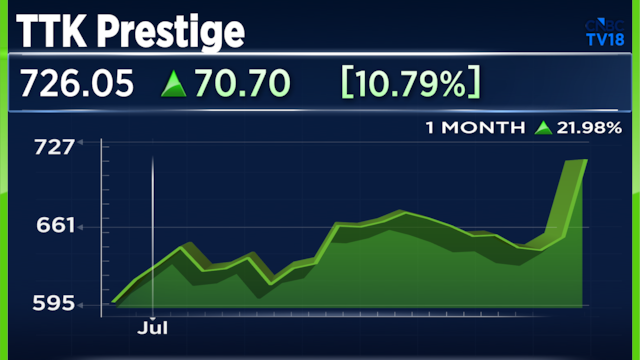
It was not all gloomy as Equitas Small Finance Bank swung back into the black with a profit of ₹184 crore against a loss a year ago, and TTK Prestige shares jumped as much as 11 % intraday after profit more than doubled on broad-based demand and improving margins, despite the same commodity cost pressure everyone else in the space is contending with.
What the corner office had to say
Beyond the numbers, a few conversations from the day are worth your time. Tata Power’s Praveer Sinha told CNBC-TV18 that the company expects India’s power demand to grow 6 to 7 % in FY27, and it’s backing that view with money, having spent ₹5,300 crore in the June quarter alone, its highest ever first-quarter capex, with roughly 2.5 GW of renewable capacity due to be commissioned this year.
HUDCO’s Sanjay Kulshrestha said the housing financier expects its loan book to touch nearly ₹2 lakh crore by the end of FY27, and may even need to revisit its longer-term FY30 target given how fast the urban infrastructure pipeline is filling up. And Coforge’s Sudhir Singh sounded genuinely bullish about the year ahead, calling FY27 an “exceptional” one for the company on the back of AI-led transformation and cloud modernisation demand, with margins improving and, in his words, a shot at setting the industry’s growth benchmark for a third year running. He also expects record large deal wins in the September quarter.
A clutch of other names also filed in through the evening, with profit growth well into double digits across sectors as different as agri-inputs and retail real estate, quiet reminders that this earnings season still has plenty left to say.
That’s Tuesday, wrapped up. We’ll be back tomorrow at 8 pm to walk you through what Wednesday brings.
For the full blow-by-blow on Q1 earnings as it happens, follow our live blog here.