
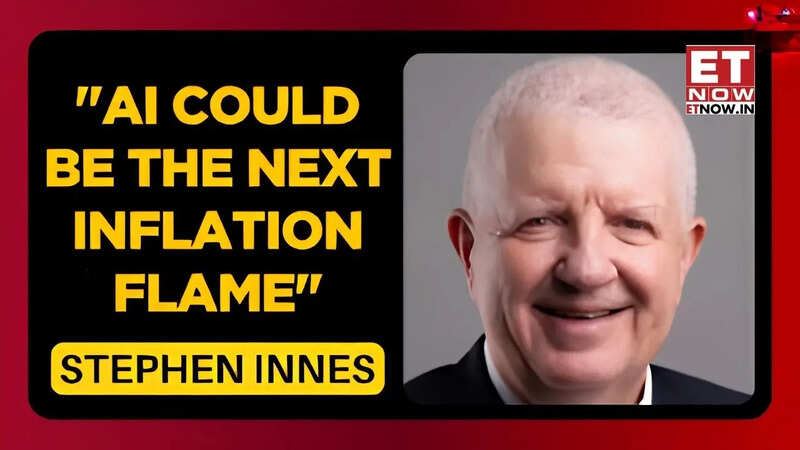
Global markets may be underestimating the inflationary impact of artificial intelligence (AI), while upcoming IPOs and a potentially hawkish US Federal Reserve could create a challenging environment for equities in the coming weeks, according to Stephen Innes, Managing Partner at SPI Asset Management.
In an exclusive interview with ET Now, Stephen said investors should remain cautious in the short term as markets navigate a combination of rising inflation risks, elevated valuations and heavy capital demands from new stock offerings.
AI’s inflation impact not fully captured yet
Ahead of the closely watched US Consumer Price Index (CPI) data, Stephen has said that AI could emerge as an expected inflation driver, even though many investors currently view it as a long-term productivity booster.
“I think the unquantifiable risk is actually the impact of AI in the economy,” Stephen said.
According to him, AI-related costs such as computing power, token usage, data centres and infrastructure spending are not being adequately reflected in traditional inflation measures.
“Most of the price pressures coming out of AI, such as token costs, are not really picked up by the index correctly,” he said.
He added that while AI could eventually become deflationary through productivity gains, the massive investment required to build AI infrastructure is creating inflationary pressures in the near term.
Higher inflation could revive hawkish fed concerns
The market’s reaction to the upcoming inflation print could be significant, especially if CPI comes in above expectations.
“Anything above 4.2 per cent is going to be quite negative for the markets,” Innes said, adding that even inflation readings above 4 per cent have historically pressured US equities.
A stronger-than-expected inflation reading could strengthen expectations that the Federal Reserve will maintain a restrictive monetary policy stance for longer.
“It is just going to lead into a more hawkish Fed narrative,” he said.
According to Innes, modern equity markets have become highly dependent on lower interest rates because many growth stocks and AI-related companies trade at elevated valuations.
“Higher interest rates are just negative for stocks. Good news is actually bad news because the market lives off lower interest rates,” he said.
AI stocks face pressure amid IPO wave
Beyond inflation concerns, Innes also highlighted another risk emerging in the market: a surge in IPO activity.
He pointed to the strong investor interest in upcoming offerings, including a much-discussed SpaceX-related listing, as a factor that could trigger portfolio reshuffling.
“The biggest question we have right now is who’s going to be paying for it?” he said.
“We are going to have to be selling some of these structural top-end winners to pay for the paper wave of IPOs coming out,” he said.
A “toxic cocktail” for equities?
Stephen warned that a combination of hawkish Fed expectations, elevated valuations and heavy IPO issuance could create what he described as a “toxic cocktail” for the market.
“It could really be a toxic cocktail if we get another hawkish surprise ahead of these IPOs,” he said.
“We usually see a nice uptick in the stock on day one of an IPO, but then the sellers come in,” Innes noted.
“I am not expecting a big bounce in stocks over the next week or two because of this super amount of issuance coming to markets,” he said.
Fed may stay in ‘higher for longer’ mode
On the outlook for US interest rates, Innes believes the market is increasingly shifting from debating rate cuts to discussing the possibility of future rate hikes.
“The bias in the market sense is towards hiking,” he said.
“We are going to be in a higher-for-longer regime,” he said.
Why oil prices still matter
Apart from AI, Innes believes energy prices remain a key variable for inflation.
“Even if we do have a peace deal, that doesn’t necessarily mean oil is going to come flowing through,” he said.
Investors may have ignored downside risks
Innes also suggested that many investors became overly optimistic during the AI rally and failed to adequately hedge against potential market weakness.
“They are all caught up in the FOMO of the AI trade,” he said.
“This is one of those learning lessons investors are going to look back at,” he added.
Will AI create the next inflation cycle?
While AI has been widely viewed as a transformational growth story, Innes believes markets will increasingly focus on measuring its inflationary effects.
“We do not have the models to determine it yet,” he said.
He expects new indicators tracking AI productivity, expansion and inflation impacts to become important tools for investors over the next few years.
“Markets are going to become increasingly more focused on AI indexes, productivity indexes and inflation push-through indexes relative to the AI build,” Innes said.