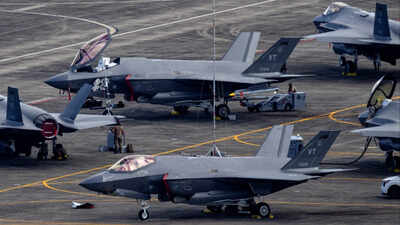
The US State Department has approved the potential sale of Lockheed Martin’s F-35 Lightning II fighter jets to Saudi Arabia for an estimated $24.3 billion, according to a notice posted online on Thursday.The kingdom has been drawn deeper into the Middle East war as it pursues the advanced aircraft.The proposed sale puts Saudi Arabia closer to acquiring one of the world’s most advanced fighter aircraft after years of seeking the F-35 from Washington.Saudi Arabia has had decades of military cooperation with the US and is the largest buyer of American weapons and defence equipment.The State Department’s approval comes amid heightened scrutiny over Saudi Arabia’s military and security ties with China.US intelligence officials have raised concerns that Beijing could potentially gain access to F-35 technology through espionage in Saudi Arabia or through the kingdom’s military and security partnership with China, The New York Times reported.
F-35 deal faces China-related security concerns
The projected sale of approximately $24.3 billion would include 48 military aircraft and 49 engines from Pratt & Whitney, as well as communication gear, spare parts, and additional support items, according to the department.The State Department sent the package to two congressional committees in June for informal approval, as the administration moved the sale into a more advanced stage.A Pentagon Defense Intelligence Agency report circulated among government agencies and congressional offices reportedly raised concerns about Chinese military access to Saudi bases and the kingdom’s use of Chinese telecommunications technology.US intelligence analysts have questioned whether secure facilities could be maintained for the F-35 technology and whether Saudi Arabia would agree to restrict access by Chinese military and intelligence personnel.The report also raised questions about the presence of equipment from Chinese technology companies Huawei and ZTE in telecommunications, router infrastructure and defence installations.The Pentagon is particularly concerned about protecting the F-35’s advanced radar and surveillance technology, the newspaper reported.The US intelligence concerns are not new. Similar issues emerged during the first Trump administration over a proposed F-35 sale to the United Arab Emirates.The Biden administration later ended that sales process after reviewing concerns about the UAE’s expanding military, intelligence and technology links with China, according to The New York Times.
Saudi Arabia’s military ties with China
Saudi Arabia maintains close military ties with Washington but also has defence cooperation with Beijing.Saudi Arabia buys ballistic missiles from China and that the Chinese military has helped the kingdom develop ballistic missiles, establish production facilities and improve missile operations.The newspaper also reported that Prince Mohammed has sought to strengthen Saudi Arabia’s military capabilities while the kingdom has faced renewed fighting with the Houthis, an Iran-backed group in Yemen.Saudi Arabia has led a coalition fighting the Houthis since 2015. The conflict has intensified again, with the Houthis launching drones and missiles at Saudi targets.Saudi Arabia said on Thursday that debris from an intercepted Houthi drone killed one person and injured two others in Taif province. The Houthis have denied targeting Mecca, after Saudi Arabia said on Wednesday that it had intercepted a drone aimed at the holy city.
Israel’s military edge also a consideration
The proposed F-35 sale could also draw scrutiny over Israel’s military advantage in the Middle East.Israel is currently the only country in the region operating F-35 fighter jets. US policymakers have historically sought to preserve Israel’s “qualitative military edge” in the region, a requirement mandated by Congress.Previous US administrations have therefore subjected proposed advanced weapons sales to Arab countries in the region to detailed reviews.Saudi Arabia’s potential acquisition comes alongside broader US-Saudi defence and strategic discussions. The Trump administration has also agreed to help the kingdom develop a civilian nuclear programme, a separate issue that has raised security concerns.The State Department said in its notice that “the proposed sale of this equipment and support will not alter the military balance in the region.”The State Department’s approval does not itself complete the F-35 sale. The proposed package remains subject to the US arms-sales process and congressional scrutiny.