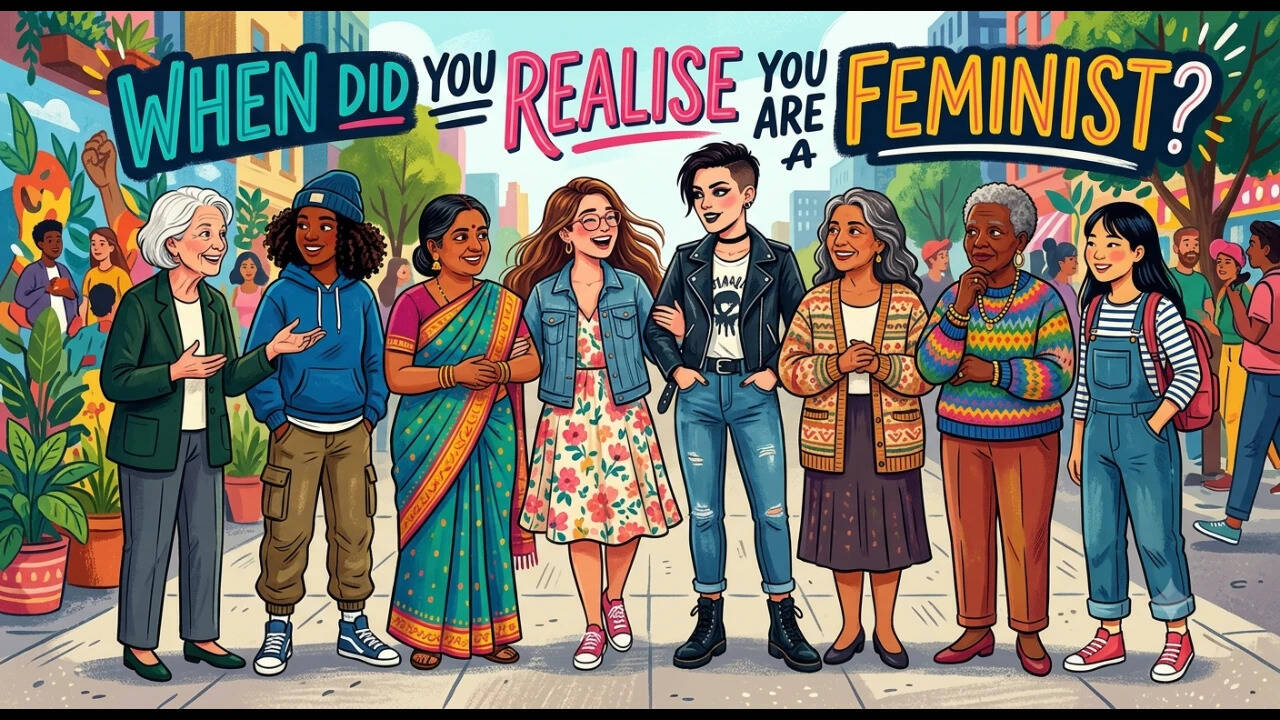
“The truth will set you free, but first it will piss you off.”― Gloria SteinemGloria Steinem, feminist, activist and writer, who died Thursday, at the age of 92, had once said she became a feminist little late in life, somewhere in her mid 30s, and said she regretted the fact that she “joined the movement so late in my life”. That got me thinking, when did I realize I was a feminist? For that matter, when did you? Because the word “feminism” draws extreme reactions from people. At least, in my experience. I have an equal number of women friends who are feminists, as the number who always make it a point to declare they are not.Once a top Bollywood actress during a casual conversation had told me the same. “Oh, I’m not a feminist. There’s no need in this day and age.” This was about 15 years ago. And it got me thinking… when did I realize I was a feminist? What does it mean to be a feminist? Do we all have to be feminists? Women and men? For people in the 20s, still navigating life, the answers would probably vary. Or, maybe, in the age of social media, everyone asks themselves whether or not they are feminists. Because let’s be honest, our perceptions of ourselves and the world are largely influenced by the reality around us. And for each one of us, it’s different.Steinem, throughout her life, had worked towards bringing women—from different socio-economic classes to different races and circumstances—to fight for themselves. Because she understood what women, all over the world, sometimes understand a little late. Feminism is not a fad. It’s not a fancy word. It is a life-long battle. Some, small and quiet. Some, big and loud. Sometimes, it’s personal. Sometimes, it’s political. But as Steinem, and many other feminist trailblazers have said: “The personal is the political”.Steinem did not view the fight for women’s rights as a battle to gain power over men. Instead, she saw it as an effort to restore full dignity, freedom, and choice to half of the human race. She defined a feminist as “anyone who recognizes the equality and full humanity of women and men”. Her core goal was simple: to create a world where every individual enjoys equal opportunity without bias, stereotyping, or forced social expectations.
Why the word “feminism” feels so personal
Perhaps that is why the word “feminist” can feel so personal, even when we are talking about something as universal as equality. I suspect many women discover their feminism not through books or political movements, but through small, almost forgettable moments that suddenly refuse to be forgotten.It could be the first time a girl is told not to stay out late because “good girls” do not come home after a certain hour, while her brother is allowed to return whenever he pleases. It could be being told that ambition is attractive in a man but somehow intimidating in a woman. It could be discovering that a woman’s anger is labelled aggression, her confidence, arrogance, her independence, selfishness, while the same qualities in a man are often celebrated as leadership.For me, the realization did not arrive as a dramatic revelation. It came gradually, through observation, conversations, friendships, work and simply growing older. You begin to notice the little negotiations women are expected to make every day: how loudly they speak, how they dress, how much they earn, whether they marry, when they have children, how much they work, how much they sacrifice. And then you begin to notice something else: how often women are expected to explain choices that men are simply allowed to make.Perhaps feminism begins precisely there, with that questioning. Why should this be different for her? Why is this acceptable for him but not for her? Who decided that this was the natural order of things?And perhaps being a feminist does not mean having all the answers. It means being willing to ask those questions, even when the answers make us uncomfortable. It means recognising that equality cannot be conditional on whether we personally have experienced discrimination. It means understanding that another woman’s freedom does not diminish our own, and that the choices we make for ourselves should not become rules imposed on everyone else.Steinem spent decades asking uncomfortable questions, including questions about power, privilege, sexuality, work, marriage, motherhood and the invisible systems that determine whose voices are heard. Her legacy lies not merely in the causes she championed, but in the permission she gave generations of women to question the roles they had inherited.So perhaps the more interesting question is not whether we call ourselves feminists. Perhaps it is whether, when confronted with inequality, we are willing to recognise it, question it and, when possible, change it. Some of us may discover our feminism in our twenties. Some may stumble upon it in our thirties, forties or fifties.I’ll add another slice of my own life here. During my school years, I was what this world calls a ‘tomboy’. Largely, this means, one doesn’t have overtly feminine traits. And there was this phase, somewhere around our teenage years, where there is almost a sense of pride declaring to the world that we are tomboys, not silly girls. For some women, it is a personality trait. But for most, it’s “cool”. Because it has always been cool for women to have some boyish traits for boys to accept women as one of their tribe.
The first problem for all of us, men and women, is not to learn, but to unlearn: Gloria Steinem
It was much later in life that I thought of this again. And then some more. Largely because by that time going through life, it had become pretty clear to me that men were largely human beings, but women… were just women. So, I turned the statement “I’m a tomboy” on its head. Who were the boys around me, in my teenage years, who proudly proclaimed: “I have a feminine side in me, and I’m proud of it.” Or, “Masculinity isn’t the only definition of being a boy or man.” Because, really, it isn’t. I could find none.It’s quite insidious actually, the way society’s unspoken patriarchal views are carried forward. By men and women. By boys and girls. But what Steinem had shown through her journalism, activism, books and articles is that it’s all okay. Because everyone has to realize and see and feel the inequality on their own to realize why feminism matters.
The existential rage is quiet, but it’s there
Let me ask a simple question, when you look around your office, especially leadership positions, how many cool cabins are women sitting in? How many times have you been made to feel inadequate not fulfilling what is considered a woman’s job or responsibility? How many times have you walked on the road without considering what to wear for your own safety? How many catcalls did it take for you to finally be silent and do nothing about it, because it is exhausting to scream and shout, and “create a scene” every day? How many days go by without all of us reading horrific articles of another woman burned to death because of dowry?This is where feminism becomes less about a word and more about a way of seeing. Because once you begin to notice these things, it becomes difficult to unsee them. You see them in the jokes that are allowed to pass because “that’s just how men talk”.You see them in meetings where a woman makes a point that nobody notices until a male colleague repeats it. You see them in the expectation that a woman will remember the birthday, organise the dinner, take the child to the doctor, look after an ageing parent and still arrive at work looking as if none of these things required effort. You see them in the strange social approval that comes when a woman is successful but not “too successful”, confident but not “too aggressive”, independent but still sufficiently accommodating.And you see it in the language we use. A man who is assertive is a leader. A woman who is assertive can be difficult. A father who spends time with his children is praised for being involved. A mother who does the same is simply doing her job. A man who prioritises his career is ambitious. A woman who does it is often asked how she is balancing everything.None of these things, individually, may seem like a battle worth fighting. That is precisely how inequality survives. It does not arrive wearing a uniform. It is disguised as a joke, a compliment, a tradition, a piece of advice, an expectation, a raised eyebrow. It tells you, gently at first, what women should be and what they should not be. And because everyone around you appear to accept it, you begin to accept it too.Steinem understood how deeply these ideas could become embedded in us. She once observed, “A pedestal is as much a prison as any small, confined space.” It is such a deceptively simple thought, but it explains so much of what women have historically been offered in place of equality: admiration instead of freedom, protection instead of independence, idealisation instead of agency. Being told that women are special can sometimes be another way of telling them they are different — and therefore subject to different rules.That, perhaps, is the most insidious part of patriarchy. It does not always require men to impose rules on women. Women can become its most efficient carriers, passing down to daughters the same warnings their mothers once gave them: don’t be too loud, don’t be too ambitious, don’t come home too late, don’t dress like that, don’t make him feel insecure, don’t earn too much more than him, don’t make your husband look small, don’t be difficult. Sometimes we call this wisdom. Sometimes we call it culture. Sometimes we call it being practical.
Steinem never dictated, she asked questions that cannot be ignored
And sometimes it is simply fear, inherited from one generation to the next. This is why Steinem’s work remains so relevant. She did not simply tell women to become stronger. She encouraged them to examine the structures that had taught them what strength was supposed to look like in the first place. She questioned why women had to adapt themselves to a world designed largely around male experiences. She questioned why women had to earn their freedom by proving they were responsible enough, respectable enough, educated enough or successful enough to deserve it.And most importantly, she understood that feminism could not be one-size-fits-all. The woman struggling to survive in a village, the woman fighting for equal pay in a corporate office, the woman raising children alone, the woman choosing not to have children, the woman who wants to be a homemaker, the woman who wants to run a company, the woman who wants to marry, the woman who does not — all of them deserve agency over their own lives.Which brings me back to my teenage self, proudly declaring that I was a tomboy. I had thought I was rejecting the stereotype of the “silly girl”. I did not realise that somewhere beneath that declaration was another, quieter message: being like a boy was somehow a little more valuable. Being tough was cool. Being emotional was not. Being independent was admirable. Being traditionally feminine was something to be slightly embarrassed about.It took me years to understand the absurdity of that equation. These may sound like small things. But lives are made up of small things. And so are inequalities. Steinem understood that. She understood that a revolution does not always begin with a march or a law or a speech. Sometimes, it begins with a woman sitting across from another woman and saying, “You too?”Sometimes, it begins when a daughter questions something her mother accepted. Sometimes, it begins when a son refuses to laugh at a sexist joke. Perhaps that is why another of Steinem’s observations has stayed with me: “The future depends entirely on what each of us does every day; a movement is only people moving.” It takes feminism out of the realm of grand declarations and places it firmly in ordinary life. In what we tolerate, what we challenge, what we teach our children, what we say to our friends and what we choose to remain silent about.Steinem believed she became a feminist late. I suspect many of us do. So the question is not really whether “we have always been feminists”. Perhaps it is when we first became uncomfortable with an inequality we had previously accepted. When did we first ask why? When did we first say, quietly or loudly, that this was not fair? When did we first realise that another woman’s freedom was connected to our own?For me, I think I am still becoming a feminist. Perhaps that is the more honest answer. Maybe that is why Steinem’s words continue to resonate. Feminism was never supposed to be a finished destination. It was always a process of seeing more clearly.She wrote in her 2015 book, My Life on The Road, looking back, “I was angry about the human talent that was lost just because it was born into a female body, and the mediocrity that was rewarded because it was born into a male one.”Does that resonate?