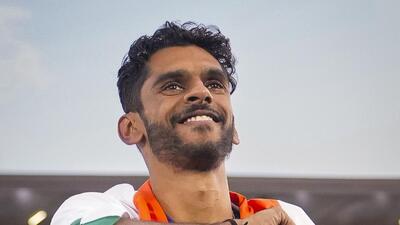
New Delhi: There are two ways to look at a silver medal — a gold lost or a medal won. Long jumper Murali Sreeshankar, who was in pole position on Wednesday night until he was upended in the fourth round, chooses to look at his from a more dispassionate perspective.
“I am happy but not satisfied. I wanted to upgrade my silver from Birmingham 2022 but unfortunately couldn’t do that,” he told reporters in Glasgow. A tired cliche, unless one considers the backdrop.
After a patellar tendon rupture that ended his hopes for the Paris Olympics in 2024 and almost finished his promising career, Sreeshankar tested competitive waters in 2025 before embarking on his first full season post-surgery. He has previously called his comeback “nothing short of a rebirth.” Viewed in that context, his silver — sealed with his second leap of 8.09m — gets some added significance.
Jamaican Tayjay Gayle, with a leap of 8.15m, took the lead on his fourth try, leaving Sreeshankar with three attempts to try for gold. The Indian responded with a foul, 7.94m, and 7.97m.
“Two years back, I didn’t even think I will be here. My technique is still a work in progress and I’ll take this medal as a stepping stone to bigger things. It will give me a lot of confidence ahead of the Asian Games,” he said.
“This year, I was able to train more like a jumper rather than focussing on rehab. I still have my limitations. I can’t train the way I did 2-3 years back. I have to make sure there’s not much load on that (left) knee. I have to focus a lot more on recovery. It’s been challenging as I have to carefully manage my training volume and intensity. To jump with a surgically repaired tendon is not easy. I have three screws in my tendon, there is a wire that goes around my knee cap that holds my tendon together. I have to respect that and train accordingly,” he explained.
Sreeshankar entered the competition on the back of a solid home season that saw him cross 8m in each competition. That was followed by a training stint in Spala, Poland that replicated the cold conditions of Glasgow. Despite that, Sreeshankar said, the conditions were too tough to navigate.
“The stint in Spala helped, but it was quite cold for all the competitors. Competing in India and Glasgow are two complete ends of spectrum. In a place like Bhubaneswar, I don’t really need to warm-up. I just do some mobility, stretches, take 2-3 strides and I am ready. Here, my warm-up lasted three hours including dynamic stretches, mobility, strides,” he said.
“But more than the jump itself, what matters is the medal, and I am glad I could do it.”
Sreeshankar’s father and coach S Murali said the medal was the most significant one of his career. “He came back from an injury that very nearly ended his career. If you look at the big picture, this medal is the most important one of his career.”
Murali also blamed the fast Mondo track of Scotstoun Stadium for messing up Sreeshankar’s run-up. “We trained on a Mondo track in Spala too, but the one here was extra fast,” he said.
“Thanks to that, he started the run-up 90cm behind his usual mark, and he still fouled an attempt by a very thin margin. If not for a foul, that would’ve been an 8.30m-plus leap. He is very close to his best, both physically and technically. I expect him to jump 8.50m within a couple of years,” Murli added.
The father-son duo will head to the Czech Republic in the first week of August to begin their final leg of preparation for the Asian Games.