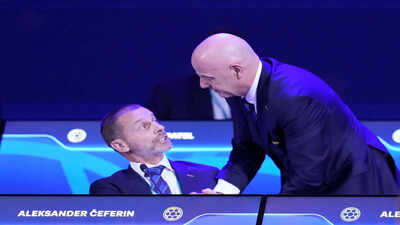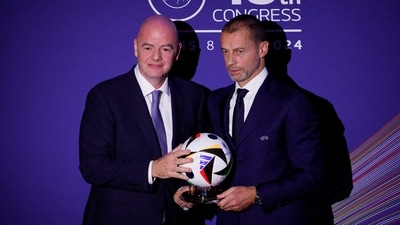
European football has launched an unprecedented rebellion against FIFA, with all 55 UEFA member associations on Thursday agreeing to boycott the World Cup and all other FIFA competitions unless the global governing body abandons its controversial private-investment plans.
The decision was taken during a virtual meeting of UEFA’s national associations, according to a report by The Athletic, marking the strongest challenge yet to FIFA president Gianni Infantino’s vision for the commercial future of world football.
UEFA later confirmed the move, saying its members had “unanimously and unequivocally” rejected FIFA’s proposal to transfer ownership interests in the World Cup and other competitions to private investors.
“As a result of today’s discussion, no UEFA national teams will participate in any FIFA competition for so long as these proposals remain alive, unless this proposal has been abandoned in its entirety and binding assurances have been given that FIFA will never again open its governance or competitions to private ownership,” UEFA said.
The standoff threatens to plunge international football into chaos. European qualifiers for the 2027 FIFA Women’s World Cup in Brazil are scheduled to begin this October, while Europe is also set to co-host the men’s 2030 World Cup in Spain, Portugal and Morocco.
What are FIFA’s new plans?
FIFA unveiled the proposal on Tuesday, outlining plans to create a commercial subsidiary that would manage its flagship competitions, including the FIFA World Cup and Club World Cup.
Under the proposal, private investors would be allowed to acquire minority ownership stakes in the company. FIFA hopes to raise as much as $4.2 billion, valuing the proposed FIFA Forward Enterprise (FFE) at $20 billion.
If approved, the project would provide each of FIFA’s 211 member associations with a one-off payment of $20 million in early 2027, while also increasing their FIFA Forward allocation for the 2027-2030 cycle from $8 million to $20 million.
Infantino described the initiative as a “golden opportunity to turbocharge the development of the game globally.”
UEFA’s scathing response
UEFA responded with a strongly worded 470-word statement, accusing FIFA of putting commercial interests ahead of football’s future.
“The World Cup cannot be treated as an investment product. It is one of football’s greatest sporting legacies. It has been built over generations by players, national teams and supporters across every continent. No part of it should ever be surrendered to private investors. The World Cup is not for sale.”
UEFA warned that allowing external investors into FIFA competitions would fundamentally alter the governance of the sport.
“The moment external investors acquire ownership interests in FIFA competitions, football changes forever. Commercial return becomes a permanent obligation. Investor expectations become a daily pressure. From that moment onwards, every decision on the international calendar, every decision on competition formats and every decision shaping the future of football is no longer driven by what best serves the game, but by what best serves shareholders.”
It added that football’s stakeholders — national associations, leagues, clubs, players and supporters — must never become subordinate to investor returns.
“Football cannot mortgage its future for financial gain.”
The statement concluded with an uncompromising message.
“There are moments when institutions are judged not by what they are prepared to accept, but by what they refuse to compromise. This is one of those moments.
“Some things are simply too important to sell. The FIFA World Cup belongs to football. It always will. And so long as Europe has a voice, it will never be for sale.”
UEFA’s opposition has also found support elsewhere. The Confederation of North, Central America and Caribbean Association Football (CONCACAF) and the Asian Football Confederation (AFC) have both expressed concern that FIFA made the proposal public before fully consulting its 211 member associations, while the Confederation of African Football (CAF) has urged its members to closely examine the proposal before taking a position.