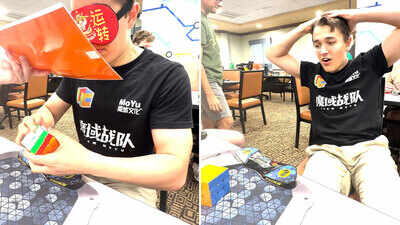
For most people, solving a Rubik’s Cube is already a frustrating challenge. Just getting all six sides to match can take hours of trial and error, countless YouTube tutorials and a great deal of patience. Now imagine doing the same thing without looking at the cube even once.That is exactly what 21-year-old American student Tommy Cherry did when he solved a standard 3×3×3 Rubik’s Cube while blindfolded in an astonishing 11.56 seconds, earning yet another Guinness World Record.His achievement is far more than a display of extraordinary memory. It is a lesson in discipline, deliberate practice, perseverance and the remarkable potential of the human brain. For students preparing for competitive examinations or trying to master difficult subjects, Tommy’s journey offers an inspiring reminder that exceptional performance is built through years of consistent effort rather than overnight talent.
A hobby that began at 11 became a world record journey
Tommy Cherry first solved a Rubik’s Cube on July 30, 2015, when he was around 11 years old.Like many children, he initially approached the colourful puzzle simply out of curiosity. But what started as a pastime quickly became a passion.Within weeks, he entered his first official cubing competition and discovered a world where thousands of enthusiasts constantly challenged themselves to solve cubes faster and more accurately.Instead of treating each competition as the destination, Tommy viewed every event as another opportunity to improve. Year after year, he refined his techniques, analysed mistakes and gradually climbed through local, regional and international rankings.That steady progression eventually transformed a school-age hobby into multiple Guinness World Records.
Breaking his own records again and again
Tommy first entered the Guinness World Records book in 2021, solving the cube blindfolded in 15.27 seconds.Most record holders celebrate once and move on.Tommy chose a different path.Rather than protecting his achievement, he kept trying to outperform himself.Since then, he has repeatedly improved his own world record, proving that real competition is often with yesterday’s version of yourself.His latest achievement—11.56 seconds, recorded on June 28—represents years of continuous refinement rather than one extraordinary day.Interestingly, the record has also changed hands several times between Tommy and Australian cuber Charlie Eggins, creating one of speedcubing’s most exciting rivalries.Instead of discouraging him, healthy competition pushed Tommy to practise even harder.
How do you solve a Rubik’s Cube without seeing it?
Blindfolded speedcubing is one of the most demanding events recognised by the World Cube Association.Before putting on the blindfold, competitors study the scrambled cube for a limited time.During those few seconds, they mentally memorise the position of every coloured piece and create a sequence of moves required to solve it.Once the blindfold is on, everything depends on memory, concentration and flawless execution.One incorrect move can ruin the entire attempt.Tommy taught himself this remarkable skill by watching online tutorials and then spending countless hours practising until the sequences became second nature.Today, he can solve a cube without a blindfold in an average of around seven seconds, while his fastest official competition solve stands at 4.53 seconds.
Learning through failure, one competition at a time
Tommy admits he did not become one of the world’s best overnight.His improvement came through years of gradual progress.He first began winning local competitions.Then regional events.Later, he reached national finals.Eventually, he entered the world’s top ten before finally becoming a Guinness World Record holder.Each stage demanded greater precision, stronger mental discipline and longer hours of focused practice.Reflecting on his latest achievement, Tommy said the victory was rewarding not because of recognition alone but because it proved that years of hard work had finally paid off.For students, the lesson is strikingly familiar.Whether preparing for JEE, NEET, UPSC, GATE or board examinations, success usually arrives after numerous mock tests, mistakes, revisions and setbacks rather than a single perfect performance.
A student, entrepreneur and coach
Despite holding world records, Tommy continues pursuing his undergraduate education.Alongside his studies, he runs the Tommy Cherry Coaching Company, where he teaches speedcubing to learners ranging from complete beginners to advanced competitors.He also regularly uploads educational videos explaining cubing strategies and documenting his own progress, showing that learning becomes even more meaningful when shared with others.His journey demonstrates that expertise is not only about mastering a skill but also about helping others improve.
The human brain is capable of more than we imagine
Tommy has never limited himself to conventional solving methods.Over the years, he has successfully solved Rubik’s Cubes using one hand, one foot, blindfolded with one hand, and even blindfolded using his feet.He also experiments with collaborative blindfolded challenges where partners communicate through carefully designed physical signals instead of spoken instructions.These unusual challenges highlight an important truth about learning.Once the brain masters one skill, it becomes capable of adapting to increasingly complex variations through sustained practice.
Lessons every student can take from Tommy Cherry
Tommy’s story extends far beyond Rubik’s Cubes.It illustrates several principles that apply equally to academics and life:• Great achievements often begin as simple hobbies.• Consistent practice beats natural talent in the long run.• Healthy competition encourages continuous improvement.• Every failed attempt provides valuable feedback.• Mastery comes from patience, discipline and repetition.Most importantly, Tommy reminds students that extraordinary abilities are rarely inborn. They are developed through years of focused effort, curiosity and resilience.An 11-year-old who simply wanted to learn a puzzle eventually became one of the fastest blindfolded cubers in history—not because he was gifted from the beginning, but because he never stopped improving.For every student chasing a difficult goal, that may be the most valuable lesson of all.Disclaimer: This article is based on information shared by Guinness World Records and is intended for educational and inspirational purposes.