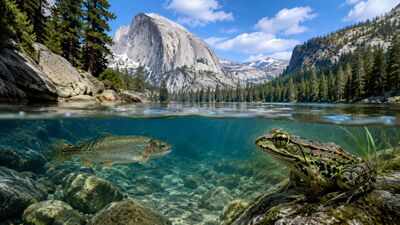
For more than a century, Yosemite’s mountain lakes became home to millions of trout that had never naturally reached those waters. Fish stocking began in 1877 and eventually put more than 33 million fish into the park, transforming habitats that had evolved without aquatic predators. The change came at a cost for the Sierra Nevada yellow-legged frog, whose eggs and young were vulnerable to introduced trout. The frog later faced another threat from a deadly fungal disease, and by the mid-2000s it had disappeared from more than 93% of its former range.As reported by the National Parks Conservation Association (NPCA), now, decades of conservation work are producing a different picture. A 20-year record of more than 7,000 surveys found that Yosemite’s yellow-legged frog population had increased sevenfold, with fish removal and signs of greater tolerance to the fungus both offering possible explanations.
How Yosemite fish stocking brought trout into the yellow-legged frog’s habitat
Before large-scale stocking began, steep waterfalls and other natural barriers kept fish from reaching many of Yosemite’s high-elevation lakes and streams. The isolation was not accidental. It had shaped an unusual aquatic environment in which native amphibians, including the Sierra Nevada yellow-legged frog, lived without the trout that later entered their habitat.As reported by NPCA, in 1877 trout were first recorded as being introduced into Yosemite waters. What began as a small-scale effort eventually became a major stocking programme. Over roughly the next century, the National Park Service estimated that more than 33 million fish were placed in Yosemite, with later releases carried out on a much larger scale, including from aircraft.The ecological consequences were not immediately understood. The mountain lakes had few places where young frogs could disappear from view. Clear water left little cover, while the fish were efficient predators. As trout became established, they added a threat that the frogs had never previously needed to deal with.The effect was eventually recognised. Fish stocking in Yosemite was formally stopped in 1991, but ending new releases did not remove the populations already living in the lakes.
How Yosemite’s fish-free lakes are helping yellow-legged frogs return
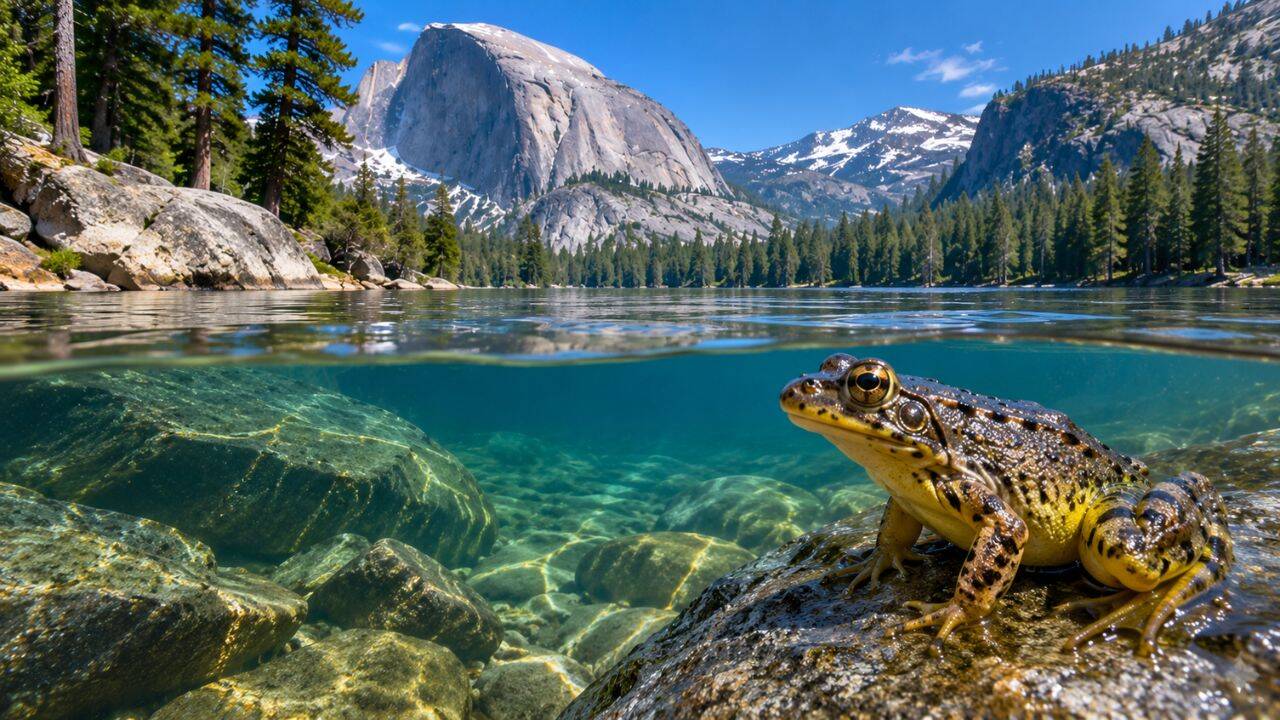
The Sierra Nevada yellow-legged frog is closely tied to the cold mountain waters of the Sierra Nevada. Its habitat includes lakes, ponds and streams at high elevations, where conditions can be difficult for many other amphibians.Introducing trout changed the balance. Fish could eat frog eggs, tadpoles and young frogs, leaving populations in stocked lakes substantially different from those in waters that had remained naturally fishless.That distinction later became useful for conservation work. Beginning in the mid-2000s, biologists and volunteers started removing non-native fish from selected Yosemite lakes and other waters in the Sierra Nevada. Gill nets were used in some locations, while electrofishing provided another way of reaching fish in suitable habitats. The work is slow. A lake can require repeated treatment, and the Park Service may need several years without detecting fish before declaring a population gone. An empty net, then, is not necessarily a disappointing result.At Budd Lake, students taking part in environmental education programmes have helped with the effort. They sometimes spend hours working around the lake without finding a trout. For the frog, that is exactly the outcome conservation teams want.
Fungus adds to the frog’s growing threats
Removing fish addressed one major pressure, but it could not explain the entire collapse of the frogs. A fungal pathogen known as Batrachochytrium dendrobatidis, or Bd, became another serious problem. It causes chytridiomycosis, a disease that damages the skin of amphibians. Because frogs use their skin for important functions including water and electrolyte regulation, infection can be fatal.The disease has affected amphibian populations in many parts of the world and has been linked to severe declines and extinctions. Scientists believe Bd reached Yosemite Valley during the 1970s, although the precise route by which it arrived remains uncertain.Its presence made the frog’s decline particularly difficult to reverse. Even where predators could be removed, the disease remained in the environment.
The frog disappeared from most of its former range
By the middle of the 2000s, the Sierra Nevada yellow-legged frog had vanished from more than 93% of the area it had once occupied. The decline was severe enough for the species to be listed under the US Endangered Species Act in 2014.The causes did not exist in isolation. Non-native trout were consuming frogs in lakes where fish had been introduced. Bd was killing infected amphibians. Habitat changes and exposure to pollutants were also considered possible contributors to the wider decline. For a species already restricted to mountain environments, losing so much of its range left relatively little room for recovery.
Frog numbers began rising again
A long-term survey provided an unexpected picture of what was happening in Yosemite. Roland Knapp of the University of California’s Sierra Nevada Aquatic Research Laboratory and colleagues examined more than 7,000 frog surveys collected over two decades.The records showed that Yosemite’s yellow-legged frog population had increased roughly sevenfold during the study period. The recovery was not confined to places where the fungus had disappeared. Bd remained present, yet many frog populations were no longer being affected by the disease at the same rate.That raises a question scientists have not completely resolved. The frogs may be developing greater resistance to the pathogen, or individuals with greater natural resistance may be surviving and producing more offspring. It is also possible that several factors are working together.Fish removal appears to have played a role in some lakes. Where introduced fish populations disappeared, frog numbers in certain cases returned to levels comparable with lakes that had never been stocked.
A recovery that is still being watched
The return of frogs does not mean the conservation problem has disappeared. Bd is still present, introduced fish remain in some waters and the species continues to face the pressures associated with a restricted mountain habitat.What has changed is the direction of the population in parts of Yosemite. After decades of decline, the frog is occupying lakes where conservation measures have reduced one of its most direct threats, while populations elsewhere appear to be coping better with a disease that once caused severe losses.Scientists are still trying to separate the effects of fish removal from the frogs’ apparent response to the fungus. That distinction matters because the answer could shape how other threatened amphibian populations are managed.