
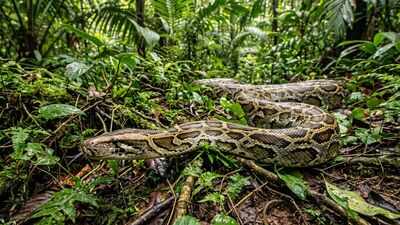
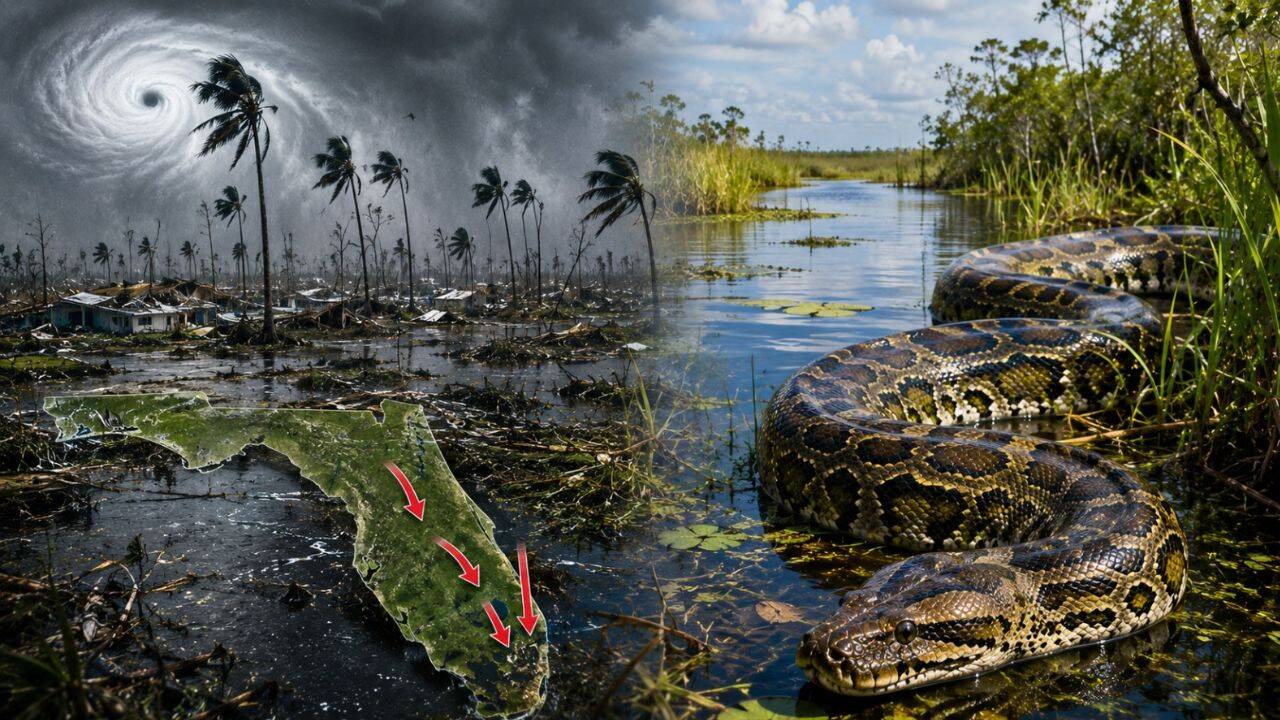
For decades, Florida’s Everglades have faced a silent invasion unfolding beneath the dense vegetation and winding waterways. What began with the arrival of Burmese pythons through the exotic pet trade has become one of the most significant wildlife challenges in the United States. The turning point came around 1992, when Hurricane Andrew damaged facilities in South Florida and may have helped release snakes into the wild. Since then, these giant predators have adapted to the warm, wet environment of the Everglades, growing in numbers and reshaping the natural balance. With few predators capable of controlling them, Burmese pythons have preyed on native mammals, birds and other wildlife. Scientists and officials continue to search for solutions as the invasive snakes remain deeply established in one of America’s most unique ecosystems.
How Hurricane Andrew helped reshape Florida’s python invasion
The Burmese python is a native of Southeast Asia and can be found in forests, grasslands, and wetlands. The large size and distinct features of the python made it very popular in the exotic pet trade in America in the 1980s as people wanted to keep unique animals as pets. South Florida presented an ideal habitat for the snake due to its tropical climate and abundance of wetlands. Many Burmese pythons were brought into South Florida in the exotic pet trade. Some escaped from captivity while some were purposely released by their owners.While there is no certain date for when the Everglades population became firmly established, the most commonly cited one is associated with Hurricane Andrew in 1992. The hurricane caused severe damage to a local reptile breeding establishment and some of the snakes managed to escape. At the time when researchers started noticing the phenomenon, the pythons had already been reproducing in the wetlands.The Everglades offered almost everything the snakes needed: warm temperatures, dense vegetation, plentiful prey and few threats from other animals.
The invasive snake that reshaped one of America’s most fragile ecosystems
Adult Burmese pythons can grow more than 15 feet long, with some individuals reaching even greater lengths. They are ambush hunters, relying on camouflage and patience rather than speed. A python may remain hidden for hours before striking when an animal comes close.In the Everglades, native mammals had little experience with such a large snake. Animals that evolved alongside smaller predators were suddenly exposed to a new type of hunter.The impact became especially visible among small and medium-sized mammals. Populations of raccoons, opossums and bobcats declined sharply in areas where python numbers increased. Rabbits and foxes became far less common, with some species nearly disappearing from parts of their former range.The snakes have also been found feeding on a wide variety of wildlife, including birds and larger animals such as deer. Their flexible jaws allow them to swallow prey much larger than their heads, making the python an unusually adaptable predator.
Why Burmese python populations in the Everglades remain a mystery
Estimating the number of Burmese pythons living in the Everglades has always been difficult. The wetlands cover a huge area, much of which is difficult for people to access. The snakes’ brown and patterned skin helps them disappear among fallen vegetation, muddy water and dense plants.Officials and wildlife experts have suggested that the population could number in the tens of thousands, although the true figure remains unknown. Traditional wildlife surveys are not especially effective because pythons spend much of their time concealed.The difficulty of finding them has made controlling their spread a slow process. A person can walk through a python habitat and never realise a large snake is nearby.
Attempts to remove the invasive snakes
Florida authorities began taking stronger action as evidence of the ecological damage grew. In 2010, the state proposed to ban private ownership of Burmese pythons and several other large constrictor species. And later in 2012, listing was finalised with four species: Burmese python, yellow anaconda, and northern and southern African pythons, as reported by the US Fish & Wildlife Service.Later, wildlife agencies introduced organised removal programmes that paid trained hunters to search for and capture snakes in the Everglades. These python removal agents patrol areas where snakes are known to live, often spending long hours looking through difficult terrain.The state has also held special python hunting competitions, offering rewards for people who capture the reptiles. Thousands of snakes have been removed through these efforts, but the number represents only a portion of the wider population.Removing female pythons is considered particularly important because a single female can produce dozens of eggs each year. Each captured breeding female represents fewer future snakes entering the ecosystem.
Searching for new ways to control the species
Traditional removal methods have helped reduce local numbers in some areas, but completely eliminating Burmese pythons from the Everglades remains extremely difficult. The landscape itself works in the snake’s favour, providing countless hiding places and a steady supply of food.Scientists have explored other approaches, including the use of trained dogs to detect snakes and advanced genetic techniques aimed at reducing reproduction. Some genetic strategies being studied in other invasive species involve altering inherited traits so populations decline over generations. Such methods remain experimental and would require careful testing before they could ever be considered for use in the wild.For now, the Burmese python remains part of the Everglades landscape. The challenge is no longer simply removing a few escaped animals. It is managing a predator that has adapted to one of America’s most complex and fragile ecosystems.