He says current market pricing for the US Federal Reserve appears reasonable given economic growth, above-target inflation and large fiscal stimulus, while a strong jobs print could weigh on global equities by reducing the Fed’s justification for remaining on hold.
Mowat says rising risk-free rates are emerging as a key headwind for equities, particularly emerging markets that require external funding. Global bond yields could move back towards pre-quantitative easing levels, which could put more pressure on stocks, real estate and infrastructure.
This is an edited transcript of the interview.
Q: Since we last spoke, which was, I think, in early July, about a month back, the April-June quarter of 2026 (Q1FY27) earnings picture from India looked a lot better. Yesterday’s gross domestic product (GDP) print was strong, but there are global headwinds that we’re dealing with: rising oil, risk, US 10-year yield, and as a result, the Indian index continues to consolidate. Sitting where you are, paint a picture for emerging markets and India in particular.
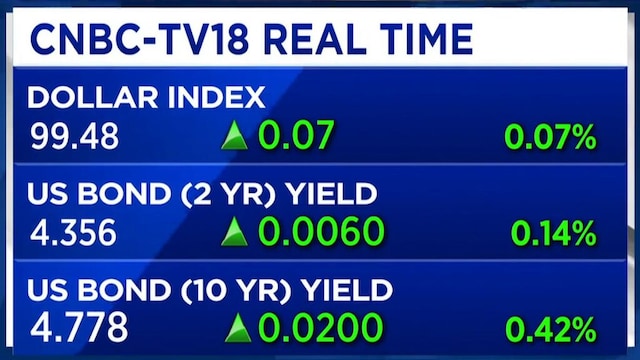
A: The most important thing that’s going on is the price of money, your risk-free rates. You (CNBC US) had the interview with Treasury Secretary Bessent, looking at what’s happening in the US bond market, but all bond markets are seeing rising yields.
And I think at this point, rather than get caught up in very short-term moves, we should step back and think about the world that we had in place pre the global financial crisis, pre-quantitative easing, zero interest-rate policy. Back then, the median yield curve, the median difference between 10-year bond yields and three months, was 1.55%.
So today, Secured Overnight Financing Rate (SOFR), which is the benchmark for three-month in the US, is about 3.6%. So, a median price for US 10-year bonds is probably closer to 5.3%, so still quite a bit higher than where we are at the moment at 4.7%.
And I think we’re in this period going back to what is a normal price for long-term money, and that’s causing a fair amount of discomfort. It’s causing discomfort at many levels for the US Treasury Secretary. They have $40 trillion worth of debt, running a 6-plus percent fiscal deficit in an economy that’s very strong.
And I think, as I look at this, the market actually should be demanding a yield curve that’s steeper than the median yield curve when you start to think through policy uncertainty, the level of the debt, the level of the fiscal deficit, the fact that the central bank is still struggling with inflation that’s well above target.
So, let’s put this back in markets. Rising interest rates, rising risk-free rates are generally a tough environment for equities, tend to be a tougher environment for emerging market equities, which, particularly if the emerging market runs a current account deficit, does require external funding.
So, I think this is an important headwind. But there are bigger implications beyond emerging markets, which I think people are underappreciating.
As the yield curve normalises, and when I talk about normalising, it’s normalising to pre-very unusual monetary policy, and the risk-free rate therefore rises, then things like real estate become under significant pressure, as do other fixed assets like infrastructure.
And so, I think there’s this ongoing squeeze here that we should be conscious of. So, it does mean that things like the US economy, which does look robust in terms of headline figures, but it’s quite narrow in terms of what’s been driving it, particularly the artificial intelligence (AI) data center spend.
When we look at the household sector, the household sector is struggling with real estate in that they can’t afford to move because the repricing of long-dated mortgages is too expensive for them to move.
I think we’re seeing real weakness in European real estate, particularly in places like London. So, there’s this sort of pressure coming in because of what’s happening in the bond market.
And it’s back to if risk-free rates go up, it tends to be a headwind for risk assets.
Q: For emerging market space, I mean India, etc., are there any implications of what you’re describing, the setup you’re describing?
A: There are implications, because, you know, India does run a current account deficit, does require external funding. So, there’s implications.
Now the Indian yield curve is sitting well above the US yield curve, so there’s already a premium there. Actually, if you look at the difference between the Indian 10-year versus 3-month, it does come out at about 1.55%, so maybe the curve is correct at this point in time.
But I see it as continuing this story of 2026, when you’ve seen outflows from FIIs. I just don’t see anything at this point in time changing that.
Q: It’s a big data week as well in the United States. Do you think what will be best suited for global equity markets is that we get a very soft print coming in with regard to the jobs data? Because as of now, the fear is that the probability of getting a hike in the coming meeting has moved up to 65%. Do you think a hike’s coming?
A: I think the market’s pricing seems reasonable based upon the level of economic growth, inflation being above targets, fiscal stimulus, which is very large in terms of fiscal deficit.
Watch the full conversation here

So, I think the market’s reasonable in pricing that. The labour market data has been mixed, and perhaps, as you allude to, if we have a weak print, then that will allow the Fed to remain on hold.
I think if we have a strong print, then the market will go down on that news because it would remove a good excuse for remaining on hold for the Federal Reserve.
Catch all the latest updates from the stock market here