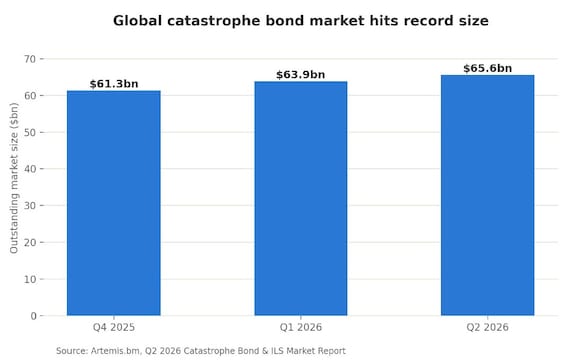
Investors, meanwhile, have been willing buyers. A Morningstar study found that catastrophe bond and insurance-linked securities (ILS) funds have pulled in $10.2 billion in new money over the past three years. The attraction is unusual: investors can earn high returns by taking on the risk of disasters that have little connection to what happens in stock or bond markets.
“Catastrophe bonds have so far delivered on their core promise of providing returns that are driven by catastrophe risk rather than traditional market or macroeconomic factors,” said Mara Dobrescu, senior principal and manager of research at Morningstar.
So how does an investor make money by taking on hurricane or earthquake risk?
A catastrophe bond is essentially a hybrid of an insurance contract and a bond. An insurer, reinsurer or even a government sets one up to protect itself against a specific disaster, say, a hurricane or an earthquake. Investors buy the bond and hand over cash upfront. In return, they earn a high interest rate for the bond’s term, usually three to five years.
If the disaster doesn’t happen, investors get their principal back, plus interest. If it does and losses cross a pre-agreed threshold, that principal is used to pay disaster claims instead, and investors can lose some or all of their money.
Cat bonds are built for institutional money — pension funds, hedge funds, sovereign wealth funds and specialist ILS managers. Their appeal is that returns don’t move with stocks or interest rates; a hurricane in Florida has nothing to do with the Nifty or the Dow, making cat bonds a useful diversification tool.
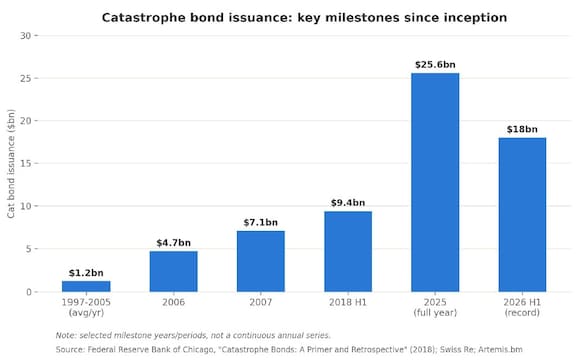
The market traces its roots to 1992’s Hurricane Andrew, which caused $27 billion in damage and pushed several US insurers into failure. To pull fresh capital into the industry, insurers created the first cat bonds in 1997. Hurricane Katrina and the 2008 financial crisis were both turning points, leading to today’s record market size.
The US, especially California and Florida, remains the dominant market, but the geography is expanding. This May, the Asian Development Bank issued its first-ever cat bonds, worth $160 million, to protect the Kyrgyz Republic and Tajikistan against earthquakes and extreme rainfall.
“When a major earthquake or flood strikes, it can set back development by years,” said ADB Vice-President Roberta Casali in a report published on May 3, 2026.
India has no cat bonds of its own yet, but the idea is gaining ground at the state level. Kerala has asked the Centre to consider issuing catastrophe bonds as part of its wish list for the Union Budget 2026-27, arguing that no state can easily raise more than ₹2,000 crore at short notice for disaster relief. Right now, that entire burden falls on state and central government budgets — money that could otherwise go to other programmes.
The case for India is strong. Kerala — hit by back-to-back floods in 2018 and 2019 and the 2024 Wayanad landslides — is far from alone: Odisha and the eastern coast face recurring cyclones, the Himalayan states face earthquake and flash-flood risks, and India’s 7,500-km coastline is increasingly exposed to erosion and storm surges.
Cat bonds could give these regions faster, ring-fenced funding after a disaster instead of waiting for budget reallocations. Countries such as Mexico and the Philippines already use them this way.
Looking ahead, wildfire-linked cat bonds are now the fastest-growing corner of the market, with issuance topping $5 billion this year alone as Europe, not just California, starts weighing similar deals.