
The changes matter because insurance distribution has become an important source of fee income for some lenders, especially NBFCs. The impact could therefore vary significantly across lenders, with those more dependent on credit-life insurance facing greater pressure on earnings if the proposals are implemented in their current form.
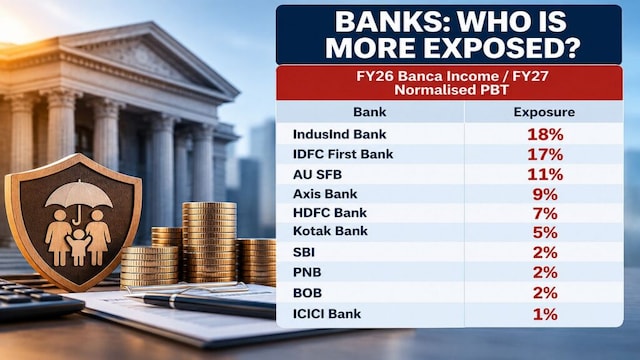
| WHO IS MORE EXPOSED? | |
| FY26 Banca Income / FY27 Normalised PBT | |
| Bank Name | Exposure % |
| IndusInd Bank | 18% |
| IDFC First Bank | 17% |
| AU SFB | 11% |
| Axis Bank | 9% |
| HDFC Bank | 7% |
| Kotak Bank | 5% |
| SBI | 2% |
| PNB | 2% |
| BOB | 2% |
| ICICI Bank | 1% |
| Source: Jefferies |
Why is insurance regulation a concern for lenders?
The answer lies in a business that many banks and NBFCs have built alongside lending — selling insurance.
When a bank or NBFC sells an insurance policy, it earns a commission from the insurer. This becomes particularly important when insurance is sold along with a loan. One such product is credit-life insurance, which covers a borrower’s outstanding loan in case of death.
Insurance distribution has therefore become a meaningful source of income for some lenders, making any change in commissions important for their earnings.
What is IRDAI proposing?
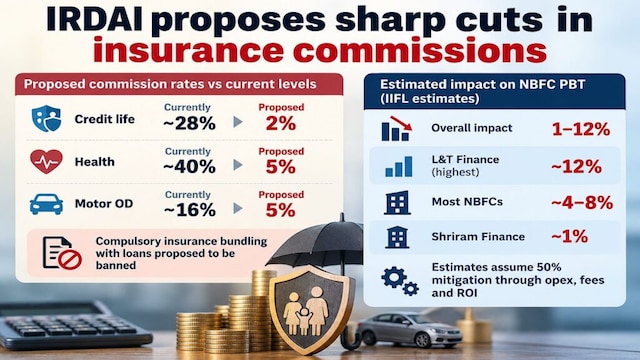
The IRDAI is proposing lower commissions on loan-linked insurance. It has also proposed that lenders should not be allowed to make buying insurance a condition for getting a loan.
The issue has become more significant as group credit-life payouts have risen sharply, from around 5% in 2022-23 (FY23) to roughly 45% in 2024-25 (FY25).
For lenders, the proposed changes could create pressure on both sides. Lower commissions could reduce income from insurance, while restrictions on bundling insurance with loans could reduce the number of policies sold.
IRDAI is also reviewing incentives under the bancassurance model, where banks distribute insurance products for insurers. Banks with multiple insurer tie-ups had average payouts of around 33%, with some reaching as high as 72%, compared with 13% for banks with a single tie-up. The regulator also wants to restrict volume-linked incentives for bank and NBFC employees selling insurance.
Why are NBFCs more exposed than banks?
The impact will vary significantly across lenders.
Among PSU banks, the exposure appears relatively low. Jefferies estimates bancassurance income as a percentage of 2025-26 (FY26) income compared with 2026-27 (FY27) normalised profit before tax (PBT) at around 2% for State Bank of India (SBI), Punjab National Bank (PNB) and Bank of Baroda (BoB), and 1% for ICICI Bank.
The exposure is higher among some private banks — around 7% for HDFC Bank, 9% for Axis Bank, 11% for AU Small Finance Bank, 17% for IDFC First Bank and 18% for IndusInd Bank.
The pressure becomes more significant for NBFCs because insurance distribution is closely linked to their lending business. Around 93% of the life-insurance business sourced through NBFCs is credit life.
Which lenders could feel the impact?
JM Financial estimates insurance distribution income at around 26% of FY26 PBT for L&T Finance, followed by Poonawalla at 17.8%, Chola at 15.5%, and HDB Financial and M&M Financial at 13.4% each.
This makes L&T Finance one of the more exposed lenders. Macquarie has also flagged the company because credit-life insurance has become a meaningful contributor to its fee income.
The stock fell as much as around 10% intraday as financial stocks came under pressure.
How much could earnings be affected?
Viral Shah, Senior VP, IIFL Capital, said the proposed cuts are particularly steep for credit-life insurance.
“The extent of cuts that have actually come through, nearly 90% in case of a credit life or say in case of a motor, it’s almost 70% kind of a cut versus where the industry average is in terms of the commissions, that definitely is fairly steep,” Shah said.
Among NBFCs, Shah estimates L&T Finance has the highest exposure, with insurance commission income accounting for nearly 26% of pre-tax profit. Chola follows at around 16%, while most other NBFCs are in the 10-15% range. Shriram Finance is among the least exposed, at around 2.5%.
However, NBFCs have some levers to absorb the impact. These include associated costs, such as employee incentives, and better monetisation of insurance products.
Shah estimates that if lenders can mitigate around 50% of the impact, L&T Finance could still see a hit of around 12% to PAT, while the impact for most other NBFCs could be in the 3-5% range.
Watch the full conversation here

What happens next?
The proposed rules are not final yet. The IRDAI paper is still under consultation, so the eventual impact will depend on the final commission structure and how lenders adjust their business models.
Shah also expects some of the proposed norms could be softened before they become final. Meanwhile, IIFL Capital’s preferred large-cap names in the space are Shriram Finance, Tata Capital and Cholamandalam Finance, while PNB Housing and Five-Star Finance are its preferred small and mid-cap names.
Catch all the latest updates from the stock market here