
While a few companies coming off a weak base could see some acceleration in growth, he believes most firms, including those that provide annual guidance, are likely to witness a moderation in revenue growth.
The brokerage believes the weakness that emerged in March has continued through April and May, affecting deal signings and delaying the conversion of existing contracts into revenue.
Rudra added, “The first quarter is very critical for incremental new business signups and ramp ups, and beginning on a soft note makes it very difficult for the year to be strong. We think that expectations of growth will be lower by half percent to 1% for the for the first quarter, and it sets up for a somewhat weak year.”
Client hesitation has emerged as a major factor behind the slowdown. Businesses are taking longer to make spending decisions amid geopolitical tensions and an uncertain global economic environment. Delays in ramping up previously signed contracts have also hurt revenue visibility.
Apart from macro concerns, the rapid evolution of artificial intelligence is creating another layer of uncertainty. Enterprises are still figuring out how to adopt AI technologies effectively, while new models and tools continue to emerge at a rapid pace.
Rudra noted that the slowdown is visible across most largecap IT companies, with no clear pockets of strength. However, some midcap firms could continue to grow faster, helped by their ability to pursue contracts more aggressively and adapt more quickly to changing customer requirements.
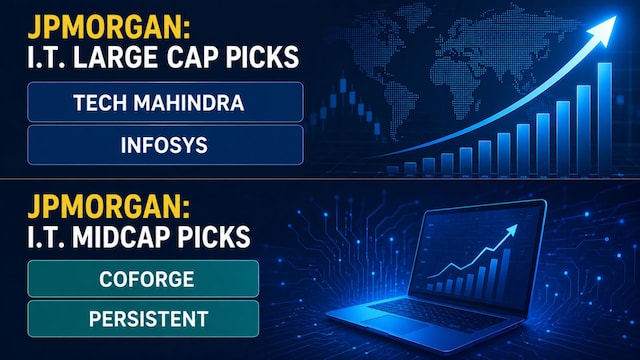
JPMorgan currently prefers a barbell strategy, favouring companies at the lower end of the valuation spectrum, where expectations are already subdued, and faster-growing midcap players.
For the entire discussion, watch the accompanying video
