
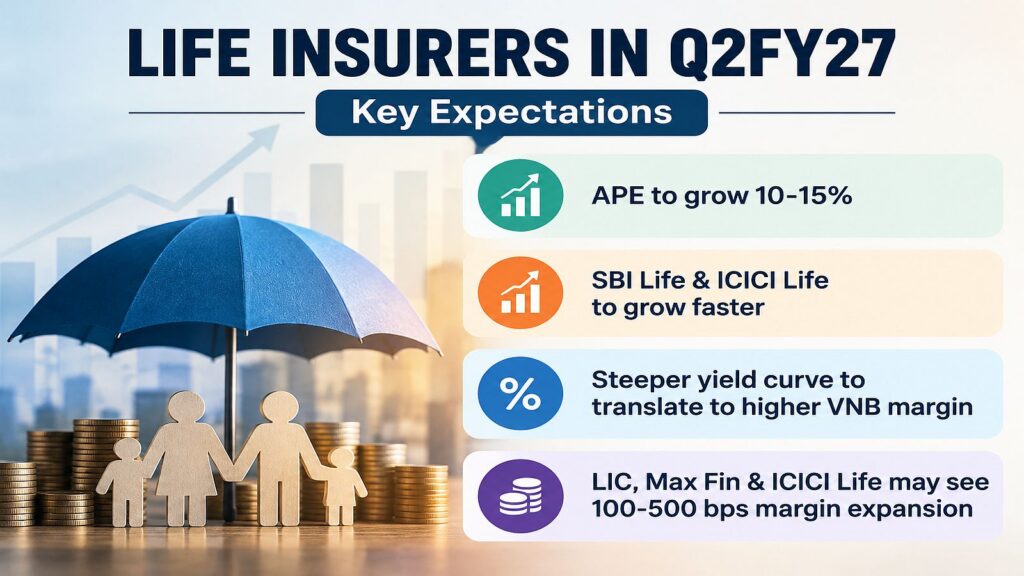
India’s life insurance sector is expected to post a 10-15% growth in annualised premium equivalent (APE) for the July-September quarter of 2026 (Q2FY27), even as the industry braces for the Insurance Regulatory and Development Authority of India’s (IRDAI) draft distribution paper. While the proposed regulations are expected to severely impact distributors by delaying profits, insurers that already meet expense management guidelines will likely see minimal disruption, according to Supratim Datta, Vice President at Jefferies India.
SBI Life Insurance Company and ICICI Life Insurance Company are projected to outpace the industry in APE growth. A steeper yield curve is anticipated to benefit life insurers, driving value of new business (VNB) margin expansion across the board.
Life Insurance Corporation of India (LIC), Max Financial Services, and ICICI Life could see margins expand between 100 and 500 basis points. Specifically, ICICI Life’s APE could double due to 100% growth in its group business, alongside a 22% VNB growth and a 200-basis-point margin expansion.
LIC is expected to report a 5% APE growth and a 45% surge in VNB, driven by a better product mix, potentially expanding margins by 600 basis points. Max Financial Services is looking at a 6% APE growth and a 100-basis-point margin expansion.
Conversely, HDFC Life Insurance Company is estimated to post a 13% APE growth and 9% VNB growth, but may face a margin contraction of 9 basis points. SBI Life is expected to see a 6% APE growth and a 9-basis-point margin expansion.
In the general insurance space, health insurers are expected to grow between 18% and 29%, aided by goods and services tax (GST) waiver tailwinds. However, multi-line insurers could see premium growth decline by 1-2%. ICICI Lombard General Insurance Company‘s premium growth is expected to decline by 2%, with its combined ratio rising 90 basis points to 106 from 105.1. Go Digit General Insurance is projected to see a 1% premium reduction and a 200-basis-point increase in its combined ratio to 113.4 from 111.4.
PB Fintech is expected to report a 36% premium growth and a 31% revenue increase, with adjusted earnings before interest, taxes, depreciation, and amortisation (EBITDA) margins expanding 150 basis points to 11%, as the IRDAI consultation paper will not impact the current quarter.
Datta categorised the sector into three baskets regarding the draft paper: companies already meeting expense of management (EoM) guidelines, those that do not and will require a five-year glide path, and distributors.
“I think within this entire pack, distributors get more impacted because there is a commission deflation that will happen there,” Datta said, noting that projected profits for 2027-28 (FY28) could be pushed out by two to three years. However, he drew a parallel to the mutual fund industry’s shift to trail commissions, where large distributors endured a temporary profit decline before emerging larger through consolidation.
For insurers missing the expenses of management (EoM) guidelines, the primary risk is a slowdown in growth. Yet, Datta pushed back against expectations of a broad industry decline, noting that unit-linked insurance plans (ULIPs) sold through bancassurance channels will not see significant commission changes. Products likely to be affected include term insurance, credit life, and health insurance attachment plans.
When identifying potential winners, Datta emphasised the importance of strong in-house agency networks and bank partners. He noted that insurers operating in an open architecture framework within banks have an opportunity to win market share, as the incentive to sell third-party plans diminishes when all players pay similar commissions.
Watch the full video here

Life insurers may see 10-15% growth in Q2FY27; Jefferies flags IRDAI rules risk for distributors
He also expects regulatory benefits to be passed on to consumers rather than retained entirely by insurers, given the highly competitive market. In health insurance, lower premiums could accelerate new business growth, which carries a positive impact on loss ratios since new policies typically see 30-40% loss ratios during the initial compulsory waiting period.
Catch all the latest updates from the stock market here
NOTE TO READERS
The views and tips expressed by investment experts on CNBCTV18.com are their own, not of the website or its management. CNBCTV18.com advises users to check with certified experts before taking any investment decisions.