
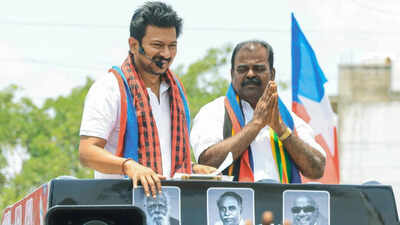
It is a piece of cloth, a gesture of respect among Tamil people. But over the years, the melthundu — ‘mel’ meaning upper, ‘thundu’ meaning cloth — has come to mean much more than that. Forbidden at one point for particular communities, later reclaimed as a mark of protest, and now reimagined in party colours, the simple shoulder cloth has become central to the political culture of Tamil Nadu.Netas across parties, from DMK chief M K Stalin to ADMK’s Edappadi K Palaniswami, have lately been sporting chequered thundus in party colours, a change from the more familiar stripes. But this is not the first time the shoulder cloth has made a political statement.
The first major moment of the thundu springing to the centre of politics and identity in Tamil Nadu was in 1924, during a nadaswaram performance that was attended by Periyar E V Ramasamy, pioneer of the Self-Respect Movement. In those days, people from lower castes were prohibited from wearing a shawl or cloth over their shoulders; only people from dominant castes were allowed to do so.At the event, a musician removed the towel from around his waist, wiped his face and placed the cloth on his shoulder. The host of the event, from a dominant caste, objected, saying someone from a “lower caste” should not wear the thundu on the shoulder. After this, Periyar introduced the practice of placing a shawl on people’s shoulders during functions as a symbol of dignity. Periyar’s followers also began wearing the melthundu as a political statement. “Periyar turned the thundu into a symbol of equality. It became a way of saying, ‘You are my fellow human being’,” says Tamil writer Olivannan G.“Since then, Dravidian politicians began to insist that those on stage drape the thundu over the shoulder, as a way of rejecting caste hierarchies,” says advocate V Kannadasan. “It began as a social equaliser and evolved into a way for leaders to create their political image.”That evolution was visible in the styles adopted by different politicians. DMK founder C N Annadurai always wore a long white shawl. Former DMK chief M Karunanidhi first wore a white one, then switched to yellow. MDMK founder Vaiko became known for his black thundu, worn as a mark of protest over issues linked to the Tamil Eelam (during the Sri Lankan Civil War).“Clothing is considered to be one of the major tools that Dravidian parties have used in politics. Veshti-shirt and melthundu are worn as traditional Tamil male attire,” says political anthropologist Nisar Kannangara. “That’s why PM Modi always wears one when campaigning in Tamil Nadu. He wore it during his 2019 meeting with Chinese President Xi Jinping in the state to appeal to Tamil sentiments.”In the 1970s, the thundu was used as a cinematic device. Actor and ADMK founder M G Ramachandran, who rarely wore the shoulder cloth himself and instead cultivated a trademark image with dark glasses and a fur hat, used the thundu in films such as ‘Idhayakkani’, supposedly to caricature Karunanidhi, his DMK rival. The films featured characters wearing long shawls and delivering verbose dialogue, says political science professor Subramaniam Chandran in a paper published in 2023.However, fashion designer Purushu Arie, who traces the evolution of political attire, says, “Distinctions are now emerging. Sometimes, within parties, simpler cotton towels are meant for cadres, while silk shawls are reserved for seniors. Ironically, the cloth meant to erase hierarchy seems to be recreating it.”In recent years, most party members in the state stopped wearing the thundu regularly. But in the run-up to the 2026 polls, the melthundu has made a comeback. This time, it is less about symbolism and more about branding and standing out in the crowd.“We wanted to try a new design,” says a DMK source, referring to the black-and-red checked thundu that has made its debut. “The strategy team first used the chequered thundu in a party engagement programme with hamlet secretaries. It caught on and, this time, most workers and seniors decided to wear it instead of the usual striped one.”
Chequered history
White to yellow
In 1989, on his return to office, M Karunanidhi was presented with a yellow shawl by Pattali Makkal Katchi (PMK) founder S Ramadoss, denoting the Vanniyar flag to honour his 20% reservation policy for the community. He wore this yellow shawl for decades as part of his trademark style, along with his dark glasses. He later gave various explanations for it, including comparison to Buddha’s yellow angavastram.
In Karnataka, ‘political fixer’s’ uniform
In a 2000 article in Asian Survey, political scientist James Manor says the phrase “towel over armpit” was used to describe small-time political fixers in Karnataka — intermediaries who moved between villages and govt offices, wielding “informal power”. Though often parodied, Manor says they play an important role in elections in most southern states.
When Prabhakaran refused the thundu
In a 2011 article in the journal Sanglap, Swarnavel Eswaran Pillai, professor at Michigan State University, says there was pressure from the West on LTTE leader Velupillai Prabhakaran to abandon his guerrilla fatigues for a modern “coat-suit attire” or the “traditional white veshti– thundu” so he could present a more “acceptable” political image. Prabhakaran refused.
MGR shawl controversy
In 2020, a statue of MGR in Puducherry was found draped in a saffron shawl, triggering political protests. While leaders condemned the act as an attempt to “saffronise” the Dravidian icon, CCTV footage later revealed that a woman had placed it as a gesture of respect, unaware of the political implications.