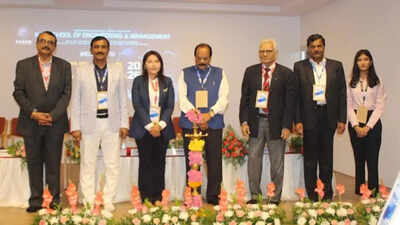
BENGALURU: The International Conference on Data Science for Cyber-Physical Systems Resilience using Advanced Applications (ICDCA 2026), hosted at K S School of Engineering and Management, Bengaluru, has announced its Best Paper Awards, recognizing outstanding research contributions that advance the security, resilience, and intelligence of modern cyber-physical and cloud-native systems. The conference has Eminent Speakers including Sai Santhosh Goud Bandari , Bandhavi Parvathaneni , Achuta Krishna Kishore Varma Alluri , Narumol Chumuang.The conference received more than 2,600 submissions from researchers, academicians, and industry professionals across the globe, spanning areas such as artificial intelligence, cybersecurity, cloud computing, data science, and cyber-physical systems. Following a rigorous multi-stage peer-review process, only 272 papers were accepted, underscoring the selectivity and technical depth of the event. The Best Paper Award recipients emerged from this highly competitive pool of submissions, recognizing research that demonstrated exceptional innovation, scientific rigor, and real-world impact.Among the distinguished award recipients was “Beyond Reactive Cloud Security: AI-Driven Predictive Drift Detection for CNAPP Environments” by Saurabh Srivastava and Rishiraj Kohli. The paper was recognized for its innovative contribution to cloud-native security and its forward-looking approach to transforming cloud defense from reactive monitoring to predictive, intelligence-driven protection.As cloud-native environments continue to grow in scale and complexity, security teams face increasing challenges from configuration drift, workload anomalies, and rapidly evolving threat landscapes. The authors address these challenges through an AI-driven predictive drift detection framework that enhances Cloud-Native Application Protection Platforms (CNAPP) by identifying and mitigating risks before they become security incidents. By combining machine learning, predictive analytics, risk scoring, event correlation, and automated response mechanisms, the framework shifts cloud security from reactive monitoring to proactive defense. Reviewers commended the work for effectively bridging advanced AI research with practical enterprise security requirements while delivering a scalable, governance-aware, and operationally relevant security architecture.According to the ICDCA 2026 technical review committee, the paper distinguished itself through its technical depth, architectural maturity, and industry applicability. At a time when enterprises are increasingly challenged by the complexity of securing dynamic cloud ecosystems, the research provides a practical roadmap for integrating predictive intelligence directly into modern security platforms and operational workflows. The committee noted that the work represents a significant step toward enabling intelligent, adaptive, and resilient cloud security systems capable of addressing the demands of next-generation digital enterprises.