
India’s forthcoming meetings with Panama, Brazil and Uruguay promise something Indian football has rarely been afforded in such concentrated fashion: a chance to measure itself against three teams accustomed to operating on a considerably higher international plane.
For Mehrajuddin Wadoo, the significance extends beyond the senior team. The former India international, recently appointed head coach of the India U-17 men’s team, sees the three matches both as a test of Khalid Jamil’s side and as a window into the level India’s emerging generation must eventually aspire to reach.
In an interaction with Hindustan Times, Wadoo spoke about the psychological challenge of confronting elite opposition, why Panama could provide the most revealing examination of India’s present level, the balance Jamil must strike against Brazil, and why these matches should not be judged merely through the arithmetic of the scoreline.
‘Panama game will show where Indian football stands’
Q: India have three fascinating matches against Panama, Brazil and Uruguay. Psychologically, what do players experience when they walk onto the pitch against opponents of this stature?
Mehrajuddin Wadoo: Psychologically, it will be very tough because they are facing World Cup participants, teams that have played at that level. It is going to be a very difficult challenge.
I think the first game against Panama will be difficult because India will also get to see what their strengths and weaknesses are. Another challenge for India is that most of the players have not played competitive games and are going directly into this match.
But if you look at the positives, they are playing in Bengaluru, where the crowd is going to be behind them. Most of the players have played on this ground. For Panama, perhaps the weather and the atmosphere in Bengaluru could also make things a little difficult. But they are World Cup participants, and they are going to come with all guns blazing and make it difficult for India.
Q: Much of the conversation naturally revolves around Brazil and Uruguay. Could Panama actually offer the more practical assessment of where India currently stand?
Mehrajuddin Wadoo: Exactly. The first game is very important because when you see India playing against Panama, you will yourself be able to judge where Indian football stands.
The players will also come to know where their strengths and weaknesses are. Then they have the Brazil game, and they can actually plan something for that match based on what they have seen and learned against Panama.
Q: During your playing career, you also faced much higher-ranked opponents. What tends to be the fundamental difference at that level — technique, physical strength or decision-making?
Mehrajuddin Wadoo: There are a lot of characteristics that are different. One of the biggest things I would say is the experience these players have.
Many of them play for big clubs and have a wealth of European experience. They have played big games and been on major stages. India have not played on such stages regularly, and that is going to be a very big difference between the teams.
Of course, India have work ethic. The players work very hard. But at the end of the day, we have to see what Khalid has planned, how he is going to set up his team and how they execute it.
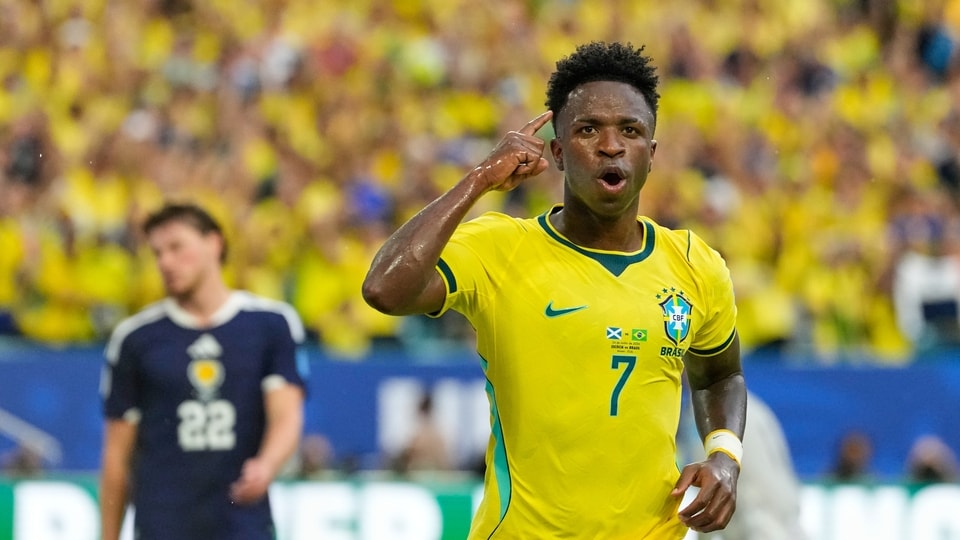
Q: Against Brazil, India could be confronted by extraordinary individual quality. How should they approach players capable of deciding games through individual skill and execution?
Mehrajuddin Wadoo: I think it depends on Khalid and what he wants to do. Is he going to sit back and wait for Brazil to come and attack, or is he going to tell his boys: enjoy this, because it is a once-in-a-lifetime experience?
Don’t worry too much about the result. Enjoy the game, show what you have got and put everything on the table. When Brazil are attacking, India have to be compact. They have to stay organised.
But otherwise, play your own football and enjoy the game. At the end of the day, we know there is a big difference between the two countries in terms of footballing quality and the kind of players Brazil have. Obviously, they are going to dominate periods of the game.
Q: How do you find that balance, though? How do you enjoy an occasion like that without treating it merely as an exhibition?
Mehrajuddin Wadoo: If I am the coach, I will take it very seriously, but at the same time, I don’t want to put pressure on my players.
You are playing against Brazil and you know what kind of team they are, but at the end of the day, you are playing for your country. That is the biggest motivation.
When you are on the pitch, you try to give your best. Be organised, make plans, watch your opponents and understand where their strengths are. After the Panama game, look at what went wrong, take the positives from it and then go into the Brazil match better prepared.
Q: Fans are already talking about potential scorelines, particularly against Brazil and Uruguay. From an outsider’s perspective, when would you say India have actually done well in these matches?
Mehrajuddin Wadoo: Fans are fans. They always want their country to do well. They want India to win the World Cup as well.
But I don’t see these games only on the basis of the results. I see them as an experience for the national team. These games are not only about the scores.
It is also about sharing cultures, customs and traditions between countries. Brazil will come to India and they will know more about India. When India are playing against Brazil, the whole world is going to know about Indian football as well.
Q: You are now working with the younger generation as India’s U-17 head coach. What would you tell your players to watch and learn from these matches?
Mehrajuddin Wadoo: Watch the game and see how India are playing, but also be ambitious.
When you are playing for the U-17 team, you should have the ambition to play for the senior team. Tomorrow, you can be there. Watch what is happening in these games and think about what you can do better if you are there five or six years from now.
Plan accordingly. Follow your idols in the game, watch it and enjoy it, but also try to understand where you can improve. Ask yourself: if I were there on that pitch, what could I have done better?