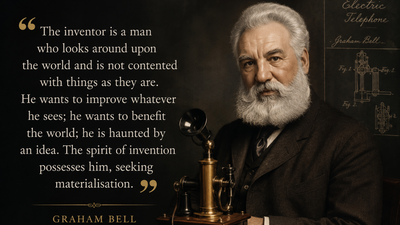
Every invention begins with a simple question: “Can this be made better?” The world’s greatest innovators did not accept limitations as permanent or believe that existing solutions were the best possible ones. Instead, they looked at everyday problems as opportunities waiting to be solved. Alexander Graham Bell’s insightful observation, “The inventor is a man who looks around upon the world and is not contented with things as they are. He wants to improve whatever he sees; he wants to benefit the world; he is haunted by an idea. The spirit of invention possesses him, seeking materialisation,” captures the restless curiosity that drives human progress. It reminds us that innovation begins with dissatisfaction, not with the world itself, but with the belief that it can always be improved.Alexander Graham Bell (1847- 1922) was a Scottish-born inventor, scientist and engineer best known for inventing the first practical telephone. Beyond telecommunications, his work extended to aviation, hearing science and medical technology, reflecting his lifelong commitment to improving people’s lives through innovation.
Quote by Alexander Graham Bell
“The inventor is a man who looks around upon the world and is not contented with things as they are. He wants to improve whatever he sees; he wants to benefit the world; he is haunted by an idea. The spirit of invention possesses him, seeking materialisation.”
What does this quote mean?
The quote teaches that inventors are driven by an inner desire to improve the world around them. They do not simply accept problems as unavoidable or believe that existing methods are good enough. Instead, they are constantly searching for better ideas, better solutions and better ways of helping society. The saying reminds us that meaningful innovation begins with curiosity, imagination and the courage to question what already exists.
Every great invention begins with dissatisfaction
Many of history’s greatest breakthroughs were born because someone refused to accept the status quo. The telephone, aeroplane, electric light and computer all began as ideas in the minds of people who believed there had to be a better way. Rather than complaining about problems, inventors study them, experiment with solutions and continue refining their ideas until they become reality. Progress is often made not by accepting limitations but by challenging them.
Curiosity is the fuel behind discovery
Innovation is rarely the result of a single moment of inspiration. It grows from asking questions, observing the world carefully and remaining eager to learn. Curious minds notice details that others overlook and imagine possibilities that seem impossible at first. Bell’s words remind us that curiosity is one of humanity’s greatest strengths because it transforms ordinary observations into extraordinary discoveries.
Ideas become valuable only when they are brought to life
A brilliant idea alone changes nothing unless someone is willing to act on it. Inventors spend years testing, failing, improving and trying again before their ideas succeed. The “spirit of invention” described by Bell is not merely about creativity; it is about persistence and the determination to turn imagination into something useful. Every innovation that improves our lives today was once just an idea that refused to be abandoned.
Why this quote still matters today
Today’s world faces challenges ranging from climate change and healthcare to clean energy and artificial intelligence. Solving these problems will require the same mindset Bell described, a willingness to question existing systems and imagine better ones. Whether inventing a new technology, improving a classroom, designing a product or finding a simpler way to solve an everyday problem, innovation begins with the belief that change is possible. The enduring lesson behind Bell’s words is that progress belongs to those who refuse to accept “good enough” and instead dedicate themselves to making the world a little better than they found it.