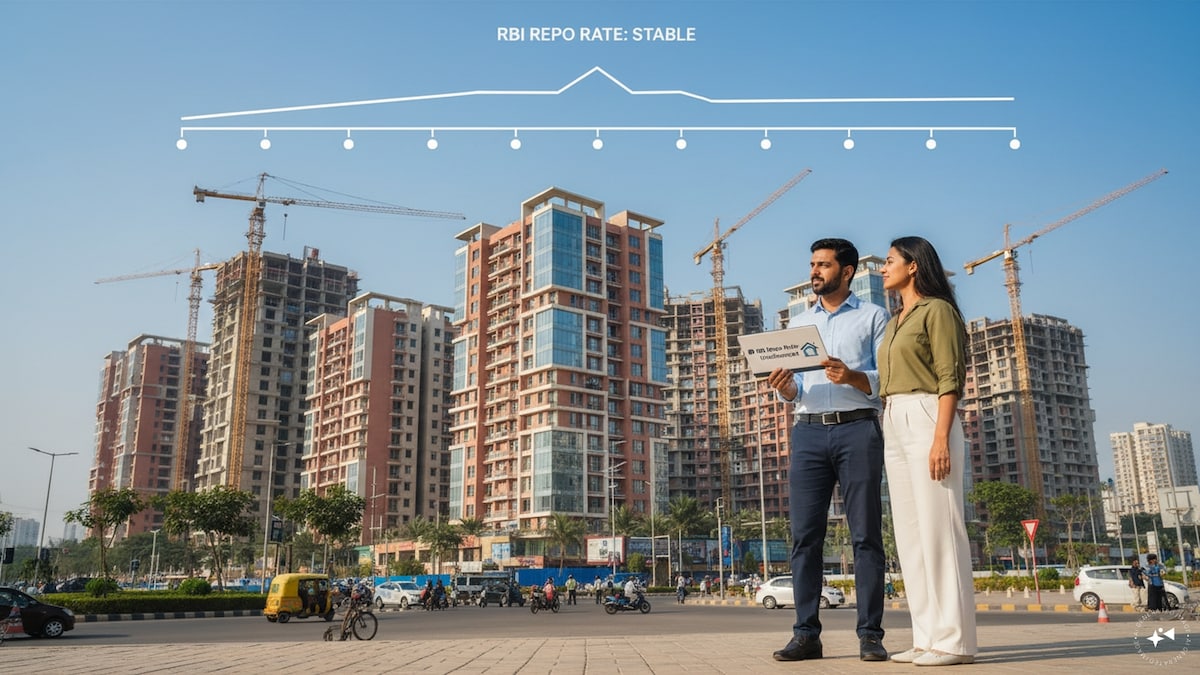
The status quo also signals that the central bank continues to prioritise inflation while balancing growth concerns.
According to BankBazaar, floating home loan rates currently range between around 7% and 9.4% at public sector banks and 7.3% to 9.3% at private sector banks, depending on the borrower’s credit profile.
Adhil Shetty, CEO of BankBazaar, an Indian financial technology platform, said borrowers planning to take a home loan should compare lenders on benchmark spreads, processing charges, prepayment rules and repayment flexibility rather than postpone their purchase in anticipation of lower rates.
He added that with the RBI continuing to prioritise inflation, borrowers should not expect an immediate reduction in lending rates.
Policy continuity supports market sentiment
Industry experts said the rate pause provides a predictable borrowing environment even as global uncertainties persist.
Mohit Goel, Managing Director of Omaxe, an ndian real estate and construction company, said the rate cuts over the past year have already improved affordability and strengthened buyer confidence. Maintaining the current policy rate, he said, provides stability for both homebuyers and businesses amid inflationary and geopolitical risks.
Aman Sharma, Managing Director and Founder of Aarize Group, a real estate development company, said policy continuity allows homebuyers to make long-term financial decisions with greater confidence while enabling developers to plan investments and project execution without the uncertainty of changing borrowing costs.
Affordable housing still faces affordability pressures
However, analysts cautioned that keeping rates unchanged alone may not be enough to revive demand in the affordable housing segment.
Anuj Puri, Chairman of ANAROCK Group, an independent real estate services company, said affordable housing remains highly sensitive to borrowing costs and rising property prices.
According to ANAROCK, housing sales across the top seven cities fell 6% year-on-year to around 90,700 units in the second quarter of 2026, while affordable housing accounted for just 6% of new launches, despite an increase in overall residential supply.
Puri said steady interest rates may provide stability, but improving affordability will require more than monetary policy, especially as residential prices continue to rise.
What should borrowers do?
With lending rates expected to remain broadly stable, borrowers may benefit more from comparing loan offers than waiting for another policy move.
Besides the interest rate, experts recommend evaluating the benchmark-linked spread, processing fees, prepayment and foreclosure charges, balance transfer options and repayment flexibility, as these can have a meaningful impact on the overall cost of a home loan.