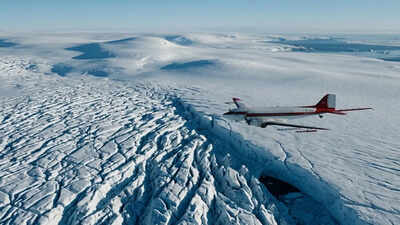
Underneath the West Antarctic ice sheets lies an enormous buried structure of granite that has been discovered by scientists through the link between peculiar pink boulders on the surface and unseen rock below the ice cover. Geologists claim that this massive subglacial structure measures approximately 100 kilometres wide and 7 kilometres deep.As published in a peer-reviewed study in the journal Nature Communications Earth & Environment, this finding occurred close to Pine Island Glacier, the fastest changing glacier in the western part of Antarctica. Field geology, mineral dating, airborne gravity surveys, and magnetic studies were used in order to uncover the concealed geological structure underneath the ice.Unusual pink rocks sparked the discoveryScientists first came across pink granite boulders in the Hudson Mountains region. The rocks seemed unusual since the surroundings were dominated by volcanic landscapes rather than exposed granite. It turned out that these boulders could not be just some surface materials as their mineralogical composition and thermal history indicated the presence of an identical subsurface formation.The estimated age of the rocks was around 175 million years, meaning they belong to the Jurassic era. According to the British Antarctic Survey (BAS) press release, the granite erratics retained a geological signature that aided scientists in tracing their origin to the concealed bedrock underlying Pine Island Glacier. The researchers explained in the paper that the erratics provide direct evidence for a concealed granitic source beneath the ice sheet.Geophysical data confirmed its existenceLocating the boulders on the surface of the glacial ice was not sufficient to confirm the presence of an invisible giant granite rock below the ice. Geophysical evidence was required to locate this geological structure.In the study, researchers conducted an aerial survey involving gravity and magnetic observations over Pine Island Glacier. Gravity observations can help differentiate between the densities of various rocks below the surface. As the granite is less dense compared to the surrounding rocks, it can be located using this technique.A negative gravity anomaly of a significant extent was identified in the research. Computer modelling was done to experiment with the various types of underground features. It was noted that the granite is the right choice considering the gravity readings taken on-site. As explained by BAS, the buried object is almost 100 kilometres in diameter and seven kilometres thick, which amounts to about half the area of Wales.
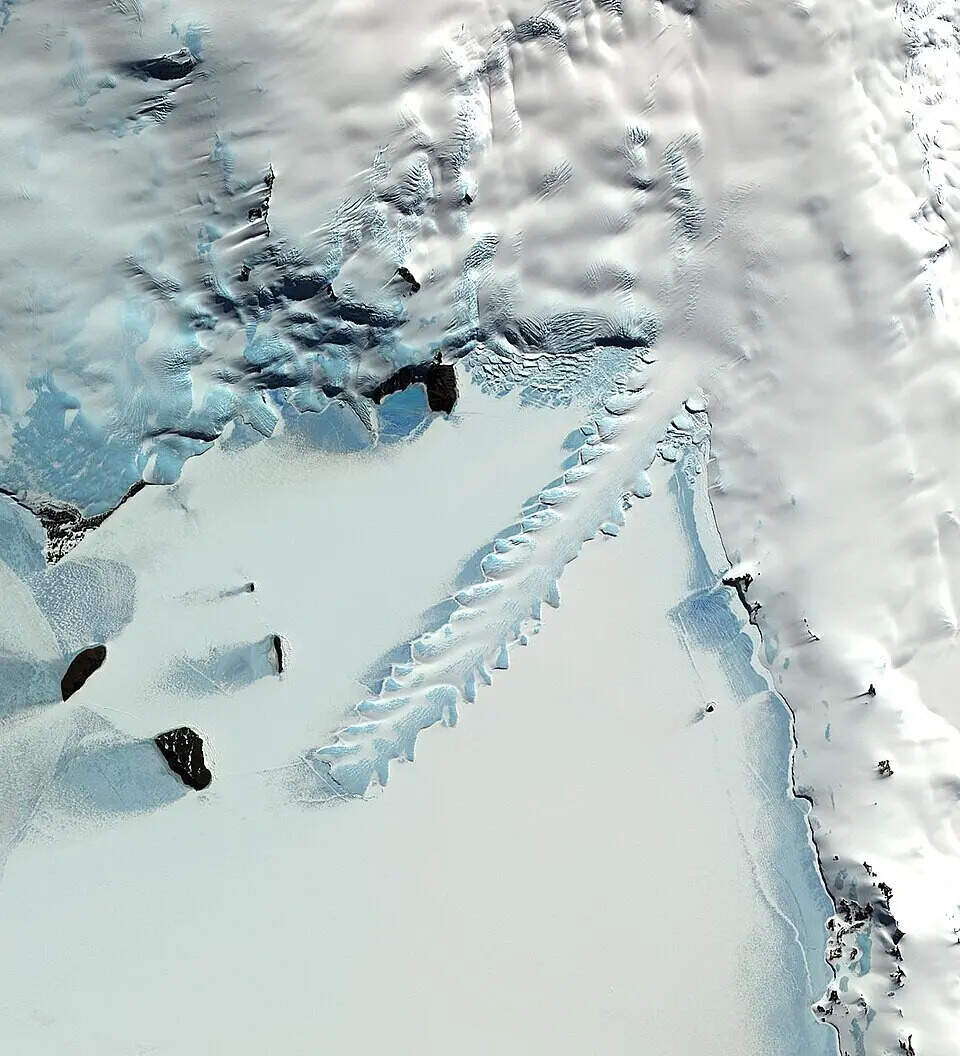
The giant structure buried under West Antarctica stayed hidden for millions of years. Image credit – Wikimedia
An ancient ice flow provided a vital clueThe scientists also reconstructed the past ice flows to learn more about how the granite rocks ended up in the Hudson Mountains. According to the findings, the glaciers moved the rocks northwards from the giant granite formation under the Pine Island Glacier. Ice movement has changed since that happened, but the boulders remain in place, indicating that the flow path was disrupted somewhere along the way.This information helped establish a connection between the visible rocks and the buried underground rock formation. It was noted that the boulders functioned like geological breadcrumbs, providing information on the formation that existed underneath the Antarctic ice sheets.Importance of the buried granite rockThe study is significant not only for the geological information it provides about the Antarctic continent, but also due to the importance of bedrock composition and shape.For instance, BAS experts note that Pine Island Glacier is a closely monitored site due to its rapidly shrinking ice. The presence of a certain type of bedrock under the glacier influences ice flow processes, including water drainage from under it and the way thermal energy is transferred.According to BAS scientists, increased knowledge of the underlying geology would help to develop better models of the future development of Antarctica. Moreover, previous geological data pointed to major crustal thinning beneath the Pine Island glacier. Thus, this new discovery provides additional information regarding the West Antarctic continental formation during continental drift.Antarctica’s hidden secrets keep coming to lightGeologists say the discovery is another example of Antarctica’s secrets, yet to be uncovered. Notably, contrary to numerous geological investigations, this study did not require drilling through the ice sheet.Researchers, however, used smaller surface evidence together with geophysical methods on a much bigger scale to discover an unknown structure lying beneath thousands of meters of ice.In addition, the study proves the importance of classical fieldwork in science. Some very strange rocks were finally traced back to one of the most interesting underground geological structures found in West Antarctica. To the researchers, the mysterious granite formation is both a geological revelation and a confirmation that there are plenty of mysteries remaining in Antarctica.