
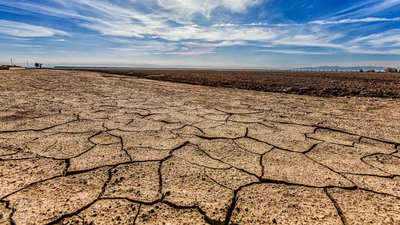
California’s devastating 2020–2022 drought may have left behind more than dried-up rivers and struggling farms. Scientists have found that intensive groundwater pumping during the drought likely caused part of a major underground water reserve in the state’s Sacramento Valley to lose some of its ability to store water permanently. The findings, published in the Proceedings of the National Academy of Sciences (PNAS), suggest that sections of the aquifer compacted so severely after excessive groundwater extraction that they cannot fully recover, even after rainfall returns. Researchers say the discovery highlights a hidden consequence of prolonged drought that could affect California’s future water security as climate change intensifies.
How California’s 2020 drought permanently damaged an underground water reserve
The study focuses on the Sacramento Valley, the northern part of California’s Central Valley, one of the world’s most productive agricultural regions. During the severe drought between 2020 and 2022, surface water supplies dwindled, forcing farmers to pump large amounts of groundwater from underground aquifers to keep crops alive.As groundwater was removed, water pressure inside the aquifer dropped sharply. This caused fine-grained underground sediments to compress under their own weight. While some compaction is temporary, researchers found that part of the aquifer collapsed permanently, reducing the amount of water it can store in the future.
Why the land began to sink
Using satellite observations, scientists measured widespread land subsidence across parts of the Sacramento Valley during the drought. Some areas sank by more than half a metre, while certain locations experienced even greater ground movement.Normally, when rain replenishes groundwater supplies, underground sediments expand again and the land surface rebounds. However, the researchers found that during 2021 the aquifer compacted so quickly and extensively that some of the pore spaces between sediment grains collapsed permanently, preventing the land from fully recovering.
Why the aquifer may never regain its original storage capacity
Aquifers store water inside tiny spaces between grains of sand, gravel and clay. When groundwater is removed too quickly, those spaces can collapse.Once this type of inelastic compaction occurs, the lost storage space cannot realistically be restored on human timescales. Although the aquifer can still hold groundwater, it can no longer store as much water as it did before the drought.
How scientists uncovered the hidden damage
The research team used high-resolution satellite measurements to monitor subtle changes in the Earth’s surface during and after the drought. These observations allowed them to distinguish between seasonal land movements and permanent subsidence caused by groundwater depletion.The findings provide what researchers describe as the first clear evidence that part of the Sacramento Valley aquifer has suffered irreversible storage loss, a problem previously associated mainly with California’s southern San Joaquin Valley.The Central Valley produces roughly one-quarter of the food grown in the United States, making reliable water supplies essential for agriculture.A permanent reduction in groundwater storage means less water can be stored underground during wet years and used during future droughts. As climate change is expected to increase the frequency and severity of droughts across California, losing part of this natural underground reservoir could make water shortages more difficult to manage.
Could this happen elsewhere?
Land subsidence caused by excessive groundwater pumping has been documented in many parts of the world, including India, China, Mexico and Iran. However, the Sacramento Valley had generally been considered less vulnerable than California’s southern Central Valley because of its geology and greater water availability.The new findings suggest that even aquifers once thought to be relatively resilient can suffer irreversible damage if groundwater extraction exceeds sustainable levels during prolonged droughts.
Can the aquifer recover?
Researchers say future rainfall and snowmelt can replenish groundwater supplies, but they cannot fully restore pore spaces that have already collapsed. In other words, the aquifer is not empty or unusable, but its maximum storage capacity has been permanently reduced.Scientists say the study underscores the importance of careful groundwater management, especially as California continues adapting to a warmer climate and more frequent extreme droughts.
What the findings mean beyond California
The study serves as a warning for drought-prone regions around the world that rely heavily on groundwater. Aquifers are often viewed as reliable reserves during dry periods, but they are not immune to permanent damage. By revealing how excessive groundwater pumping can irreversibly reduce underground water storage, the research highlights the need for sustainable water management to protect resources that millions of people and vital agricultural regions depend on.