
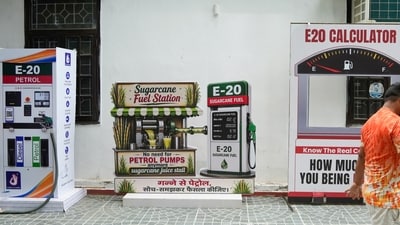
The Society of Indian Automobile Manufacturers (SIAM), in its now withdrawn letter to the Union ministry of petroleum and natural Gas (MoP&NG), raised the issue of possible chloride and water contamination after the rollout of E20 fuel – a blend of 20% ethanol with petrol – across the country this year.
The letter said chloride and moisture were turning up in fuel samples and that the issue, in the industry body’s assessment, lay in the supply chain rather than in E20 formulation.
In its clarification withdrawing the letter, SIAM asserted the industry had “always been fully supportive” of the government’s E20 initiative and that the steps oil marketing companies (OMCs) and the ministry already have in place “fully meet the needs of the automobile industry”. The body also said the readings it had cited in the letter needed authentication through wider data collection and consultation.
The episode came as AAP convener Arvind Kejriwal on Tuesday protested against E20 rollout in the country, demanding – among other points – that the government offer commuters options to use only-petrol along with ethanol-blended fuel.
The Narendra Modi-led government has consistently maintained, including in responses to Parliament, that E20 is safe for use, does not damage vehicle engines, and causes only a slight dip in mileage.
The potential issues
SIAM’s now-withdrawn communication said its members had reported seeing cases of damage in auto-parts that were in direct contact with either the fuel or the combustion gases — components on both the fuel-delivery side (fuel injectors, fuel pumps) and the exhaust side (exhaust gas recirculation, or EGR, valves).
These, SIAM said, pointed to corrosion and wear consistent with chloride exposure.
Two broad patterns were described. One was corrosion-linked wear in fuel-system parts — the slow, cumulative kind that shows up as component failure over time. The other was stalling shortly after refuelling, which the letter attributed to phase separation — the splitting of ethanol and petrol into distinct layers — caused by high moisture in fuel.
Before SIAM’s communication, petrol pump owners had written to the ministry asking for a standard operating procedure (SOP) and equipment to test E20 quality at retail outlets, HT reported on July 24. The dealers said they currently have the ability to test only for density and water paste — a limited toolkit for a fuel that behaves differently from unblended petrol in the presence of water.
Monty Sehgal, spokesperson for the Federation of All India Petroleum Traders, had said phase separation “spoils the 20% of the entire product” once water enters ethanol-blended fuel — a problem largely absent with only-petrol.
Also read: Don’t want E20, go for pure petrol, says Gadkari: What drivers in India can actually buy at the pump
Why chloride is corrosive
Chloride ions attack the thin protective oxide film that forms on stainless steel, aluminium and their alloys — the metals from which most fuel-system components, including injectors and pumps, are built. That film is what keeps such parts from corroding under normal conditions.
Once that film is breached at a microscopic point, a tiny cavity — known as a pit — begins to eat into the metal. Chloride ions accumulate inside the pit, and the local environment there turns acidic. Both conditions speed up the corrosion further, so the pit deepens — a self-sustaining process known as pitting corrosion.
Under mechanical stress, the same mechanism can drive stress-corrosion cracking, in which cracks grow through metal that is corroding.
This kind of exposure is especially harmful for a fuel injector. Fuel injectors rely on micron-level orifices to deliver fuel to the engine’s cylinders in a specific spray pattern. Even small pits alter that geometry, shift fuel delivery, and can eventually cause the part to fail.
Fuel pumps use similar stainless internals and rotating seals, and are vulnerable in similar ways.
A 2017 study published in Results in Physics — testing the effect of chloride contamination on micro-alloyed steel, which is used in auto parts — found that dissolved chloride in a simulated E20 environment initiated pitting on the metal, with pit growth increasing as chloride concentration rose.
But where does chloride enter an ethanol supply chain in the first place?
“Water used in distillation, caustic soda used for pH balancing, transport equipment, and denaturant are chief sources of chloride contamination in ethanol. The US Standard for chloride in ethanol is 8ppm. The Indian standard of quality for ethanol does not specify a chloride level limit,” said GK Sood, executive director at Meir Commodities, a Mumbai-based agri-commodities trading firm active in the sugar and ethanol business.
In plain terms: chloride can slip into the ethanol at several stages of its production — from the water used in distilling it, from chemicals used to balance the acidity of the mix, from the equipment that carries it around, and from the additives put in before blending.
Also read: Ethanol blending in fuel: What Brazil does, and where other countries stand
On the exhaust-side
When chloride-containing fuel burns, the chlorine can end up as hydrogen chloride (HCl) in the exhaust gas stream.
The exhaust gas recirculation (EGR) loop is a standard piece of a modern engine’s emissions control kit. By design, it cools a portion of the exhaust and routes it back into the engine’s intake to reduce combustion temperatures and cut nitrogen oxide emissions.
When the exhaust cools, any HCl in it will condense on metal surfaces as hydrochloric acid — a strongly corrosive agent that eats EGR valve internals, catalyst substrates and downstream steel.
Phase separation and stalling
Ethanol is hygroscopic — it absorbs water from the atmosphere and from any humid surface it contacts. This means an E20 blend can easily pick up water during handling, from humid air inside storage tanks, or through moisture ingress at older fuel pumps.
That water dissolves into the fuel up to a saturation limit, which depends on temperature and on the composition of the base petrol.
Once the water content crosses the saturation threshold, the fuel can no longer hold the water in the solution, and the mix splits into two layers — a process known as phase separation. The water and a fraction of the ethanol drop out of solution and settle at the bottom of the storage tank — the vehicle’s fuel tank, or the underground tank at a petrol station — as a distinct aqueous layer. A vehicle drawing fuel from a tank in which this has happened picks up that aqueous slug and stalls, sometimes within minutes of refuelling.
Pure petrol did not have this vulnerability. Water in a petrol tank sat quietly at the bottom, immiscible with the fuel above it, and could be drained during routine maintenance.
Ethanol removes that separation. It acts as a bridge between the water and the hydrocarbons in petrol, holding moisture in the solution until the point at which it suddenly does not. This is why the same underground tanks that were fine on E10 can become a problem on E20 if there is water inside.
Chloride and moisture are also linked at a molecular level. Chloride ions are far more soluble in a water-rich phase than in petrol.
In an E20 blend with excess moisture, any chlorides in the fuel preferentially collect in the water layer rather than staying dispersed through the petrol. Concentrated in that thin aqueous layer, they become more mobile and — on the surfaces they contact — they are more aggressively corrosive than they would be in drier fuel.
Also read: The E20 debate is asking the wrong question
Where things now stand
In its response over the withdrawn letter, SIAM said fuel quality testing under the prevailing regulatory framework is a comprehensive process covering more than 150 parameters, carried out by the OMCs.
The communication in question, it said, had been part of routine, ongoing technical deliberations between industry bodies, OMCs, auto original equipment manufacturers (OEMs) and testing agencies.
The industry body also pointed to steps already in place. MoP&NG, it said, has instituted a 3 ppm precautionary guideline for chloride and sulphur content in the ethanol being blended into the petrol supply chain. OMCs are conducting water ingress testing 8-12 times a day at over 87,000 outlets, and after every instance of rain near petrol pumps, it said.