
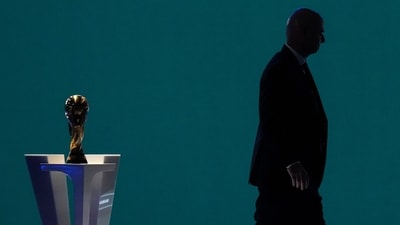
Two weeks after presiding over the men’s world cup, Fifa president Gianni Infantino is facing the biggest challenge yet to his job that until recently looked untouchable.
A cluster of European football associations has publicly announced that they will withdraw support for his re-election bid in March 2027. And three of world football’s six regional confederations — Europe’s Uefa, north and central America’s CONCACAF, and the Asian Football Confederation (AFC) — have spoken against his leadership after his abandoned plan to bring in private investors sparked fury across the globe.
At the heart of the storm is a proposal Fifa floated last week and formally scrapped within days. It was called the Fifa Forward Enterprise, or FFE — a new commercial subsidiary that would have taken over the running of the world cups, Club World Cup and other Fifa tournaments, and sold the rights that go with them. Fifa valued FFE at $20 billion and planned to raise $4.2 billion by selling about a 20% stake in it to private investors.
The anchor investor would have been Thrive Eternal, a vehicle of Thrive Capital, the firm founded by Joshua Kushner, whose brother Jared Kushner is a son-in-law of US President Donald Trump.
Infantino, after withdrawing the plan, apologised for how it divided the sport.
The bigger question now is whether the 56-year-old Swiss-Italian lawyer, who has led world football since 2016, can survive till March 18 next year. That is when the Fifa Congress convenes in Rabat, Morocco, and he was expected to be waved through unopposed for a fourth and final term running to 2031.
Opponents & supporters
Reuters reported that five European federations — England (FA), Wales, Serbia, Sweden and Finland — have formally withdrawn earlier letters of support for Infantino’s re-election. Denmark’s federation, which didn’t support him earlier too, said it was never going to back him in any case.
The Football Association of Wales, which broke first, cited “recent failures in good governance, processes, leadership, values, stakeholder management, communications and sound judgement”.
The English FA, in a statement, called for “a full and robust review of Fifa’s leadership and governance”. Sweden’s federation cited “recurring shortcomings in governance, transparency and management”.
Cracks were visible within Fifa’s own Zurich headquarters. Chief operating officer Kevin Lamour said last Friday that staff had been “deceived” and described the FFE as “the project of one person”.
On Tuesday, secretary general Mattias Grafström — long seen as a close Infantino ally — sent an email to Fifa staff, calling the past week “a sad and reproachable series of events” and adding that “individuals, unstable moments and unfortunate episodes come and go”.
Former Arsenal manager Arsène Wenger, Fifa’s chief of global football development, said in a separate statement that he was “not involved in this strategic plan” and that “the decision to withdraw the project was absolutely necessary”.
Infantino’s most vocal backers are largely out of Europe. The football federations of Morocco, Qatar, Kuwait, Lebanon and Sri Lanka have publicly declared their continuing support, and Infantino has been amplifying their statements on Instagram.
In Africa, home to 54 of Fifa’s 211 members, senior figures, including Confederation of African Football (CAF) vice-president Fouzi Lekjaa of Morocco, and Fifa Council members from Egypt, Niger and Mauritania, have sent messages of support. But CAF is due to meet on Thursday and has not yet taken a formal position.
South America’s CONMEBOL, which is relying on Infantino to expand the 2030 World Cup to 64 teams, from 48 currently, has not made a public statement yet.
Separately, Fifa on Tuesday dismissed as “pure fiction” a New York Post report that Infantino had tried and failed to reach Trump by phone since last week, when the pushback had erupted. A US State Department spokesperson said there were no plans for US secretary of state Marco Rubio to speak to him either.
An ‘Extraordinary Congress’
Infantino’s most pressing worry may not be next year’s ballot but the possibility of being forced into an earlier confrontation.
Under Article 25.4 of the Fifa Statutes, an Extraordinary Congress can be convened if at least a fifth of the 211 member associations — 43 or more federations — submit a formal written request specifying the agenda items. Once triggered, the Congress must be held within three months.
Uefa alone has 55 members, and can convene such a meeting. Together, Uefa, CONCACAF (35 members) and the AFC (46 members) account for 136 votes, also comfortably above the trigger.
The Times of London reported this week that the three confederations were determined to force Infantino out and were even prepared to start their own competitions if he refused to go. CONCACAF, the AFC and Fifa did not immediately respond to requests for comment on that report, according to Reuters; Uefa said it had no comment.
A virtual Extraordinary Congress is already scheduled for November 23 to confirm hosts for the 2031 and 2035 women’s world cups, according to Fifa.
But Article 25.5 of Fifa Statutes bars any alteration to the agenda once an Extraordinary Congress is called. That means opponents would likely have to trigger a separate Extraordinary Congress.
The governing body’s rules say only its Congress — not the Fifa Council — can dismiss a sitting president. The 37-member Council, which Infantino heads, can convene an Extraordinary Congress on its own initiative but the decision to remove the president belongs to the 211 member- federations.
In other words, a Council majority against Infantino would only escalate the matter. It cannot, by itself, end his tenure.
Uefa has separately fired a legal warning shot. Its US lawyers sent Fifa a “document preservation letter” naming 18 executives, including Infantino, Wenger and chief financial officer Thomas Peyer, and warned that any destruction of records could amount to “spoliation of evidence”.
Uefa said it was “actively considering legal action, arbitration, and/or regulatory complaints” over the FFE plan.
The Fifa presidential election
Fifa holds a presidential election every four years, at the Congress that follows a men’s world cup.
Candidates must have played an “active role in association football” for two of the previous five years, must pass an eligibility check by a Fifa committee and — most importantly — must secure written declarations of support from at least five member-associations before the nomination deadline, which falls on November 18 this year.
Each federation can back only one candidate. That makes the current wave of withdrawn support letters more than symbolic: every letter torn up is a signature that may not go to Infantino during the vote.
Every one of Fifa’s 211 member associations gets one vote of equal weight, whether it is Spain or Seychelles, Argentina or Aruba.
When only one candidate stands for election, Fifa Congress may elect the president by acclamation, without a ballot, as it did in 2019 and 2023.
When two candidates stand, the rules require a simple majority of the valid votes cast to win — 50% plus one of the ballots actually returned, not necessarily of the full 211 membership.
When three or more candidates stand, the first round requires two-thirds of the votes of the member-associations present and eligible to vote. The lowest-polling candidate is eliminated each subsequent round until only two remain.
The vote is conducted by secret ballot, and there is no bloc voting. So, confederations can recommend, but their member federations vote as they choose. That distinction has mattered before. Sheikh Salman bin Ibrahim Al Khalifa entered the 2016 election with the public backing of the Asian and African confederations — theoretically more than 100 votes — but polled only 88.
Previous elections and how Infantino got there
Fifa has had only nine presidents since its founding in 1904, and Infantino is only the third since the 1970s.
His predecessors Joao Havelange and Sepp Blatter, between them, held the office for more than 40 years.
After Blatter resigned in 2015 amid a corruption storm, Fifa in 2016 capped presidential tenure at three terms of office, or 12 years, in Article 33.2 of its statutes. Infantino has argued that his initial three-year term should not count against that cap, which would allow him a run of 15 years in the job.
The last competitive Fifa presidential election was the 2016 vote in Zurich that first brought Infantino to power.
Infantino beat four rivals — former Fifa vice-president Prince Ali bin Hussein of Jordan, who had lost to Blatter in the previous election in May 2015; Sheikh Salman, the Bahraini royal who has run the AFC since 2013; Jerome Champagne, a French former diplomat and former Fifa deputy general secretary; and Tokyo Sexwale, the South African businessman and former Robben Island prisoner — after securing 115 votes in the second round to overtake the early favourite, Salman.
His re-elections in 2019 and 2023 were both approved by acclamation, without a ballot. The April 2026 Fifa Congress in Vancouver had teed up next year’s vote in Rabat as a similarly uncontested affair.
Until now.
Who could challenge him
No rival candidate has formally declared. But the November 18 deadline is only 15 weeks away, and several names have emerged as possible contenders:
Victor Montagliani, the Canadian businessman who runs CONCACAF and sits as a Fifa vice-president, is considered the likeliest challenger and is believed to be seriously weighing a bid.
Sheikh Salman bin Ibrahim Al Khalifa of Bahrain, the AFC president who lost to Infantino in 2016, has opposed expanding the 2030 World Cup to 64 teams.
Aleksander Ceferin, the Slovenian Uefa president, boycotted last month’s world cup final and has led the European pushback.
Nasser Al-Khelaifi, the Qatari sports executive who leads Paris Saint-Germain, has been floated as a contestant by some European officials, according to a Politico report.
Lise Klaveness, president of the Norwegian federation, has been proposed by Blatter himself. Writing on X, the former Fifa president said “the time is right for a woman to take the lead”.
What comes next
Infantino has seven months to rebuild his coalition before Rabat. His power base, like Blatter’s and Havelange’s before him, was built outside Europe, on Fifa development grants that many of the poorer federations rely on to function — a system he expanded significantly after taking over. His FFE pitch offered members one-off dividends and incentives that resonated in many of the smaller associations, especially in Africa.
Whether that is enough to hold his majority will depend on the arithmetic of the next few weeks, or months.