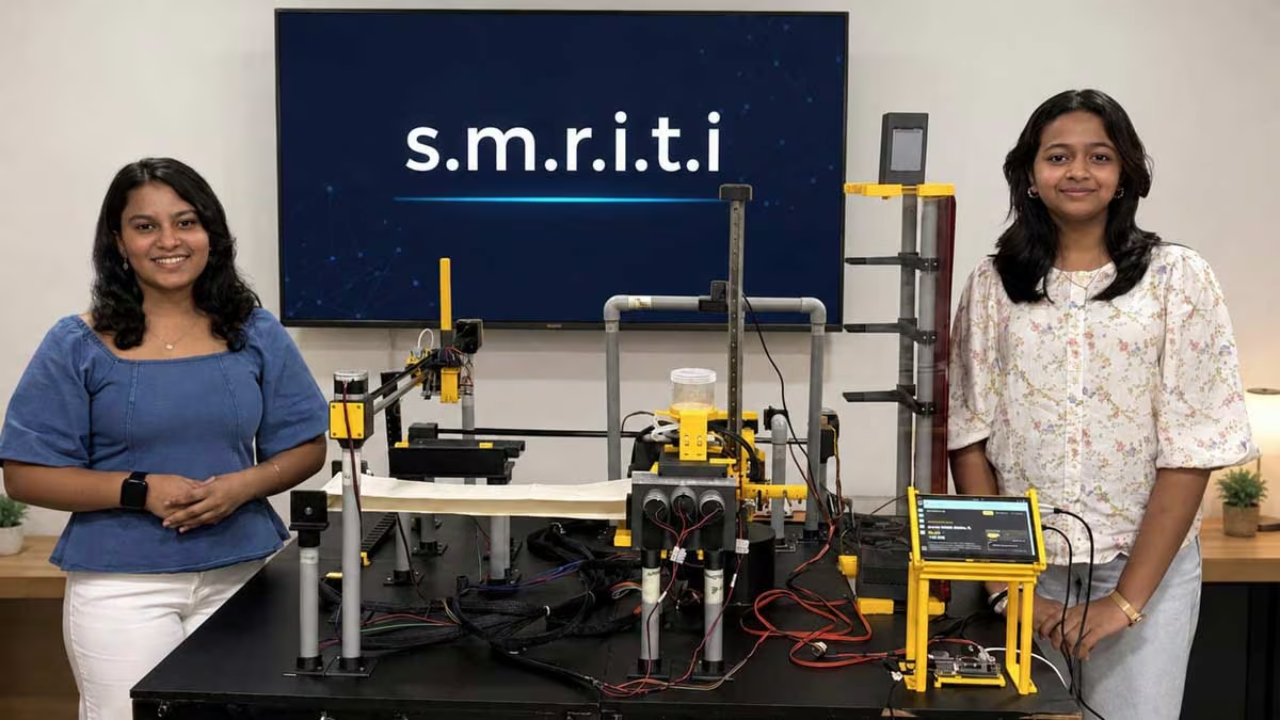
Two 14-year-old girls from Kerala have built a robotic system that cleans, preserves and digitises fragile palm-leaf manuscripts and their project has now taken them from a school robotics competition in Hyderabad to the international stage in Puerto Rico. Cathlin Marie Jeesan of Holy Grace Academy in Mala and Navika D. Nair of Naipunnya Public School in Kakkanad have developed Smriti 1.0. It is a system that combines robotics, controlled drying and artificial intelligence to handle old palm leaves and convert their writing into digital text.The students, competing as Team UWR Synergy, won first place in the Future Innovators-Senior category at the World Robot Olympiad (WRO) India Nationals in Hyderabad, held from August 26 to 28. They will now represent India at the WRO International Championship in San Juan, Puerto Rico, from December 8 to 10, 2026, according to Mirror Now.
Why two school students chose palm-leaf manuscripts
The idea began with the girls trying to understand how old knowledge recorded on palm leaves could be preserved. According to The Week and various media, Cathlin and Navika became interested in the subject while learning about ‘Madhava of Sangamagrama,’ the Kerala mathematician and astronomer whose mathematical knowledge was recorded on palm leaves. They found that such manuscripts can be difficult to access because the leaves are fragile and some contain older forms of Malayalam script that are difficult for modern readers and OCR systems to process.Their research took them to the Manuscript Research and Presentation Centre in Irinjalakuda, where they learnt how palm-leaf manuscripts are cleaned, treated and dried. That visit changed the direction of the project. The challenge was not simply to photograph an old manuscript. The girls had to think about how to move, clean and dry a fragile leaf without damaging it before attempting to read and digitise its contents.Benson Thomas of Unique World Robotics, which mentors the students, pointed out that palm leaves contain much more than the material people commonly associate with them. “It is not just horoscopes that are being written on palm leaves,” he said, according to The Week, referring to the historical and mathematical material recorded on such manuscripts.
What Smriti 1.0 actually does
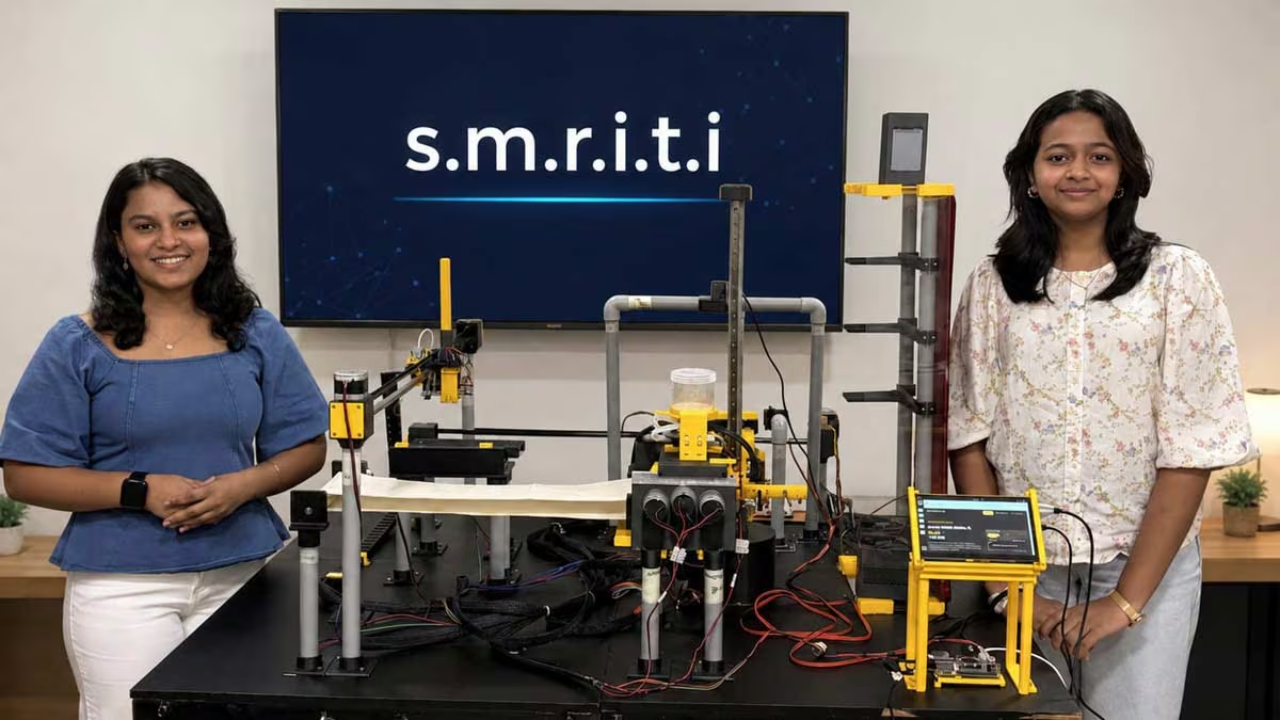
Photo credit: The Week
The system is designed as a sequence of steps. A suction-based mechanism carefully moves a palm leaf onto a conveyor. Rollers then remove dust from the surface. The system applies lemongrass oil, which, as reported by The Week, helps protect the leaf against microbial damage and insects and can also make the writing clearer.A robotic arm then transfers the leaf into a microclimate-controlled drying chamber. The temperature and humidity are monitored during the drying process. Once this stage is complete, the manuscript moves to a scanning station. A camera captures the inscription and Optical Character Recognition (OCR) is used to extract the writing and convert it into digital text. This means the project attempts to bring several traditionally separate stages like handling, cleaning, preservation, drying, scanning and text extraction into one automated system.
The girls had to solve a problem beyond robotics
Navika told The Week that they had to ensure the manuscript did not get damaged during processing and that the text did not fade or the leaves become more brittle. The second major challenge was reading the old writing. Cathlin handled the language and translation component, while Navika worked on training the AI-based OCR system. The girls found that conventional OCR struggled with the older Malayalam scripts found in palm-leaf manuscripts.So Smriti 1.0 is not yet a finished machine. The current prototype can handle only a limited manuscript size, and its OCR system needs further training. Before the international competition, the students want to make it better.
How Cathlin and Navika became a team
The two students met when they were in Class 8 and teamed up because of their common interest in robotics. Cathlin, now a Class 9 student focuses on innovation, robotics and writing. Navika, also in Class 9 works mainly on design, hardware architecture and research. Cathlin also has international WRO experience. She finished third at the WRO International competition in Turkey in 2024, where she competed with her sister Clare Rose Jeesan.
From gold in Hyderabad to Puerto Rico
Their work earned Team UWR Synergy the top position in the Future Innovators-Senior category at the WRO India Nationals in Hyderabad. The gold-medal finish secured their place at the 2026 WRO International Championship in San Juan, Puerto Rico, where they will compete from December 8 to 10. The project will still need improvements before then. Both the girls are working on that.