

As Americans head into the final stretch of campaigning for the Nov 3 US midterm polls, both Democratic and Republican parties are set to field their big guns – and go on an ad-blitz – across key battleground states. Weighing on voters’ minds are issues like the rising cost of living, Trump’s war against Iran that has seen fuel prices skyrocket, healthcare and housing. Here’s a quick primer on what’s at stake in the polls, why it could be hugely consequential for the Trump presidency, and how it may shape US foreign policy.Betting on the House: All 435 seats in Congress’s House of Representatives are up for grabs. Republicans hold a slim majority of 218 to Democrats’ 214 in the House. But this is widely expected to flip. That hinges on about 50 competitive races. Pollsters say Democrats could end up with a majority of as many as 15 seats.Senatorial action: But it’s the Senate races that will determine whether Trump’s agenda over the next two years sinks or floats. The chamber has only 100 seats, but senators have staggered six-year terms. That means only 35 seats are up for grabs this time, of which about 10 are really competitive and likely to flip. If Democrats snag them up, they will overturn Republicans’ current majority of 53 to 45. Which is precisely why Republicans are pulling out all stops to boost their candidates in key races.If Dems get House, GOP holds Senate: A likely scenario, although Republicans have been shaken up by reported close contests in red states like Texas and Kansas. Plus, Trump’s approval rating is down – a record low for him at 31% in the latest poll. So, Republicans are divided over associating themselves with Trump’s policies. For some, getting the President’s endorsement may actually spell doom in tight races.
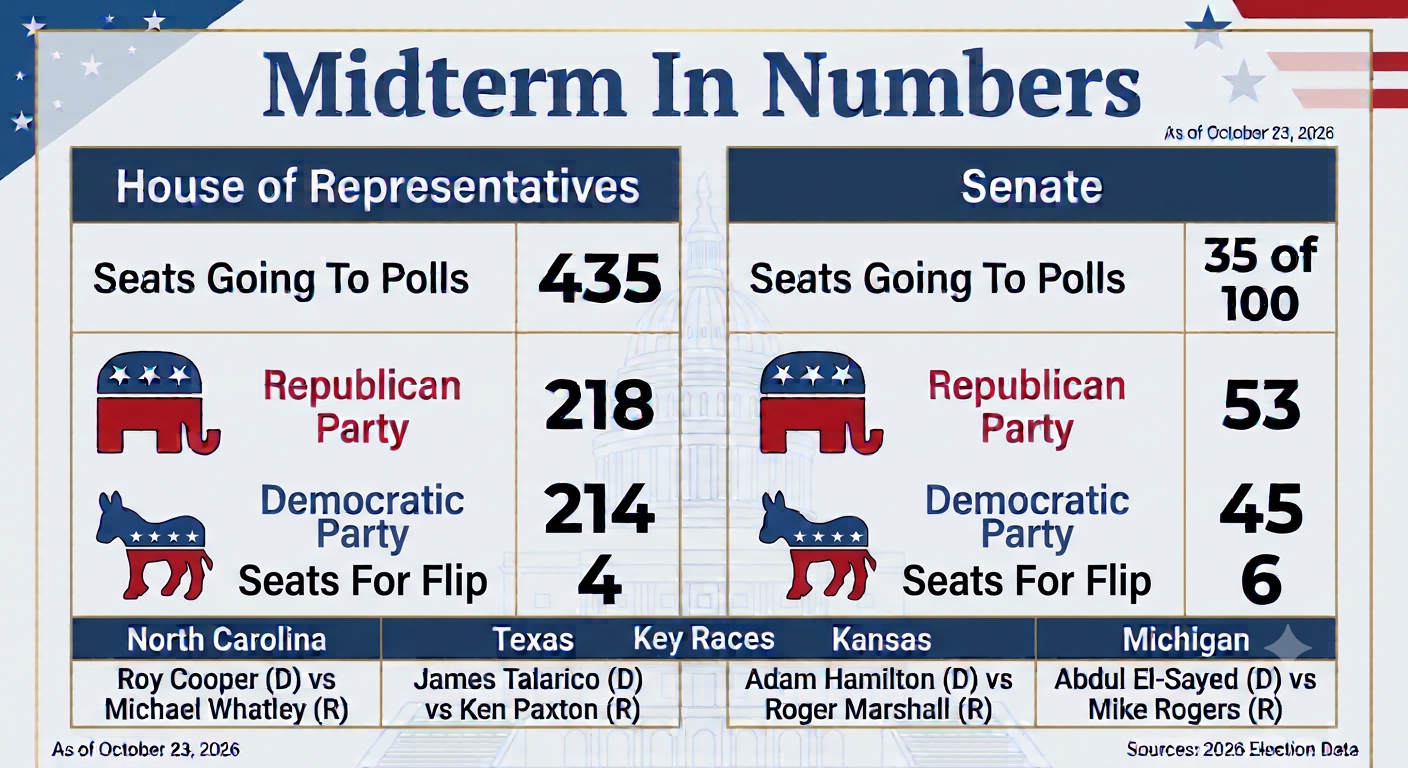
Midterm in numbers
But if Republicans do manage to hold onto their majority in Senate, Trump would still have room to manoeuvre and, more importantly, bat down political challenges emanating from a Democrats-dominated House.If Dems win both houses: That’s the nightmare scenario Trump and GOP are trying to avoid. If Democrats control both the House and Senate, they effectively gain control of the legislative agenda. Sure, Democrats would still have to contend with Trump’s veto power – he could use that to block any Democrats-led legislation. And overturning a presidential veto requires two-thirds majority in both houses – a rarity.But Democrats could still prove a point by forcing Trump to exercise his veto. That in turn could have political implications for presidential polls in 2028, putting Republicans looking for a post-Trump future in a tight spot. Also, unlike the House where a simple majority passes legislation, for bills to pass Senate they require a supermajority of 60 votes. Still, this is a scenario that GOP would like to avoid at all costs.Key races: Naturally, most of them focus on Senate seats.
- In North Carolina, Democratic candidate Roy Cooper is leading in the polls over Republican candidate Michael Whatley. This is a seat GOP appears to be giving up on, holding back on ad spends in the final two weeks.
- Texas is turning out to be a humdinger. Polls show a tight race between Democrat James Talarico and Republican Ken Paxton. Talarico is pegged to be slightly ahead at this point. And if he pulls it off on election day, Dems would end their 32-year losing streak in the state. But Republicans are pouring big money into this race, and are slated to outspend Democrats by three times, with overall GOP ad spend on this race set to cross $380mn.
- Kansas, likewise, is witnessing a neck-to-neck race where Democrat Adam Hamilton is squaring off against GOP senator Roger Marshall. Recent polls showed there’s practically nothing to separate the two candidates. If Democrats win here, it would be historic – the state hasn’t elected a Democratic senator in 94 years.
- The race in Michigan is grabbing a lot of eyeballs, thanks to Democratic candidate Abdul El-Sayed who is going up against Republican Mike Rogers. Trump himself has taken potshots at El-Sayed, calling him a Muslim radical, while other Republican leaders have tried to associate him with the Muslim Brotherhood. If El-Sayed wins, he would be the first Muslim senator in US history.
Impact on US foreign policy: If Democrats win back both houses, it would certainly reduce space for Trump to act unilaterally on the foreign policy front. However, there are many ways in which Trump could work around any restrictions. For example, his war against Iran has skirted around the 60-day window for congressional approval through White House’s clever classification of the military action as aimed at ‘protecting American people’. Trump has also argued that since the war has started and stopped several times, the 60-day window for approval has renewed each time.However, if Democrats control Congress, they could curtail any funding for that war. Conversely, they could also try to fast track funding support for Ukraine. But Trump could veto that or simply not act. So, it could be a stalemate between Trump and a Democrats-controlled Congress.A third impeachment: A nuclear option, but not beyond the realm of possibility if Democrats win Congress. More likely though would be Democrats taking control of several committees, launching investigations against Trump officials or Trump family members, and blocking Trump’s appointments to key govt positions and roles, essentially leading to a lame-duck presidency.