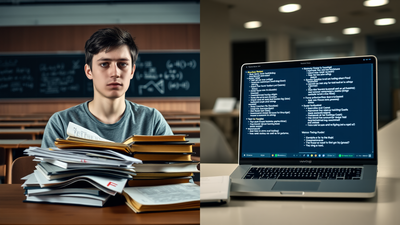
Imagine spending four years being told that using artificial intelligence can penalise you. It could amount to cheating. And then as soon as you step out of your college gates, you discover that employers expect you to know how to use it. That is the uncomfortable contradiction staring at the eyes of the students today. The classroom is still debating where exactly AI sits. Students are consequently caught between an education system trying to safeguard traditional learning methods and a job marked demandig new-age skills.Entrepreneur and educator Ankur Warikoo recently captured this dilemma in a social media post, observing that colleges can punish students for using AI even as companies reject candidates for not knowing how to use it. Behind that contradiction lies a larger problem: the world of work is changing faster than the syllabus.
When AI becomes a classroom problem
There are legitimate reasons why colleges are wary of artificial intelligence. If students simply ask an AI tool to complete an assignment and submit the answer as their own, they may earn marks without actually learning anything.But using AI does not automatically mean avoiding learning.A student struggling with a difficult concept can use AI for a simpler explanation. Another can use it to identify weaknesses in an argument, practice questions, or explore different approaches to a problem. The real issue is whether AI replaces the student’s thinking or helps strengthen it. The point is to comprehend the difference between treating AI as a shortcut or using it as a tool to uplift your learning experience. It is all about choices, whether you let AI cripple you or choose it to empower you.That distinction will become increasingly important as AI becomes embedded in professional life.
The workplace is already changing
The paradox laughs harder when you cross the thresholds of your college. A student may be discouraged from using AI while completing an assignment, only to enter a workplace where AI tools are increasingly used for research, coding, writing, analysis, communication and routine tasks.This means employability is no longer determined solely by what a student remembers from a textbook. Employers increasingly value adaptability, practical problem-solving and the ability to work with emerging technologies.For today’s students, AI literacy could therefore become as important as learning conventional workplace software was for earlier generations.
Students are compelled to learn AI themselves
Perhaps the most inspiring part of this transition is that many students are not waiting for institutions to catch up.They are learning at night. Watching free tutorials. Experimenting with AI tools. Building projects. Testing ideas. Learning skills that may not appear anywhere in their prescribed curriculum.And this is not entirely new. Every generation has learnt beyond the classroom when the formal education system could not keep pace with reality. Students taught themselves computers when technology transformed offices. They learnt the internet when communication moved online. Later came coding, digital marketing, design and countless other skills.AI is simply the latest frontier.The future belongs to learners, not just graduatesHowever, being AI-ready does not mean blindly allowing machines to think on our behalf.The real advantage will belong to people who understand their subjects deeply enough to know what to ask AI, how to verify its answers, and when to challenge or reject them.A journalist must still verify facts. A programmer must understand the code. A researcher must question evidence. And a student must ultimately understand what they submit.That is where human judgement remains irreplaceable.The education system will eventually have to adapt, from simply asking whether AI is allowed to teaching students how to use it ethically and intelligently.Until then, students will continue doing what generations before them have always done: learning what the future demands, even when it is not yet written in the syllabus.Because a degree may mark the completion of education, but curiosity is what keeps learning alive.