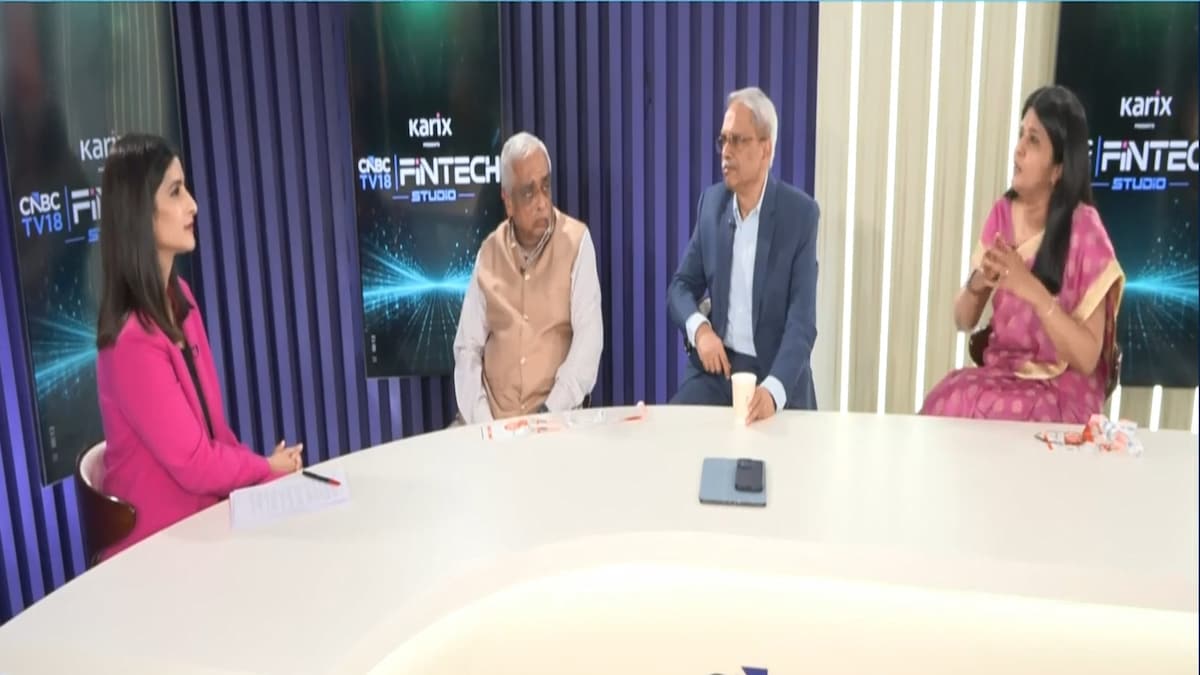
Speaking to CNBC-TV18 on the sidelines of the Global Fintech Fest 2026, former RBI Executive Director G Padmanabhan, Infosys co-founder and Axilor Ventures Chairman Kris Gopalakrishnan, and NPCI Executive Director – Growth Sohini Rajola outlined what they see as the next phase of India’s fintech journey.
Padmanabhan said the focus now needs to shift towards what comes after the success of UPI, while ensuring that the adoption of emerging technologies such as artificial intelligence and quantum technologies does not compromise cybersecurity or financial inclusion.
“I think the Prime Minister, in his address yesterday, was very clear that the country has to now move beyond UPI,” Padmanabhan said.
He said cybersecurity would become increasingly important as fintech firms and financial institutions adopt technologies such as AI and quantum computing.
At the same time, he stressed that technological progress should remain inclusive.
The challenge, according to Padmanabhan, is to ensure that the benefits of new technology reach those who have traditionally been underserved by the financial system.
Credit emerges as next big fintech opportunity
For Gopalakrishnan, one of the biggest opportunities for fintechs lies in using technology and data to expand access to credit, particularly for small borrowers.
He pointed to farmers, daily vegetable vendors, as well as small and medium enterprises, as segments where technology could enable new forms of lending.
“So, one big opportunity is in credit. Taking technology to give credit to a farmer, a daily vendor, a vegetable vendor, or a small and medium enterprise,” Gopalakrishnan said.
He said fintechs could bring together data from multiple sources, including GST and payments transactions, to build a more complete picture of borrowers.
This could allow lenders to create credit products based on transaction and business data rather than relying solely on traditional forms of collateral or asset information.
“On the volumes, you can actually create credit products. So, that’s a huge opportunity,” he said.
Gopalakrishnan also highlighted the role of tokenisation in the evolution of credit. By digitising assets and making the underlying data available, tokenisation could help create new avenues for credit products.
He said startups could play an important role by rethinking traditional credit products and using technology to serve smaller borrowers.
NPCI looks to take UPI beyond India
For NPCI, the next phase involves both taking UPI to more countries and expanding its use beyond payments.
Rajola said UPI has already demonstrated what digital public infrastructure can achieve in India, but the focus now needs to be on how it can become part of India’s interaction with the global economy.
“Where do we go from here?” Rajola said, adding that NPCI wants UPI to become not just a tool for domestic financial inclusion but also part of how India interacts with the world.
She said this could include supporting trade flows, connecting with more countries and helping other developing nations build sovereign digital public infrastructure.
According to Rajola, UPI is currently present in 11 countries, and the ambition is to take it “both broader and deeper”.
The expansion, she said, is aligned with the larger vision of making India’s digital public infrastructure relevant beyond its domestic market.
Credit on UPI becomes a key focus
Domestically, NPCI is also looking beyond payments, with credit emerging as a major area of focus.
Rajola said NPCI is working to enable more individuals and businesses, including MSMEs, to access credit based on their UPI transaction history.
She pointed to the example of vendors who can build a history of UPI transactions and subsequently access a RuPay credit card.
“A credit card was always something which was the preserve of the rich and the elite,” Rajola said, adding that the objective is now to create frameworks through which more individuals and MSMEs can access credit based on and linked to UPI.
NPCI is also looking at opportunities beyond credit, including insurance and investments.
Rajola said UPI has already become an important part of the IPO subscription process, with about 80% of subscriptions in new issues taking place through UPI, according to her.
She added that NPCI is also working on the next generation of infrastructure and models that banks and fintech companies can build on.
Data will be critical to expanding financial inclusion
Padmanabhan cautioned that expanding credit access must go hand in hand with robust data and borrower selection.
He said the financial system needs to ensure that efforts to reach underserved borrowers do not result in weak credit assessment.
“Do we have data on the poor?” he asked, pointing to the risk of adverse selection if lenders do not have sufficient information to assess borrowers.
For him, the availability and quality of data will therefore be critical as fintech moves beyond payments and towards wider credit access.
“While we extend the reach, our selection process is robust. And that’s where the data comes in, and that’s very critical,” Padmanabhan said.
The broader message from the three leaders is that India’s fintech story is entering a new phase. After establishing UPI as a large-scale payments infrastructure, the next opportunity lies in using technology, data and digital infrastructure to deepen access to credit, expand financial services, strengthen security and take India’s fintech capabilities to global markets.