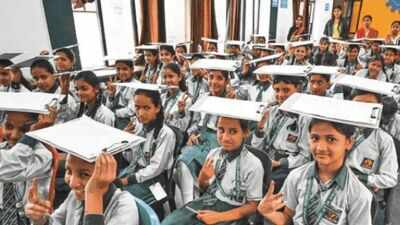
When Chintoo sat at home on a rainy morning, his dil (heart) and dimaag (mind) gave him very different answers to the same question. His heart urged him to stay in and relish a plate of pakodas, while his mind reminded him that it was a school day. Which should Chintoo listen to? This seemingly simple dilemma sparked a lively discussion among over 140 students at Saraswati Inter College in Loni, Ghaziabad, as they took part in an interactive session on critical thinking. The exercise formed part of the Times Critical Thinking Championship (TCTC), an initiative by TOI , inspired by the Times Foundation, that is bringing inquiry-based learning to schools across the country. Far from a conventional lecture, the session turned the classroom into a space for debate and reflection. Three students were invited to the front of the hall to play the roles of Chintoo, his dil , and his dimaag .As the trainer presented situations and questions, hands shot up across the room, with students offering varied responses and defending their choices. Each answer became the starting point for a deeper conversation. Students explored the difference between facts and opinions, assumptions and inferences, and discussed how evidence, reasoning and perspective shape decisionmaking. Rather than focusing on finding a single “correct” answer, the session encouraged students to question, analyse and justify their thinking.For many, the interactive format made the concepts easier to grasp. “We learn a lot through these sessions because they are so interactive,” said Vaishnavi, a class 8 student.“There are many ways of approaching a particular problem, but if you use critical thinking, you can find a solution to any kind of problem. That’s what we learnt today”.At first, the children are hesitant, with the front rows remaining conspicuously empty. But hesitation gives way to enthusiasm. An ice-breaking round involving quick hand-eye coordination exercises has the students laughing, participating and gradually warming to the trainer. Then comes another hook. The trainer walks to the board and writes “2025”. A flurry of hands shoots up. “It’s 2026,” students call out.The deliberate “mistake” is meant to spark curiosity, and it works. What follows is a steady stream of questions,observations and counterpoints from the students, turning the classroom into a lively discussion rather than a oneway lecture. “It is a way to keep the session interactive. The students have to express themselves and communicate with me. That’s when they don’t get bored and are able to understand the concepts better,” said Rajeev Mishra, who conducted the session in a lively manner and with constant engagement.According to Mishra, no two sessions are the same. “The way I deliver a session depends on the situation, the age group and the grades the students belong to. The approach changes with the audience, but the objective remains the same, which is to make them think rather than simply tell them the answers,” he said.The impact of that approach is evident to the school’s educators as well. “Before reaching any conclusion, students should learn to ask questions, examine the facts, and apply their own reasoning. These sessions encourage that process in an engaging way. Beyond improving analytical skills, they also build confidence, communication and presentation abilities, as studentslearn not only from the concepts being taught but also from the way they are delivered,” said school principal Rocky Kaushik.As the session drew to a close, it was time to put the lessons to practice. Each student was handed a worksheet containing 10 scenario-based questions, in both Hindi and English.The exercise challenged them to apply the concepts they had just learnt, distinguishing between facts and opinions, identifying assumptions and inferences, and using reason rather than instinct to arrive at an answer. The classroom, which had been buzzing with discussion moments earlier, fell silent as students bent over their papers. Within minutes, one by one, they placed their writing boards on their heads, which was a playful signal understood by both the trainer and the class that they had finished. Manasi Saxena, the English teacher and coordinator of the programme at the school, said the sessions stand out because they break away from the routine classroom format and encourage participation. “The students enjoy them a lot because they’re interesting and interactive,” she said.For many students, the takeaway went beyond the worksheet. “We should think sensibly before believing or deciding anything,” said Navya, a class 6 student.Referring to a common belief that an upside-down slipper leads to a quarrel, she added, “People say that if a slipper is lying upside down, there will be a fight. But if there is no evidence, it is just a superstition.” Ishika, another student, said the session taught her a new way of looking at everyday situations.