Over the years, football has evolved in many different ways. The sport has also undergone significant tactical developments. One tactical trend that has become increasingly noticeable involves how teams defend free kicks.
The conventional free-kick defending approach
Traditionally, when defending a free kick, the goalkeeper is responsible for organizing the defensive wall, which must be positioned at least 10 yards away from the spot where the free kick is taken.
This involves directing teammates into position, deciding how many players should stand in the wall, and ensuring it is placed to reduce the shooter’s angle as much as possible.
Until a few years ago, that was considered the standard approach. The players in the wall would stand shoulder to shoulder, forming a solid barrier between the ball and the goal.
The evolved technique
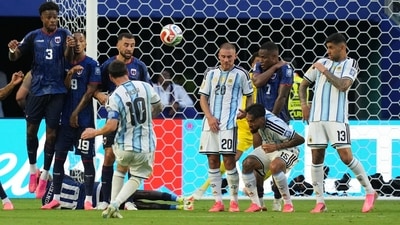
Today, however, fans will often notice an additional defensive tactic. Along with the players standing in the wall, one defender is frequently positioned lying horizontally on the ground directly behind the wall.
While the rest of the wall remains upright, this player stays flat on the turf.
Why does a player lie down behind the wall?
The player lying behind the wall has a very specific defensive role.
When a free kick is taken, the players forming the wall will often jump in an attempt to block a shot that is expected to travel over them or curl into the goal.
Since free-kick takers frequently aim to lift the ball over the wall, defenders instinctively leave the ground to make themselves a bigger obstacle.
In recent years, however, free-kick takers have increasingly exploited that instinct. Instead of attempting to curl the ball over the wall, many have opted for a low, driven shot along the ground.
As the defenders jump, a gap briefly opens between their feet and the turf. Skilled free-kick specialists have taken advantage of that opening by sending the ball underneath the airborne wall, often catching the goalkeeper by surprise.
Because the shot stays hidden behind the wall until the last moment, goalkeepers are left with very little time to react or even get a clear view of the ball before it heads toward goal.
Blocking shots under wall
This technique relies less on power and more on precision, timing, and intelligence, and it has proved highly effective in numerous matches.
To counter this growing trend, many teams now position a player lying flat behind the defensive wall during free kicks.
That player’s job is to block any low shot aimed beneath the jumping wall, preventing the ball from slipping through the gap and reducing the chances of conceding from such cleverly executed free kicks.