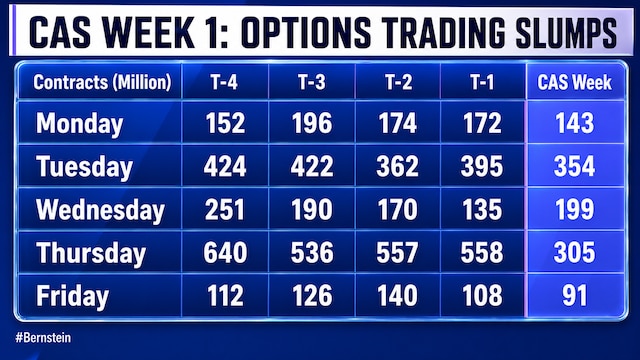
In the short term, these disruptions are pressuring trading volumes and impacting capital market stocks across the board.
What Has Happened So Far: Thin Liquidity and Teething Issues
The debut of the Closing Auction Session has seen sparse participation during the dedicated auction window, Bernstein noted, adding that this lack of depth has led to distorted price action driven by thin liquidity.
Beyond price volatility, operational and implementation teething issues have created heightened concerns, particularly within the options market, where participants are adjusting to new end-of-day mechanics, the note said.
The Impact of CAS on Asset Managers
For fund managers, Bernstein noted that the introduction of CAS brings new execution challenges for both passive and active strategies:
Passive Funds: Index funds and ETFs have largely stayed away from the auction window during this initial week, according to Bernstein. However, the true test for passive managers will arrive on upcoming index-rebalance days, which may force them to participate in the CAS window to match closing benchmarks, the brokerage noted.
Active Managers: Active fund managers face execution risks if substantial shifts in stock or index prices occur during the auction window. Dislocation between auction pricing and heavy closing NAV buying or redemption orders can lead to tracking errors and execution slippage, Bernstein’s note stated.
The Impact of CAS on Retail Discount Brokers
Discount brokers, especially those heavily reliant on retail index-options trading, are feeling near-term pressure due to revenue model structures:
Lower Order Counts: Because discount brokers charge fees on a per-order basis, wide price swings have weighed on the total number of options contracts traded, putting near-term revenue realization at risk if market dislocations persist, Bernstein said.
Leverage Constraints: This revenue pressure is further compounded by a potential shrinkage in trading volumes resulting from tighter leverage constraints on proprietary participants.
The Impact of CAS on Exchanges and Option Traders
For stock exchanges and derivatives traders, the dynamics of the auction window have shifted trading behavior and revenue metrics:
Exchange Revenue: Stock exchanges charge fees based on premium turnover rather than contract volume. While the total number of traded contracts has declined, premium turnover has fallen less sharply because the average turnover per contract has jumped, Bernstein noted.
Option Writers Vs Option Buyers: Retail option-writers have expressed dissatisfaction due to delayed theta decay and unpredictable price movements in the final minutes of trading, the brokerage said. Conversely, option buyers have experienced extreme outcomes, seeing either windfall gains or sharp losses during the auction window.